Summarize in ChatGPT
Running an SEO audit in 2026 looks fundamentally different from what it did just two years ago. A complete website audit today focuses on five core areas: technical SEO, on-page optimization, user experience, content quality, and AI visibility. The stakes are higher than ever: according to Semrush's 2025 Website Health Benchmark Report, 72% of websites fail at least one critical technical SEO factor, directly impacting crawlability, indexation, and search visibility.
But rankings in Google's blue-link results are no longer the only metric that matters. More than 50% of Google searches now show an AI Overview, and ChatGPT alone has between 800 and 900 million weekly active users. In 2026, with 58% of searches resulting in no clicks, being cited by AI has become essential to maintain digital visibility.
This guide is your complete SEO audit checklist for 2026 — organized into actionable sections that cover everything from foundational technical health to cutting-edge AI visibility optimization.
Why SEO Audits Matter More in 2026
A modern SEO audit is closer to a diagnostic scan: it tells you what Google can access, what it chooses to index, what it's rewarding, and where your site is quietly leaking growth — through crawl waste, intent mismatch, internal competition, and stale pages that used to work.
In 2026, a technical SEO audit is no longer about fixing errors — it is about building a search-ready, AI-friendly, and high-performance website that earns trust from crawlers, indexers, and answer engines.
The benefits of a thorough audit are concrete:
Improved Rankings: Identify technical and on-page errors that block your SEO progress.
Better User Experience: A faster, smoother website improves engagement and conversions.
Smarter Investment: Instead of guessing what's wrong, you get actionable data to guide decisions.
AI Discoverability: AI SEO doesn't replace traditional SEO — it requires it. The phrase "SEO feeds AI" captures this relationship precisely.
Backlinko's 2025 analysis shows that proper technical optimization increases organic traffic by 30% on average. That's too significant an opportunity to ignore.
Phase 1: Pre-Audit Setup
Before diving into individual checks, lay the groundwork for an organized, repeatable process.
Define Your Scope and Goals
Before you run a single crawl, set a clear scope. Decide whether to audit the entire site or a specific section. Define what success looks like: are you fixing a traffic drop, preparing for a migration, or conducting a routine health check?
Assemble Your Tool Stack
The following tools are great for covering most audits: Google Search Console for coverage, indexing signals, sitemaps, and page experience; a crawler such as Screaming Frog, Sitebulb, or Semrush Site Audit; PageSpeed Insights and Chrome UX Report data for Core Web Vitals.
Create an Issue-Tracking System
Create an issue-tracking spreadsheet. Group issues by severity: critical errors, warnings, and informational notices. Assign each one an owner and a deadline. Using the QuickSEO SEO Audit template can help you stay organized from the very beginning.
Priority framework for fixes:
🔴 Critical (Fix Immediately): Crawl blocks, 5xx server errors, noindex on key pages, HTTPS failures, and major Core Web Vitals failures.
🟡 High Priority (Fix This Sprint): Redirect chains, missing canonical tags, broken internal links, duplicate title tags, duplicate pages, and missing meta descriptions.
🟢 Low Priority (Backlog): Minor image alt text gaps, cosmetic URL issues, and informational notices that do not directly affect rankings.
Phase 2: Technical SEO Audit
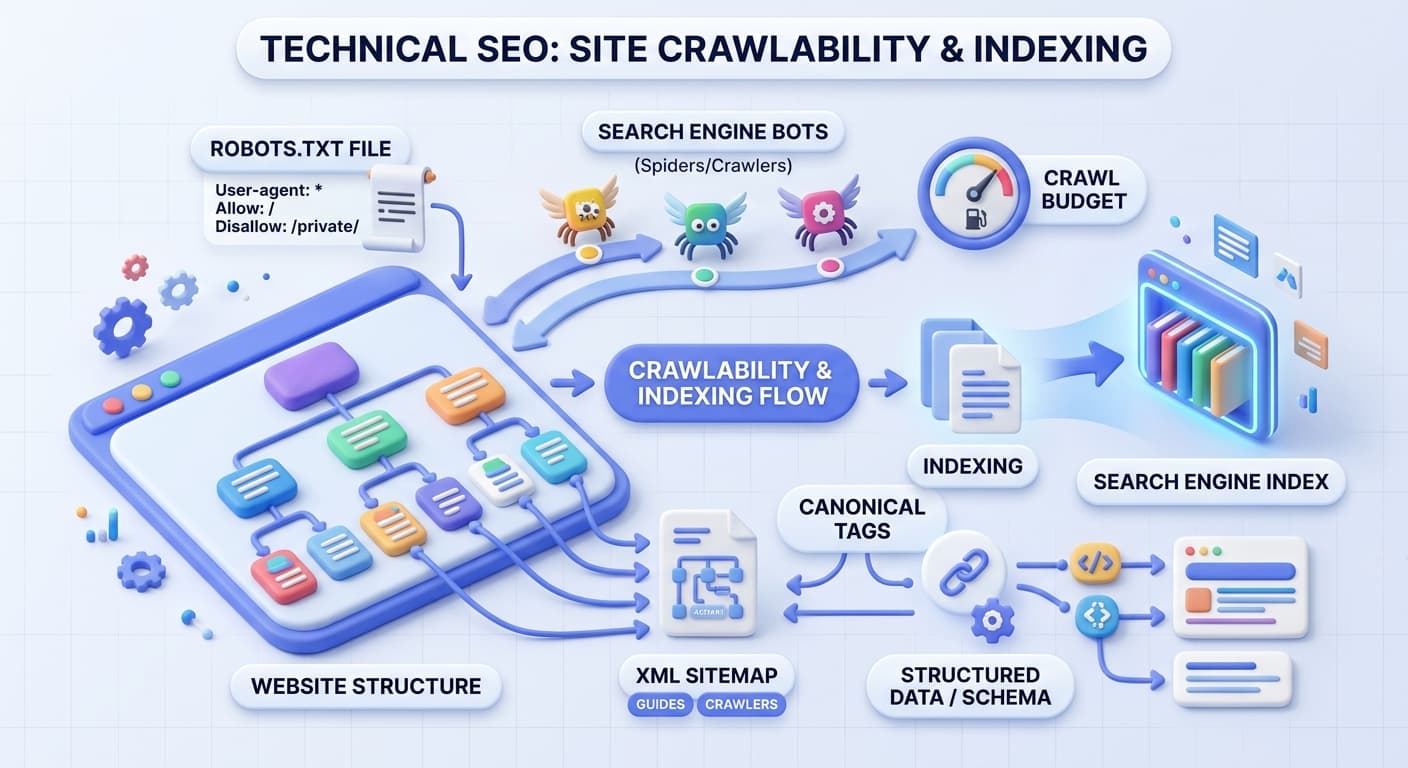
Technical SEO is the bedrock of everything else. A technical SEO audit reveals exactly what's stopping search engines from crawling, indexing, and ranking your pages. Broken links, slow load times, duplicate content, and misconfigured redirects quietly kill rankings every day.
Crawlability & indexation
Search engines must be able to discover, access, and index your pages before they can rank them. Crawlability issues prevent bots from reaching content, while indexing problems keep pages out of search results.
robots.txt: Check your robots.txt file by visiting yoursite.com/robots.txt. Verify that you're not accidentally blocking important pages or resources. Common mistakes include blocking CSS or JavaScript files that Google needs to render pages properly, or blocking entire sections that should be indexed. Use the robots.txt validator to catch any misconfigurations.
XML Sitemap: Check your robots.txt, XML sitemap, canonical tags, and HTTP status codes first — these directly control what search engines can access and index. You can also use the sitemap validator to verify your sitemap is error-free.
Indexation check: The first thing on your technical SEO audit checklist should be to check how many of your pages are actually in Google's index.
noindex tags: Confirm no important pages are accidentally tagged with noindex using the noindex checker tool.
URL structure & site architecture
Evaluate URL structure for clarity and consistency. URLs should be descriptive, use hyphens to separate words, avoid unnecessary parameters, and follow a logical hierarchy.
A clean site structure improves crawl efficiency and user navigation. URLs should be short, descriptive, and keyword-focused.
Review site depth since pages buried more than three clicks from the homepage receive less crawl priority and link equity. Flatten your architecture by adding internal links that create shorter paths to important content.
Core Web Vitals & page speed
Core Web Vitals are critical Google ranking factors. Your audit must prioritize these performance metrics that directly impact user experience and search rankings.
Key metrics to check:
LCP (Largest Contentful Paint): Should be under 2.5 seconds
INP (Interaction to Next Paint): Interaction to Next Paint (INP) has officially replaced the old First Input Delay (FID) metric. Aim for under 200ms
CLS (Cumulative Layout Shift): Should be under 0.1
In 2026, performance is not just something "nice to have." It affects your users' trust levels, conversion rates, and search visibility signals.
Image optimization checklist:
WebP is still the safest bet for maximum browser compatibility in 2026.
Add descriptive file names with keywords (e.g., "seo-audit-checklist-2026.jpg" instead of "img1234.jpg") for better SEO optimization.
Use the image SEO checker to audit all images across your site.
Mobile-first optimization
Google predominantly uses mobile versions of pages for indexing and ranking. Your mobile experience must be flawless.
Test all page layouts on mobile viewports
Ensure tap targets are appropriately sized
Confirm structured data and canonicals match between desktop and mobile versions (if you have separate URLs).
HTTPS & security
Verify your SSL certificate is valid and not expiring soon using the SSL checker
Confirm all HTTP pages redirect properly to HTTPS
Check for mixed content warnings in the browser console
Redirect audit
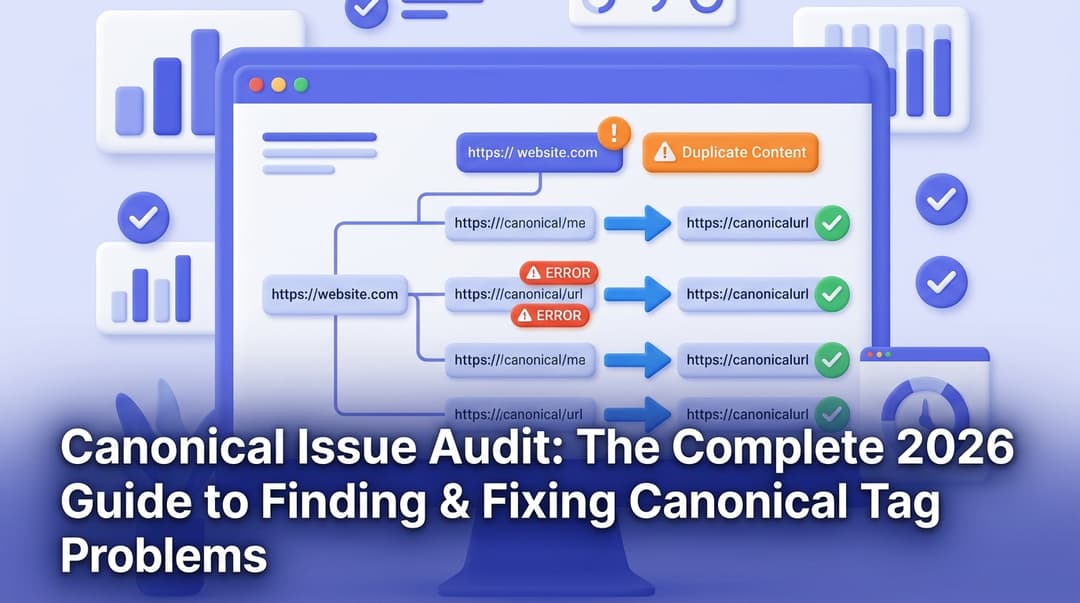
Check for duplicate content using tools like Siteliner or Screaming Frog. Common sources include www vs non-www versions, HTTP vs HTTPS, trailing slashes, and parameter variations.
Identify and fix redirect chains and loops with the redirect checker
Confirm 301 (permanent) redirects are used for all permanent URL changes
JavaScript rendering
In 2026, your most important content must be present in the initial HTML or SSR output, not only after hydration — especially for large navigations, product grids, and article bodies.
Verify critical content renders server-side
Use Google's URL Inspection Tool to test how Googlebot renders your pages
Ensure internal links exist without user interaction. Ensure pagination and category discovery does not depend on scroll events.
Phase 3: On-Page SEO Audit
Title tags & meta descriptions
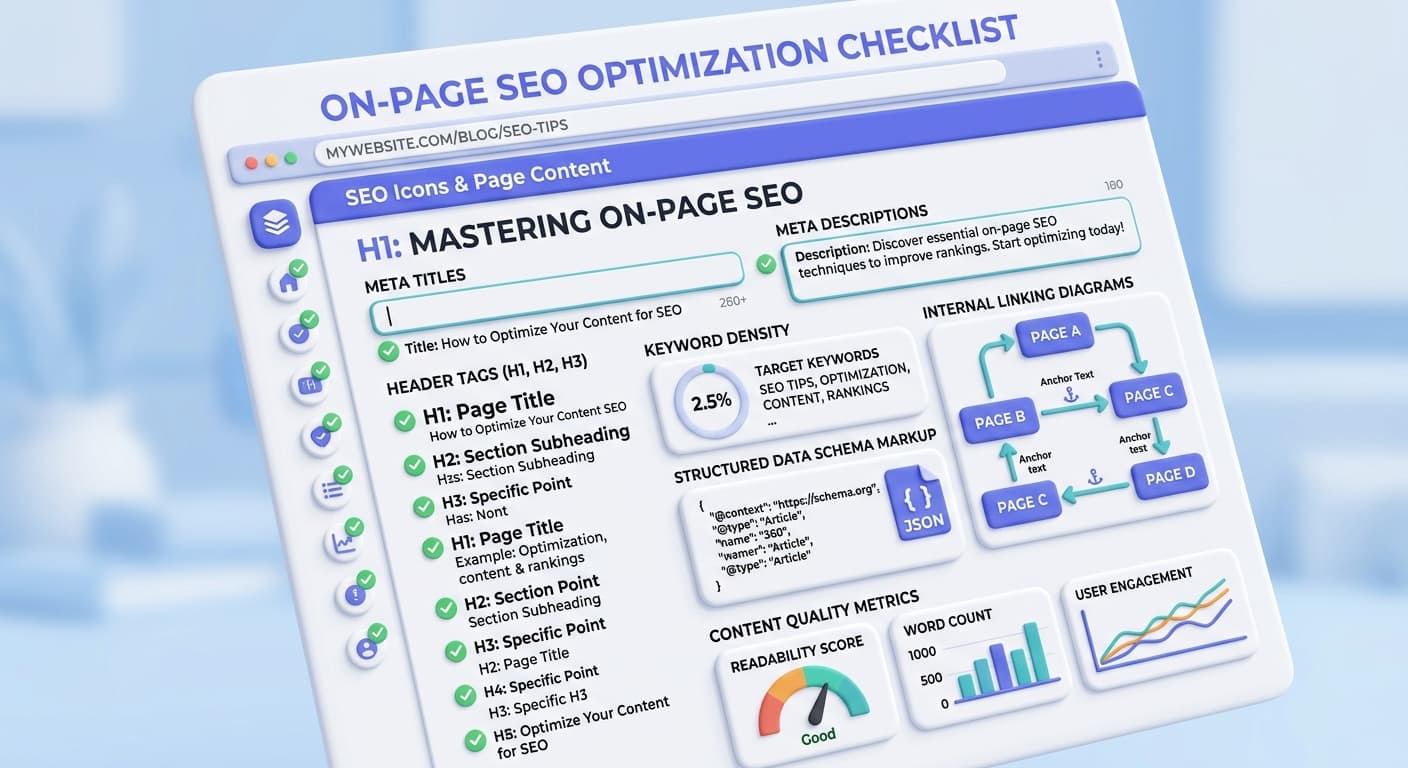
Review meta titles, descriptions, headers, and keyword usage. Even the smallest optimization can make a big impact on click-through rates.
Every page should have a unique, compelling title tag (50–60 characters)
Meta descriptions should be 120–160 characters and include a call-to-action
Focus on optimizing the title, H1, and meta description. These elements have the highest and most immediate impact on CTR and ranking.
Use the SERP preview tool to see exactly how your title and description will display in search results
Check for duplicate or missing meta descriptions using the meta tag analyzer
Header structure (H1–H6)
Each page should have exactly one H1 tag containing your primary keyword
H2–H3 tags should provide logical content hierarchy
Use the heading structure analyzer to audit heading hierarchy across all pages
Keyword optimization
Every page needs one main target keyword or phrase. Research keywords your ideal customer actually searches for.
Avoid keyword stuffing — focus on natural integration
Check for keyword cannibalization (multiple pages competing for the same term) using the keyword cannibalization checker
Content quality
Evaluate how relevant and valuable your content is. Google rewards websites that solve user problems and provide up-to-date, informative answers.
Ensure short paragraphs, lists, and proper heading hierarchy are used. Confirm the content clearly and completely answers the user's search intent.
Identify and update thin or outdated content
Audit E-E-A-T signals using the E-E-A-T checker
Structured data and schema markup
Structured data will not force rankings, but it can improve eligibility for rich results and clarify meaning. Add it when it reflects real content and real business details.
Implement relevant schema types (Article, FAQ, Product, Organization, LocalBusiness)
Validate all structured data using the structured data validator
Use the AI schema markup generator to automatically generate schema for new pages
Open Graph & social tags
Every shareable page should have correct Open Graph title, description, and image
Audit your OG tags with the Open Graph checker
Validate Twitter Card tags for proper social sharing previews
Phase 4: Internal Linking Audit
An internal linking audit is a process of reviewing and evaluating the internal links on a website. Internal links are links that point to other pages within the same website. They are an important aspect of SEO because they can help to improve the accessibility and usability of a website, as well as its ranking in search results.
Internal link health checklist
Analyze internal linking to ensure important pages receive adequate link equity. Your homepage typically has the most authority, so link from it to key category pages. Category pages should link to relevant subcategories and individual pages. Use descriptive anchor text that indicates what the linked page is about.
Find and fix broken internal links with the broken link checker
Run a full internal linking audit to map your link equity flow
Look for orphan pages (pages with no internal links pointing to them)
Clean URL structure and strategic internal linking help search engines understand your site hierarchy and distribute authority effectively.
Phase 5: Content & Backlink Audit
Content audit
A keyword cannibalization audit is a process used to identify and resolve situations where multiple pages on a website are competing for the same keywords or phrases, resulting in a dilution of ranking and traffic for those keywords. This type of audit is often performed when a website has a large number of pages that cover similar or overlapping topics, as this can lead to confusion for search engines.
Content audit checklist:
Identify underperforming pages (low traffic, thin content, outdated information)
Refresh stale content — update anything older than 30 days with new statistics or examples, then update the dateModified timestamp.
Consolidate duplicate content and set appropriate canonical tags
Group related content under clear topic clusters to build topical authority
Backlink profile audit
A strong site audit always checks your backlink quality. Identify toxic or spammy links that might hurt your reputation.
In an audit, look at what the backlink profile signals at a glance: who links to you, which pages they choose to link to, what language they use, and whether the overall pattern reads like a legitimate footprint or a manufactured one.
Identify and disavow toxic backlinks where necessary
Find competitor backlinks you could earn for yourself
Build cross-platform authority by earning mentions on third-party sites, industry databases, Wikipedia, review platforms, and high-authority publications.
Phase 6: AI Visibility Audit (New for 2026)

This is the most critical new addition to any 2026 SEO audit. Unlike a traditional SEO audit — which focuses on keywords, rankings, and traffic — a GEO audit evaluates whether AI systems can access, interpret, verify, and confidently quote a brand's content in generated answers.
Nearly a third (31.3%) of the US population will use generative AI search in 2026, pushing marketers to optimize for platforms like ChatGPT, Google AI Overviews, and Perplexity alongside traditional search engines.
AI crawl access
The minimum viable crawl configuration allows GPTBot, ChatGPT-User, ClaudeBot, PerplexityBot, and Google-Extended. Blocking any of these five means you are invisible on the corresponding platform.
Review your robots.txt to ensure you're not inadvertently blocking AI crawlers
At minimum, verify your pages are indexed in both Bing (for ChatGPT) and Google (for AI Mode/Gemini). Set up IndexNow for faster Bing crawling.
Content structure for AI extraction
Audit your existing content to identify pages that answer high-intent questions, then restructure them with direct H2 questions followed immediately by standalone, factual answers.
Each section should work as a complete thought standing alone when extracted. AI often pulls individual paragraphs, so make sure each provides value without surrounding context.
Add specific, citable statistics to every key claim in your content — vague statements are not picked up by LLMs, but precise data points are.
Add structured formats — convert dense paragraphs into tables, numbered lists, or FAQ schema where appropriate.
Schema markup for AI readability
Implement structured data markup (FAQ schema, Article schema, HowTo schema) so AI crawlers can parse your content more efficiently.
Publish dedicated FAQ pages that answer conversational queries directly
Add methodology and "How It Works" pages to demonstrate expertise
Track your AI visibility scores
Lock a stable 10–30 prompt set and capture screenshots and citations across ChatGPT, Perplexity, Gemini, and Google AI Overviews to establish a measurable baseline.
Using dedicated AI rank tracking tools is essential for this step. You can track how your brand appears in specific AI chatbots using dedicated trackers:
You need both traditional SEO metrics and AI visibility metrics to understand your full organic search presence in 2026.
E-E-A-T signals for AI trust
If you are not listed in AI responses, it is usually because you lack E-E-A-T (Experience, Expertise, Authoritativeness, Trustworthiness) signals or authoritative citations.
Display clear author bios with credentials
Link to original research and reputable external sources
Earn brand mentions on authoritative third-party sites and directories
Phase 7: Performance Tracking & Reporting
No audit is complete without a measurement plan. Tracking performance is essential for understanding what works and what does not. Data analysis guides your future optimization and content strategy. Focus on metrics that reflect user behavior and search engine visibility.
Key Metrics to Track
Traditional SEO metrics:
Monitor your organic search traffic using Google Analytics. Increases in this traffic show success for your SEO checklist work.
Use Google Search Console to monitor page performance and Core Web Vitals scores.
Track keyword rankings, CTR, and impressions
AI visibility metrics:
The percentage of relevant queries in your niche where your brand is mentioned or cited in AI-generated answers — the primary GEO visibility KPI.
Brand citation frequency across ChatGPT, Gemini, Claude, and Perplexity
That includes tracking citation presence in AI outputs, impression-level exposure, and shifts in branded and long-tail search demand.
For a structured view of all your SEO data in one place, the QuickSEO SEO dashboard template provides a solid starting point for organizing and presenting your audit findings.
How Often Should You Run an SEO Audit?
Perform a comprehensive technical SEO audit quarterly, with monthly checks on Core Web Vitals and critical issues. Major website changes, redesigns, or platform migrations should trigger immediate audits to prevent SEO issues.
Here's a practical cadence:
Frequency | What to Check |
|---|---|
Weekly | Core Web Vitals, crawl errors, indexation status |
Monthly | AI visibility scores, content freshness, broken links |
Quarterly | Full technical audit, backlink profile, keyword cannibalization |
After every major change | Migration, redesign, new CMS deployment |
A site audit checklist is not a one-time task. Revisit audits quarterly to adapt to algorithm updates, user behavior changes, and new technologies. Continuous improvement is what separates average sites from high-performing ones.
SEO Audit Checklist: Quick Reference
Here's your at-a-glance checklist for a full 2026 SEO audit:
🔧 Technical SEO
robots.txt verified (no accidental blocks)
XML sitemap submitted and error-free
Core Web Vitals passing (LCP, INP, CLS)
HTTPS active on all pages
No redirect chains or loops
Mobile-first experience confirmed
JavaScript rendering verified
AI bots (GPTBot, ClaudeBot, etc.) not blocked
📄 On-Page SEO
Unique title tags (50–60 chars) on all pages
Meta descriptions (120–160 chars) on all pages
Single H1 per page with primary keyword
Structured data validated (FAQ, Article, HowTo)
Open Graph tags complete
Images optimized (WebP/AVIF, descriptive alt text, correct filenames)
🔗 Internal Linking
No broken internal links
No orphan pages
Descriptive anchor text used throughout
Key pages reachable within 3 clicks from homepage
📝 Content & Authority
Thin or outdated content identified and updated
No keyword cannibalization
No duplicate content issues
Toxic backlinks disavowed
E-E-A-T signals visible (author bios, citations, expertise)
🤖 AI Visibility
Content structured with direct Q&A format
Specific statistics and citable data included
FAQ and HowTo schema implemented
Brand tracked on ChatGPT, Gemini, Claude, and Perplexity
Content freshness maintained (dateModified updated)
How to actually run this audit in a week
By focusing on crawl efficiency, indexing accuracy, Core Web Vitals, structured data, JavaScript rendering, and internal linking, businesses can protect visibility across Google Search, AI Overviews, and voice assistants.
The 2026 SEO audit is broader, more complex, and more consequential than ever — but with the right checklist, it's entirely manageable. The businesses that treat SEO auditing as an ongoing discipline rather than a one-time task will build the resilient, adaptable online presence needed to succeed in both traditional search and the growing world of AI-powered discovery.
For more on the intersection of SEO and AI visibility, explore our guides on how to show up in Google AI Overviews and our hybrid SEO and AI strategy playbook.
Need quick audits without the spreadsheet? QuickSEO has free tools for sitemap validation, robots.txt, redirects, schema markup, and 150+ more checks — and when you're ready to track ongoing visibility across Google and AI chatbots, the full QuickSEO dashboard runs your weekly checks for you. Explore at quickseo.ai →
Sources and further reading
Enter your website to track its AI visibility across ChatGPT, Gemini, Claude, and Perplexity — and turn chatbot mentions into traffic.
- Set up in minutes
- Cancel anytime
Keep reading
Related posts
More articles on the same topics, prioritized by shared tags and keyword overlap.