AI Agents for SEO Statistics 2026: 50+ Data Points on Adoption, ROI & Automation

 Summarize in ChatGPT
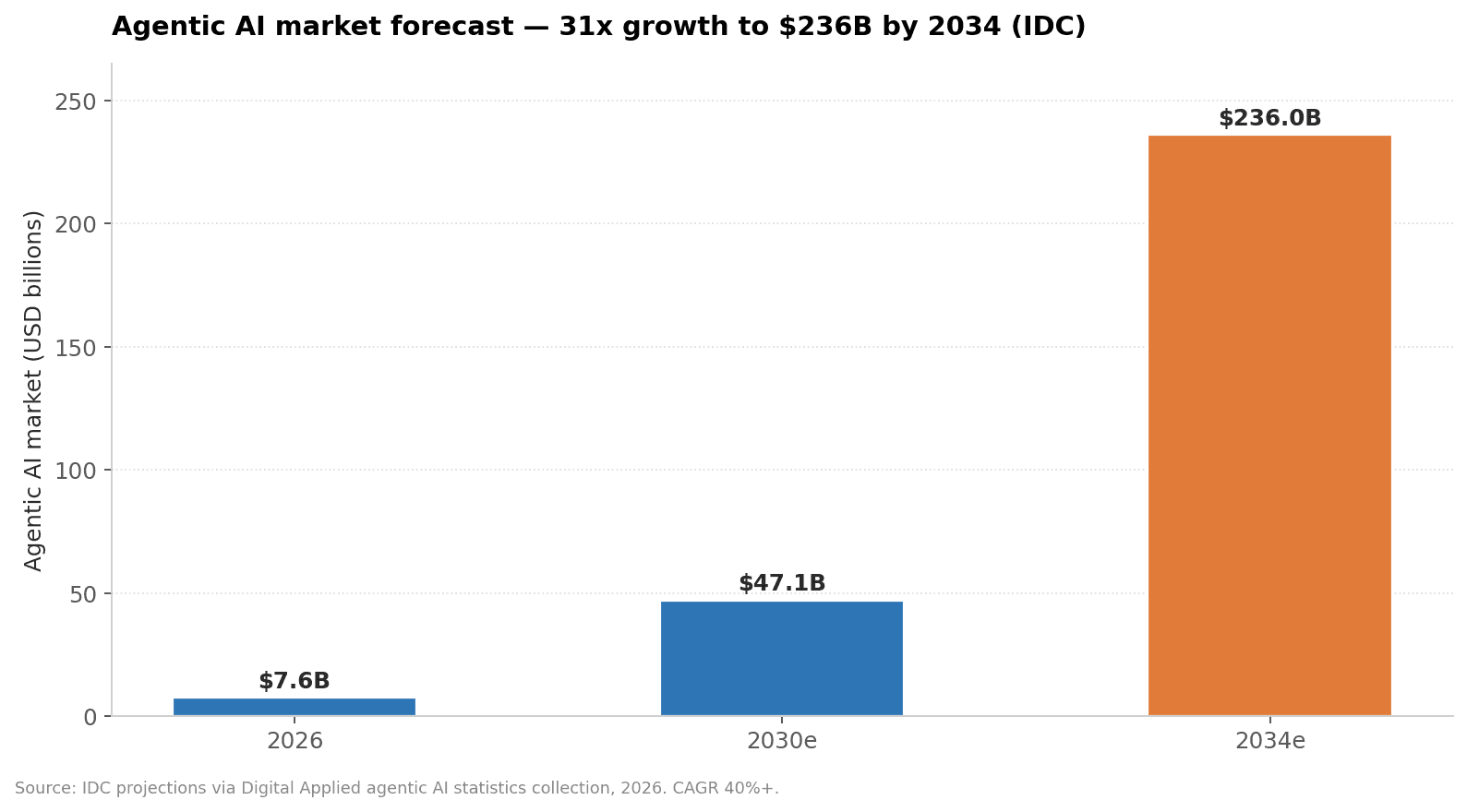
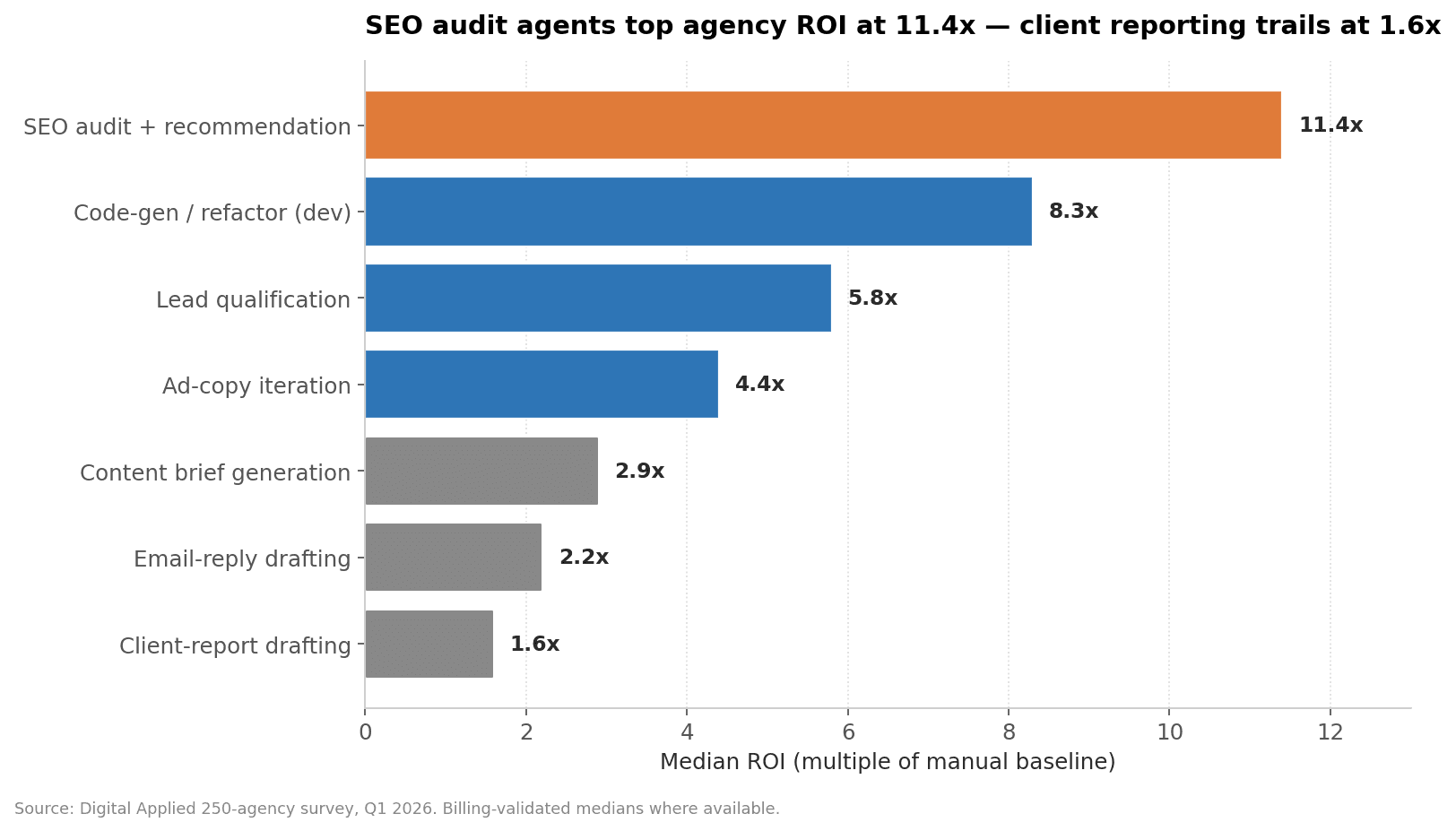
The agentic AI market is on track to grow from $7.6 billion in 2026 to $236 billion by 2034 — a 31x expansion. Four in ten marketing agencies already run at least one AI agent in production, and the single highest-ROI agent workflow they report is an SEO one: audit agents returning a median 11.4x over the manual baseline.
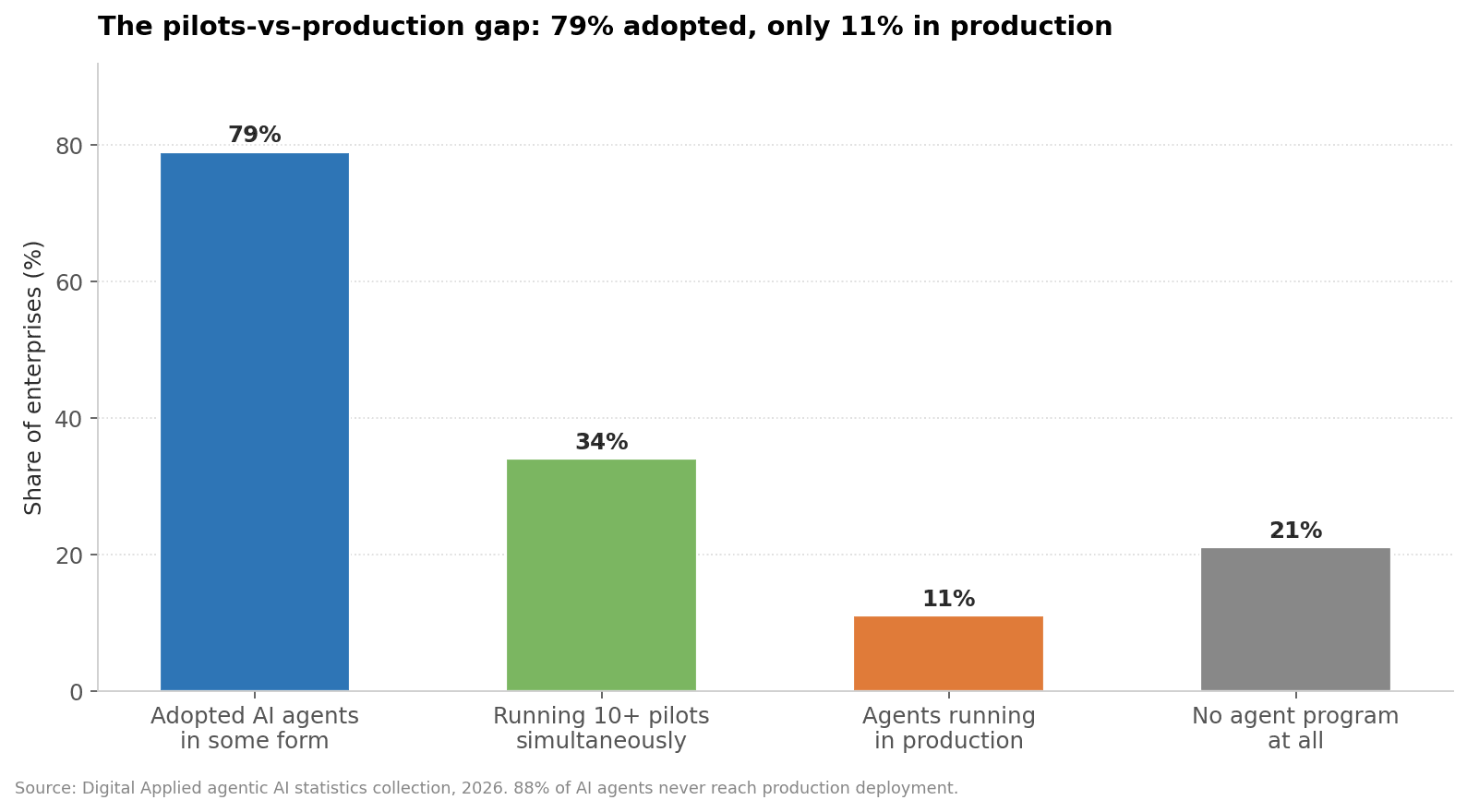
And yet only 11% of enterprises have moved agents out of pilots into production. The gap between "experimenting with agents" and "operating on agents" is where SEO teams will win or lose the next two years.
This post collects 50+ statistics on AI agents for SEO — market forecasts, agency adoption and spend, ROI by agent type, automation depth, case-study outcomes, and the MCP server ecosystem that connects agents to SEO data. Every number links to its source, and a methodology note at the end explains how the stats were verified (including a few widely repeated figures we corrected or dropped).
The agentic AI market is growing 31x to $236B by 2034
The macro numbers frame everything else. Agentic AI — software that plans and executes multi-step tasks, not just answers prompts — is the fastest-growing enterprise software category since early cloud:
Statistic | Value | Source |
|---|---|---|
Global agentic AI market, 2026 | $7.6B | |
Projected market, 2030 | $47.1B | |
Projected market, 2034 | $236B (40%+ CAGR) | |
VC investment in agentic AI startups through Q1 2026 | $18.4B | |
YoY growth in enterprise agentic AI spending, 2025–2026 | 340% | |
Fortune 500 companies with active agentic AI programs | 67% | |
New enterprise software deals that include agentic components | 44% | |
McKinsey estimate of annual economic value unlockable by agentic AI | $2.3T |
The SEO slice of that market is growing too. Business Research Insights values AI SEO software tools at $2.43 billion in 2026, heading to $5.97 billion by 2035 (10.5% CAGR); an alternative estimate from Verified Market Reports has the category going from $1.2 billion in 2024 to $4.5 billion by 2033 at a 15.2% CAGR. Either way, the SEO tooling market is tripling inside a decade — and that's before counting the adjacent generative engine optimization market, which has its own multi-billion-dollar trajectory.
The same shift is squeezing the channel SEO has always optimized for. Gartner predicts traditional search engine volume will drop 25% by 2026 as users shift to AI chatbots and virtual agents, and that 33% of enterprise software applications will include agentic AI by 2028 — up from under 1% in 2024. Gartner also forecasts the hangover: over 40% of agentic AI projects will be cancelled by 2027, mostly for cost and unclear-value reasons. Both predictions can be true at once. That tension — explosive investment, high failure rate — runs through every section below.
79% of enterprises have adopted AI agents, but only 11% run them in production
The defining statistic of 2026 isn't an adoption number. It's a gap:
79% of enterprises have adopted AI agents in some form, but only 11% run them in production — a 68-percentage-point deployment backlog
34% of enterprises run 10 or more agent pilots simultaneously
Failed enterprise agent projects sink an average of $2.1 million (Fortune 1000)
The flip side is what happens for the minority that gets agents into production: an average 171% ROI globally (192% in the US), a median payback period of 8.3 months, and median annual cost savings of $340K per deployed agent among Fortune 500 firms. Successful deployments average 6 months from pilot to production; unsuccessful ones drag 18 months before abandonment. New agent deployments are growing 3.2x year over year, and the enterprises already in production run 4.7 agents on average.
Why do 88% fail? The cited causes are operational, not model-quality: infrastructure gaps (41% of failed projects), governance and security barriers (38%), ROI measurement failures (33%), and skills deficits (29%). Model quality issues account for just 14%. Keep "ROI measurement failures" in mind — it reappears as the dividing line in the agency data below.
41% of agencies run at least one AI agent in production (Q1 2026 survey)
The most granular adoption data for the SEO world comes from Digital Applied's Q1 2026 survey of 250 marketing and dev agencies ($1M–$50M ARR, US/EU/APAC, with 47 agencies' figures validated against actual billing data):
Agency metric (Q1 2026) | Value |
|---|---|
Agencies with ≥1 agent in production | 41% (up from 9% in Q1 2025) |
Agencies piloting (not yet truly agentic) | 58% |
Agencies that haven't explored agentic AI | 1% (down from 14%) |
Median monthly token spend per active agent | $1,800 |
Top-quartile spend per agent | $4,200/mo |
Bottom-quartile spend per agent | $420/mo (a 10x spread) |
Median total agency AI spend | $7,400/mo |
Top-decile total agency AI spend | $48,000/mo |
Source: Digital Applied 250-agency survey.
Two details make this survey more credible than most vendor research. First, it's billing-validated: cross-checking self-reports against real spend data showed agencies overstate ROI by about 18% and understate token spend by about 24% — a correction factor worth applying to every self-reported AI survey you read. Second, the authors note the sample over-indexes on agencies already engaged with the topic, so true adoption across all agencies is likely 5–10 points lower.
The survey also splits agencies into three archetypes: AI-native (12% of the sample, ROI medians above 6x, running 4–8 agents), retrofit (38%, median 2.4x), and legacy (50%, still piloting). Notably, the split doesn't correlate with agency size — it correlates with whether leadership rebuilt the delivery process.
The talent ladder is restructuring underneath this. Agencies are hiring AI engineers at +22% year over year and senior content strategists at +14%, while junior content writers compress at −15% and junior SEO specialists at −11%. The entry-level rung of the SEO career ladder is being eaten by exactly the workflow that tops the ROI chart below. How this reshapes agency economics — pricing, retainers, margins — is a topic we covered in depth in our state of the SEO agency industry report.
SEO audit agents return 11.4x median ROI — the highest of any agency agent workflow
Here's the stat that matters most for SEO teams. Across all agent workflow types agencies deploy, SEO audit and recommendation agents return the highest median ROI at 11.4x the manual baseline:
Agent workflow | Median ROI | In production at |
|---|---|---|
SEO audit + recommendation | 11.4x | 51% of agencies |
Code-gen / refactor (dev agencies) | 8.3x | 71% (dev cluster only) |
Lead qualification / enrichment | 5.8x | 27% |
Ad-copy iteration / variants | 4.4x | 48% |
Content brief / outline generation | 2.9x | 64% |
Email-reply drafting | 2.2x | 22% |
Client-report drafting | 1.6x | 39% |
Source: Digital Applied 250-agency survey, Q1 2026.
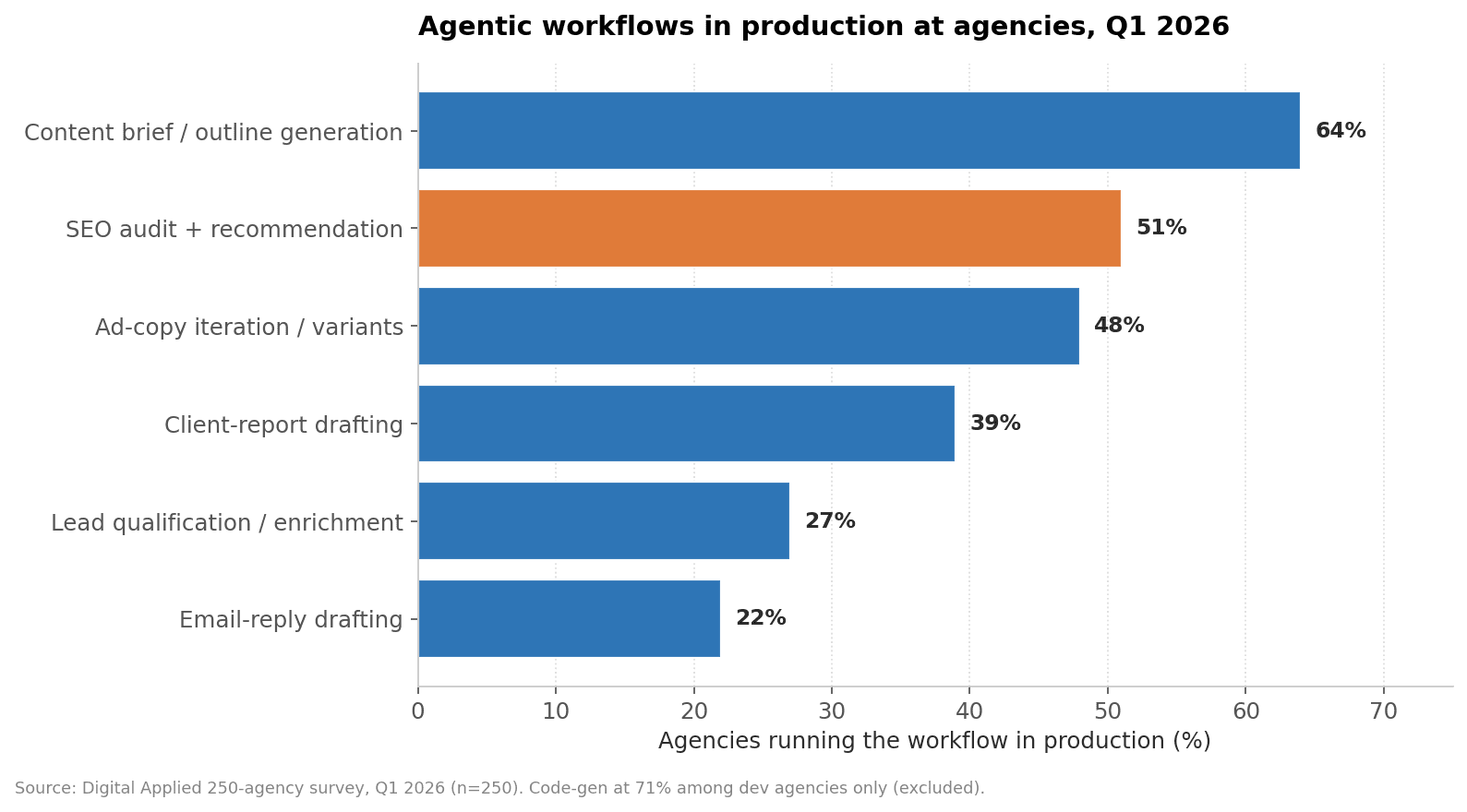
Put the two columns side by side and an uncomfortable pattern appears: the most-deployed workflow is not the most profitable one. Content brief generation leads adoption at 64% but returns just 2.9x, because it sits next to senior strategists who edit everything anyway — the agent saves 20 minutes per brief, not three hours. SEO audit agents return 11.4x because they replace 4–8 hours of senior SEO time per audit that bills at $200+/hour and that nobody enjoys doing manually.
The survey's own conclusion is the cleanest formulation of agent economics we've seen: ROI scales with the cost of the labor the agent displaces, not with the engineering complexity of the agent. If you're choosing your first SEO agent workflow, the data says start where senior billable hours go to die — audits, technical reviews, competitive monitoring — not where the demos look most impressive.
The 0.7x-to-11x ROI spread: evaluation is the dividing line
The median agency reports 3.2x ROI on agents — but the top decile reports 11x and the bottom quartile sits at 0.7x, below break-even. A quarter of agencies running agents in production are losing money on them.
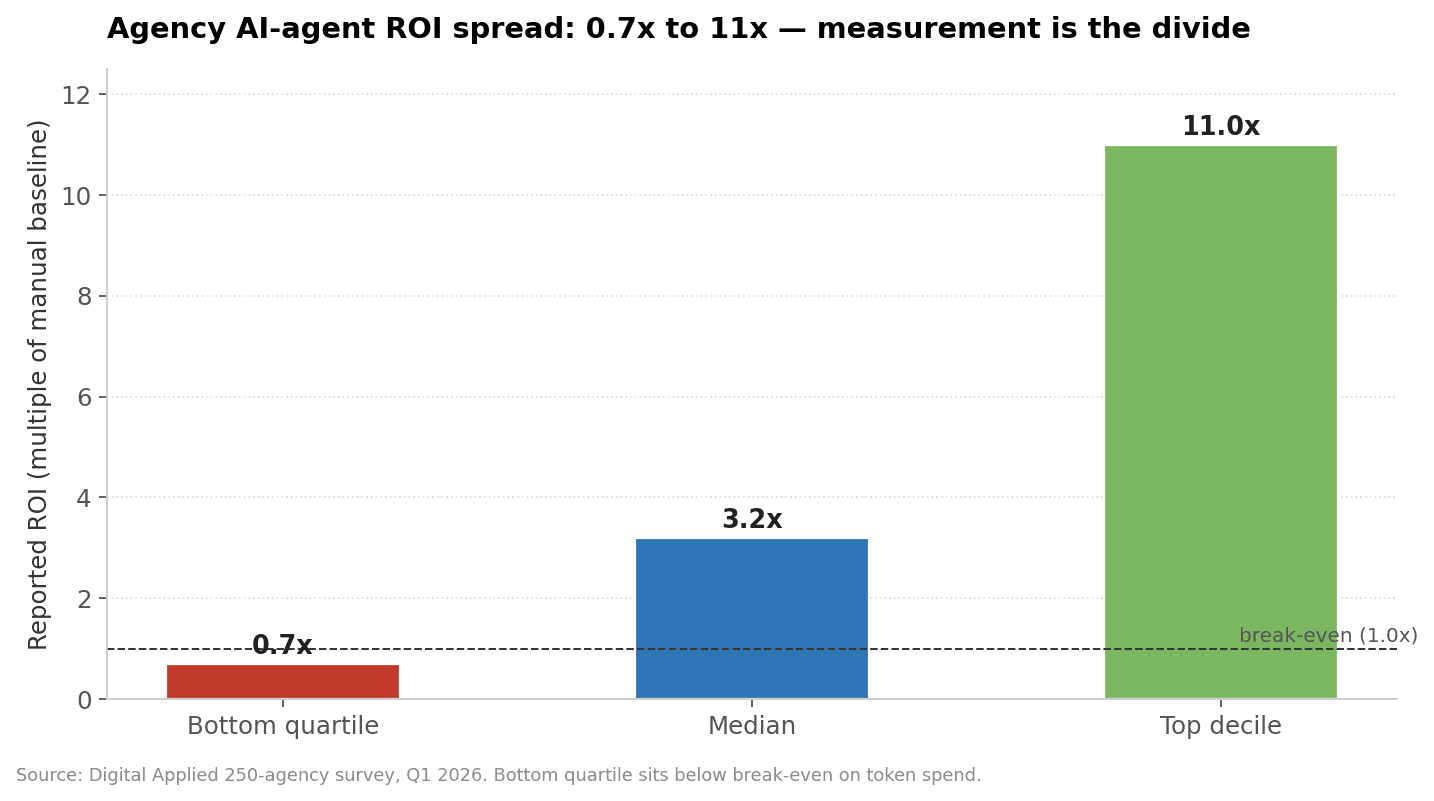
What separates the two tails? Not model choice. The survey found ROI correlates strongly with whether the agency built a workflow-level evaluation harness before scaling — golden datasets, scoring rubrics, before/after measurement. The blocker rankings tell the same story:
Evaluation and testing complexity is the #1 blocker, named by 49% of agencies
Client trust / explainability: 37%
Cost predictability: 32%
Tool sprawl / integration: 28%
Hallucination ranks just 7th, at 18% — down from #1 in 2024-era surveys
That last point is the quiet headline of 2026: agencies have largely solved accuracy for narrow workflows. What they can't do is prove improvement — to clients or to themselves. An agent that rewrites your meta descriptions but can't show what happened to clicks afterward is a cost center with good vibes. The 0.7x quartile isn't running worse agents; it's running unmeasured ones.
70–80% of routine SEO tasks can be automated end-to-end in 2026
How much of an SEO job can agents actually take over? The practitioner estimates converge on a surprisingly high number:
70–80% of routine SEO tasks — audits, rank tracking, on-page scoring, internal linking, meta generation, schema, reporting — can be automated partially or fully in 2026
A well-configured automation stack saves 15–25 hours per week per SEO professional; the same source notes a typical $400–700/month tool stack still demands those hours of human implementation, while agent platforms cut oversight to 2–3 hours/week
A manual content workflow runs 9–14 hours per article versus 30–60 minutes agentic, per Frase's (vendor-published, so calibrate accordingly) stage-by-stage breakdown; the independent baseline is Orbit Media's finding that an average blog post takes 4 hours 10 minutes to produce
BCG research finds AI-powered workflows cut time spent on low-value tasks by 25–40%, and organizations leading in agentic AI achieve 5x the revenue gains of laggards
The people doing the work agree. 66.85% of SEO leads and managers say automating repetitive tasks is generative AI's single biggest benefit, and 30.49% of enterprise SEO teams have already restructured roles because of AI. Microsoft Research's occupational study of real-world Copilot usage found writing-heavy occupations score highest on AI applicability — SEO content production sits squarely in the most-exposed zone.
Adoption among marketers broadly:
Statistic | Value | Source |
|---|---|---|
Marketers using generative AI for SEO | 56% (31% extensively, 25% partially) | |
Planning extensive genAI SEO use within 2–3 years | 45% | |
Enterprise SEO pros who've integrated AI into strategy | 86.07% | |
Enterprise SEOs planning to invest more in AI | 82% | |
SEOs at 200+ employee firms reporting improved performance after AI | 83% | |
Respondents who saw no improvement from AI | 6.22% | |
Businesses reporting higher content marketing ROI from AI | 68% | |
Small businesses using AI for content/SEO | 67% | |
Marketing organizations with AI agents in their stack | 90.3% | |
Organizations using AI in ≥1 business function | 72% | |
SEO specialist roles expected to be impacted by genAI | 69% | |
SEOs who think genAI will assume SEO jobs (moderate–high likelihood) | 85.56% |
Will agents replace SEO professionals? The hiring data gives a more precise answer than the survey sentiment: junior execution roles are compressing (−11% junior SEO specialists), senior direction roles are growing (+14% senior strategists). Agents aren't replacing SEO teams — they're deleting the rung where people used to learn the craft. And on the flip side, 35% of businesses still don't know AI can be used for content and SEO at all, which is a reminder of how early this still is outside the bubble.
AI-agent SEO campaigns are producing measurable wins (the case-study data)
ROI multiples are abstract. Here's what agent-driven SEO programs report in actual traffic and revenue terms:
Seagate (with Directive Consulting): an AI-assisted content program drove a 75% month-over-month increase in organic traffic to the blog subfolder and a 50.6% improvement in keyword visibility, with a 56% lift in AI search visibility contributing to 162% organic traffic growth and $2.87M in attributed pipeline
A B2B SaaS company grew AI-referred trials from 575 to 3,500+ — a 6x increase — in seven weeks of deliberate answer-engine optimization, alongside a 600% citation uplift
Brands cited inside a Google AI Overview earn a 35% higher organic click-through rate than when the AI Overview appears without them (Seer Interactive)
In a single-site Seer case study, ChatGPT-referred traffic converted at 16% versus 1.8% for Google organic
Semrush's 500-topic study found AI search visitors are 4.4x more likely to convert than traditional organic visitors
AI-referred sessions grew 527% year over year (BrightEdge data)
The context making these numbers urgent: 60% of Google searches now end without a click, and only 17% of sources cited in Google's AI Overviews rank in the top 10 organic results for the same query — page-one rankings no longer guarantee AI visibility. The original Princeton/Georgia Tech GEO research found that adding citations, statistics, and quotations lifts AI-engine visibility by up to 40%, which is exactly the kind of systematic content surgery agents are good at executing at scale.
Notice the common thread: every winning case study pairs automated execution with visibility measurement. Seagate tracked AI search visibility, the SaaS company tracked AI-referred trials and citations, Seer tracked AIO citation CTR. None of these outcomes are observable from inside a content tool. The measurement layer is what turned automation into attributable revenue — the same lesson as the 0.7x-vs-11x split.
MCP servers connect agents to SEO data: 97 million downloads and a read-write divide
If agents are the workers, the Model Context Protocol is the doorway they use to reach your tools. Anthropic open-sourced MCP in November 2024; by early 2026 it had hit 97 million downloads, with 1,000+ compatible servers and support across 18 major platforms including Claude, Cursor, VS Code, and Zed. At peak in Q1 2026, server registrations grew 400% month over month; 73% of enterprise developers now cite MCP as their preferred agent-tool connectivity standard, and 89% of new enterprise agent projects plan MCP integration. The broader directory ecosystem is sprawling — Glama alone listed 22,775 MCP servers as of May 2026.
For SEO specifically, the landscape splits on one axis — whether the server lets agents read data or also act:
SEO platform | MCP server | Access | What an agent can do |
|---|---|---|---|
Semrush | Read-only | Pull keyword, domain, backlink, position data | |
Ahrefs | Read-only | Pull backlink data; Brand Radar monitors 343M+ AI prompts monthly | |
Frase | Read-write | Research, brief, write, score, publish (6/6 pipeline stages by its own framework) | |
SE Ranking | Official | Read-only | Keyword research, rank tracking data |
Surfer SEO / Clearscope | None (as of March 2026) | — | Not agent-accessible |
The read-write debate misses a third category, though: outcome data. An agent that can write and publish but can't see what happened afterward — did the page rank, did ChatGPT start citing it, did a competitor take the mention — is flying the same blind loop that puts agencies in the 0.7x quartile. The agent stack that actually compounds is: execution tools (writing, publishing, fixing) + measurement tools (search analytics, AI visibility) wired into the same assistant. We've written before about what the execution half looks like in practice when running programmatic SEO workflows through Claude Code — the measurement half is what closes the loop.
One more dose of realism for the "fully autonomous SEO" pitch: in First Page Sage's study of 8,128 agentic AI users, the mean task completion rate across major agent platforms was 75.3%, agents saved 66.8% of task time versus manual work, but 54% of users still trusted manual search results more than agentic ones (only 34% trusted the agent more) and roughly 8.9% of requests were refused outright. Agents are spectacular interns, not unsupervised employees. The human-out-of-the-loop future isn't here; the human-reviewing-agent-output present very much is.
What the numbers add up to
Run the numbers from this post back to back and one conclusion falls out. The highest-ROI agent workflow is the SEO audit (11.4x). The #1 blocker is proving results (49%). The losing quartile (0.7x) is the unmeasured one. And every standout case study measured AI visibility alongside organic traffic.
In other words: the binding constraint on agentic SEO in 2026 isn't generation capacity — it's measurement.
Methodology: how these statistics were compiled
All statistics were collected and source-verified in June 2026 by scraping the cited pages directly, preferring primary publishers (Gartner press releases, the original survey write-ups, the arXiv paper, vendor case-study pages) over secondary roundups. Each stat links inline to the page where the figure appears. A few corrections versus commonly repeated versions of these numbers: the agency-production figure is 41%, not the often-quoted 40% (the survey's own headline rounds down); the "6x AI-referred trials" case study belongs to Discovered Labs' B2B SaaS client, not an agency named Organic; and we dropped an unverifiable "88% task overlap for SEO writers" claim in favor of the underlying Microsoft Research occupational study. Vendor-published benchmarks (Frase's time comparisons, MEGA's automation estimates, Digital Applied's survey) are labeled as such — the 250-agency survey is the strongest of these because it cross-validated self-reports against billing data, and its self-report bias findings (+18% ROI overstatement) are a useful discount rate for every other number in this genre, including the ones above.
Whatever share of search AI answers end up taking, Google Search Console is still where you see the clicks Google actually sends you. QuickSEO puts Search Console for every website you run on one free dashboard. See all your sites in one place →
QuickSEO shows clicks, impressions, keywords and pages for every website you manage, compared with the period before.
- Unlimited websites on the free plan
- No credit card needed
Keep reading
Related posts
More articles on the same topics, prioritized by shared tags and keyword overlap.