The 10 Best AI SEO Agents in 2026, Ranked by What They Actually Automate

 Summarize in ChatGPT
Most products calling themselves an "AI SEO agent" in 2026 are AI writing tools with a keyword field bolted on. A real agent takes a goal — "grow organic traffic for these topics" — and executes across the whole pipeline: research, briefs, drafting, optimization, publishing, and monitoring. Very few products actually do that, and the ones that come closest often gate the agentic parts behind enterprise contracts or label them "coming soon" on their own homepages.
So instead of repeating vendor claims, we scraped the marketing and pricing pages of all ten tools in this list (June 2026), screenshotted them, and scored each one against a six-stage pipeline rubric. The gap between what the headlines promise and what the pricing tables deliver is wider than you'd expect.
One framing note up front: QuickSEO, our own tool, is ranked first — not because it out-drafts the writing agents, but because it owns the half of the loop every agent depends on and none of them can fake: measuring whether any of it worked, in both Google and AI search.
How we scored these 10 AI SEO agents
Every tool was scored against the same six pipeline stages:
Research — keyword/SERP/prompt research and competitor analysis
Briefs — turning research into actionable content briefs and outlines
Drafting — generating publish-ready articles
On-page optimization — SEO and GEO/AEO scoring applied to content
Publishing — pushing content into a CMS without manual copy-paste
Monitoring — tracking rankings and AI-chatbot visibility after publishing
Plus three secondary scores that most round-ups skip:
AI-visibility coverage — which chatbots it tracks (ChatGPT, Claude, Gemini, Perplexity, AI Overviews…) and, crucially, at which pricing tier
MCP support — none, read-only, or read-write (can an external agent like Claude Code actually act through it?)
Goal-mode — does it act on a goal autonomously, or only respond to prompts?
Every capability claim below comes from the vendor's own marketing or pricing pages as scraped on June 6, 2026, with screenshots. Where a feature is enterprise-gated or marked "soon," we say so explicitly. Pricing changes often — treat the numbers as a snapshot.
Quick comparison: all 10 AI SEO agents at a glance
Tool | Best for | Pricing (as scraped, June 2026) | Key differentiator |
|---|---|---|---|
QuickSEO | The AI-visibility + search measurement half of the agent loop | Free trial available | GSC + ChatGPT/Claude/Gemini/Perplexity tracking in one dashboard, with an MCP server agents can read |
Frase | Most complete self-serve content pipeline | $49–$299/mo | Read-write MCP: external agents can create, audit, and publish |
Writesonic | Track-to-fix loop for AI search | $79–$399/mo + custom | Action Center turns visibility gaps into executed fixes (full version enterprise-only) |
MEGA AI | Hands-off SMBs who want a managed autopilot | Sales-led (homepage advertises plans from $299/mo) | Agents fully manage SEO, ads, and website with human oversight |
Nightwatch (NightOwl) | Rank tracking unified with AI citations | €79–€399/mo | All 6 AI surfaces (incl. Claude) on every plan + in-dashboard agent credits |
Surfer SEO | NLP content optimization at scale | $49–$299/mo (Enterprise from $999) | Best-known Content Editor; agent and MCP both marked "soon" |
Semrush | Enterprise research depth | $117.33–$455.67/mo annual | 28B-keyword database + AI Visibility Toolkit; read-only MCP |
SE Ranking | Budget all-in-one suite with MCP | $103.20–$223.20/mo annual | Read-only MCP access included on every plan |
Rankability | Agencies selling AI-search visibility as a service | $99–$399/mo (credit-based) | No feature gates — every plan has the full platform, unlimited clients and users |
Clearscope | Content grading purists | $129–$399/mo | A-grade content scoring plus ChatGPT/Gemini prompt tracking in every plan |
And here's the scoring table the rest of this post defends — pipeline coverage, MCP, and AI-visibility coverage side by side:
Tool | Research | Briefs | Drafting | Optimization | Publishing | Monitoring | MCP | AI platforms tracked (base → top tier) |
|---|---|---|---|---|---|---|---|---|
QuickSEO | Partial | — | ✓ | Partial | — | ✓✓ | Read + prompt-write | ChatGPT, Claude, Gemini, Perplexity (all plans) |
Frase | ✓ | ✓ | ✓ | ✓ | ✓ | ✓ | Read-write | 2 → 8 platforms (tier-gated) |
Writesonic | ✓ | ✓ | ✓ | Enterprise | ✓ (WordPress) | ✓ | Listed, scope unclear | ChatGPT only → 10 platforms (Enterprise) |
MEGA AI | ✓ (managed) | ✓ (managed) | ✓ (managed) | ✓ (managed) | ✓ (WP plugin) | Partial | — | ChatGPT + AI Overviews ("LLM placement") |
Nightwatch | ✓ | Partial | — | Partial | — | ✓✓ | Read | 6 surfaces incl. Claude (all plans) |
Surfer SEO | ✓ | ✓ | ✓ | ✓ | Partial | ✓ | "Soon" | 0 → ChatGPT+Perplexity+Google surfaces (no Claude) |
Semrush | ✓✓ | Partial | Partial | ✓ | — | ✓ | Read-only | ChatGPT, Perplexity, Gemini + Google (Claude/Grok enterprise-only) |
SE Ranking | ✓ | Partial | ✓ | ✓ | — | ✓ | Read-only (all plans) | AI Overviews, AI Mode, ChatGPT, Perplexity (no Claude) |
Rankability | ✓ | ✓ | ✓ | ✓ | — | ✓ | — | ChatGPT, Perplexity, Gemini, Claude, Copilot, Grok, AI Mode (shown on homepage) |
Clearscope | Partial | Partial | ✓ | ✓✓ | — | ✓ | — | ChatGPT, Gemini (all plans) |
1. QuickSEO — best for the AI-visibility half of the agent loop

QuickSEO is the odd one out on this list, and we're putting it first for a specific, honest reason: it doesn't try to be the writing agent — it's the measurement layer the writing agents are missing. It tracks your brand across your pick of three of ChatGPT, Claude, Gemini, and Perplexity at the prompt level (mentions, rankings within answers, sentiment, citations) and puts that next to your full Google Search Console data — clicks, impressions, positions, page groups, branded vs non-branded splits — in one dashboard. It auto-extracts competitors from actual AI answers and computes share of voice across the chatbots you track, runs a weekly technical SEO + AI-readiness audit (including whether GPTBot and ClaudeBot can even crawl you), and generates SEO articles targeted at the exact Search Console keywords and AI prompts where you're invisible, grounded in live web research with internal links pulled from your sitemap.
The agent-stack angle: QuickSEO ships an MCP server, so Claude Code, Cursor, Codex, or any MCP-compatible agent can read your AI-visibility and search data and add tracked prompts — your agent decides what to write based on real visibility gaps instead of a generic keyword list. If you're already running programmatic SEO workflows with Claude Code, this is the data source that closes the loop.
Pros
Any three of the four major chatbots (ChatGPT, Claude, Gemini, Perplexity) on every plan — your pick — combined with full GSC analytics in one view
MCP server built for coding agents — read visibility + search data, add prompts, then let the agent act
Article generation starts from your measured gaps, not a keyword you typed in
Cons
Doesn't cover the upstream pipeline — there's no keyword-research database, brief builder, or optimization editor like Frase or Surfer ship
Generated articles save as drafts; there's no native one-click CMS publishing pipeline yet
Tracks ChatGPT, Claude, Gemini, and Perplexity but not Google AI Overviews or Copilot, and AI scans run weekly rather than daily
Best for: anyone pairing an execution agent (or their own Claude Code workflow) with a measurement layer that proves whether the content actually earns rankings and AI citations.
2. Frase — the most complete self-serve content pipeline
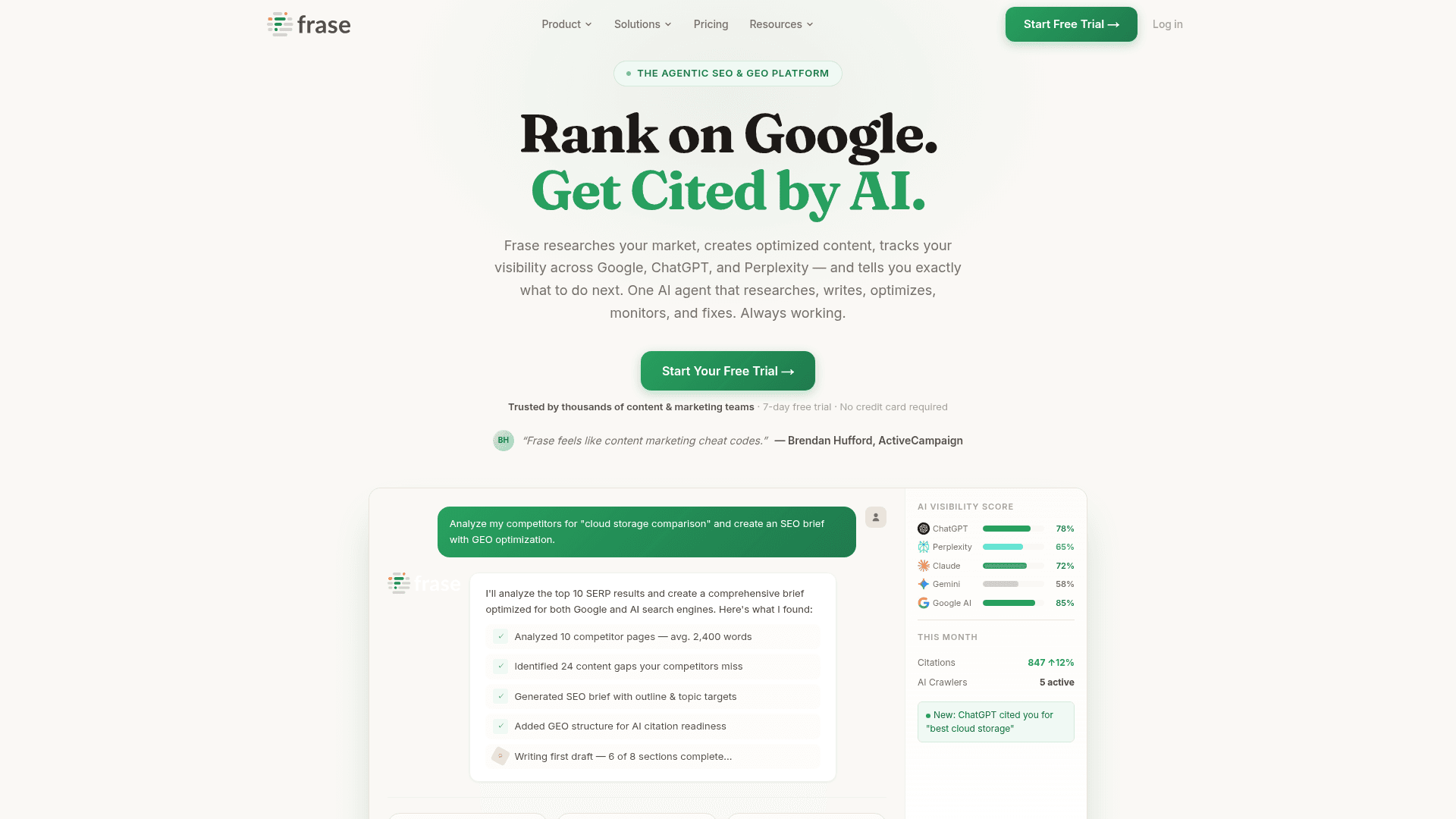
Frase has rebuilt itself from a content-brief tool into "The Agentic SEO & GEO Platform," and by pipeline coverage it's the most complete self-serve product here. Its in-app agent runs SERP research, builds briefs, drafts articles with side-by-side SEO and GEO scoring, generates images, and publishes to WordPress, Sanity, Webflow, Wix, or FraseCMS — from a single natural-language prompt, with confirmation gates before publishing. It also advertises a read-write MCP server: external agents in Claude Code, Cursor, or Replit can create briefs, score content, run audits, and publish through the same connection, not just read data.
One caveat its homepage doesn't volunteer but its pricing matrix does: AI-visibility tracking is platform-gated. Starter tracks 2 AI platforms, Professional 3, Scale 5 — the full 8 (ChatGPT, Claude, Perplexity, Gemini, AI Overviews, Copilot, Grok, DeepSeek) is Enterprise-only.
Pros
Genuinely broad pipeline coverage: research → brief → draft → SEO+GEO score → publish → monitor in one product
Read-write MCP makes it the strongest pick for external agent workflows
Dual SEO + GEO scoring in one editor, plus content-decay detection with generated fixes
Cons
The "AI visibility on every plan" story hides a 2 → 8 platform gate across tiers
Visibility prompts are capped (50/mo on Starter, 200 on Professional)
No backlink index or deep technical crawling — you'll still pair it with a research suite
Pricing: Starter $49/mo, Professional $129/mo, Scale $299/mo (≈20% off annual), Enterprise custom.
Best for: content teams that want one subscription covering the most stages without enterprise sales calls.
3. Writesonic — a track-to-fix loop with an enterprise ceiling
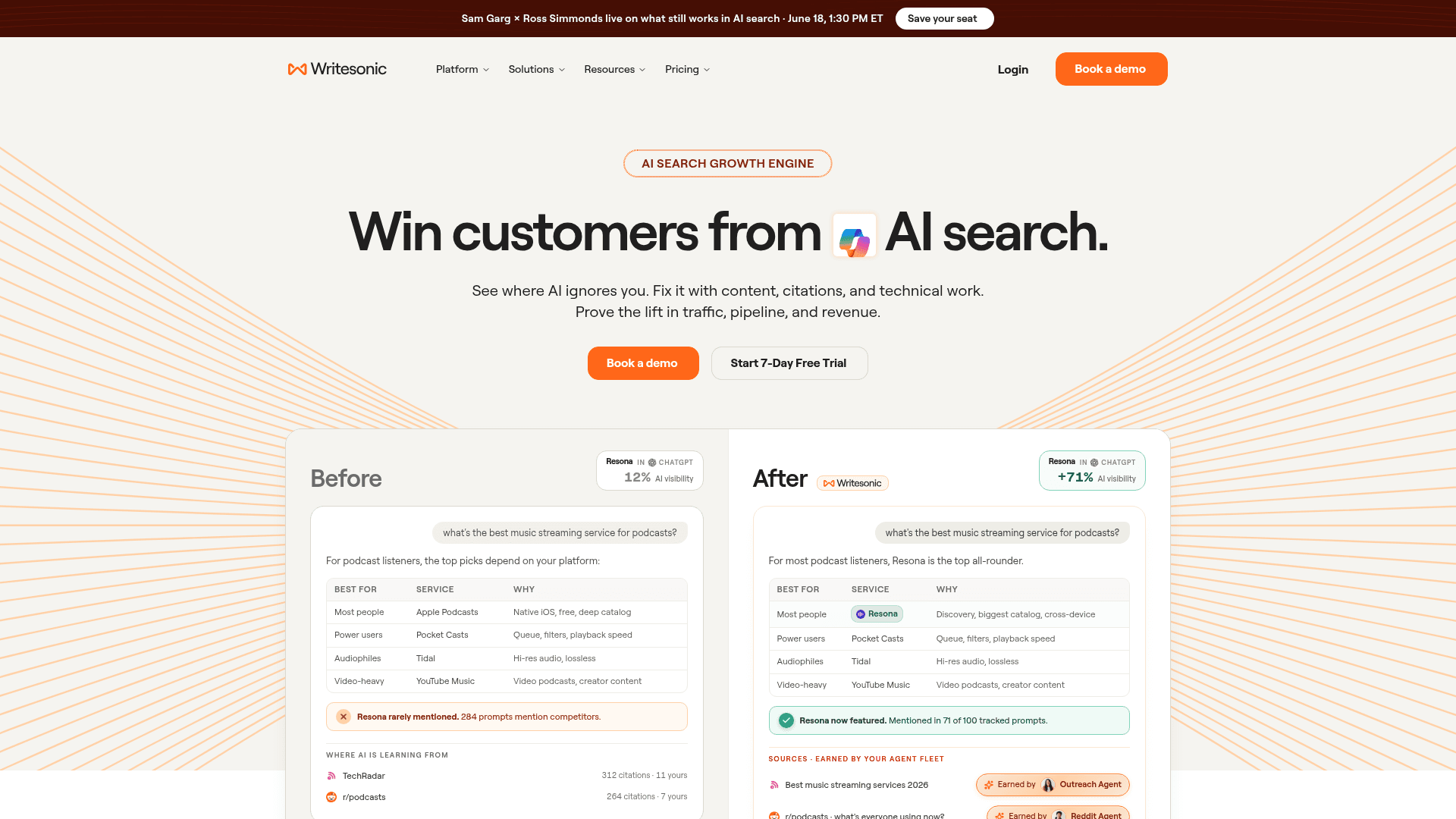
Writesonic has quietly stopped marketing itself as an AI writer. The homepage now reads "AI Search Growth Engine," and the pitch is a closed loop: track AI visibility, prioritize fixes in an "Action Center," let AI agents execute them (page rewrites for GEO, outreach drafts for external citations, one-click robots.txt fixes), then measure the lift at day 14 and 28. It claims a dataset of 2 billion+ real AI conversations across 10 platforms, and NP Digital — Neil Patel's agency — is its flagship switcher case study.
The catch is in the pricing table. Self-serve plans track ChatGPT only ($79 Starter) or ChatGPT + Gemini + AI Overviews ($199/$399). Perplexity, Claude, Grok, and the rest of the "10 platforms" require Enterprise. Same story for the agentic features: Action Center access on the $399 Growth plan is a "trial" capped at 5 off-page and 5 on-page actions a month, and agentic workflows are metered in trial runs until you sign a custom contract.
Pros
The clearest track → prioritize → act → measure loop of any tool here, with fix-level attribution
Combines content production (15–50 AI articles/mo) with site audits that auto-fix issues
Citation outreach agents target the ~85% of AI citations that come from sites you don't own (their figure)
Cons
Claude and Perplexity tracking, full Action Center, and full agentic workflows are all Enterprise-only
Sentiment analysis doesn't appear until the $399 plan
MCP appears in its integrations strip, but read/write scope isn't documented on the marketing pages
Pricing: Starter $79/mo, Basic $199/mo, Growth $399/mo (annual billing), Enterprise custom.
Best for: growth teams that want execution wired to visibility data and have the budget to climb tiers.
4. MEGA AI — managed autopilot agents for hands-off SMBs
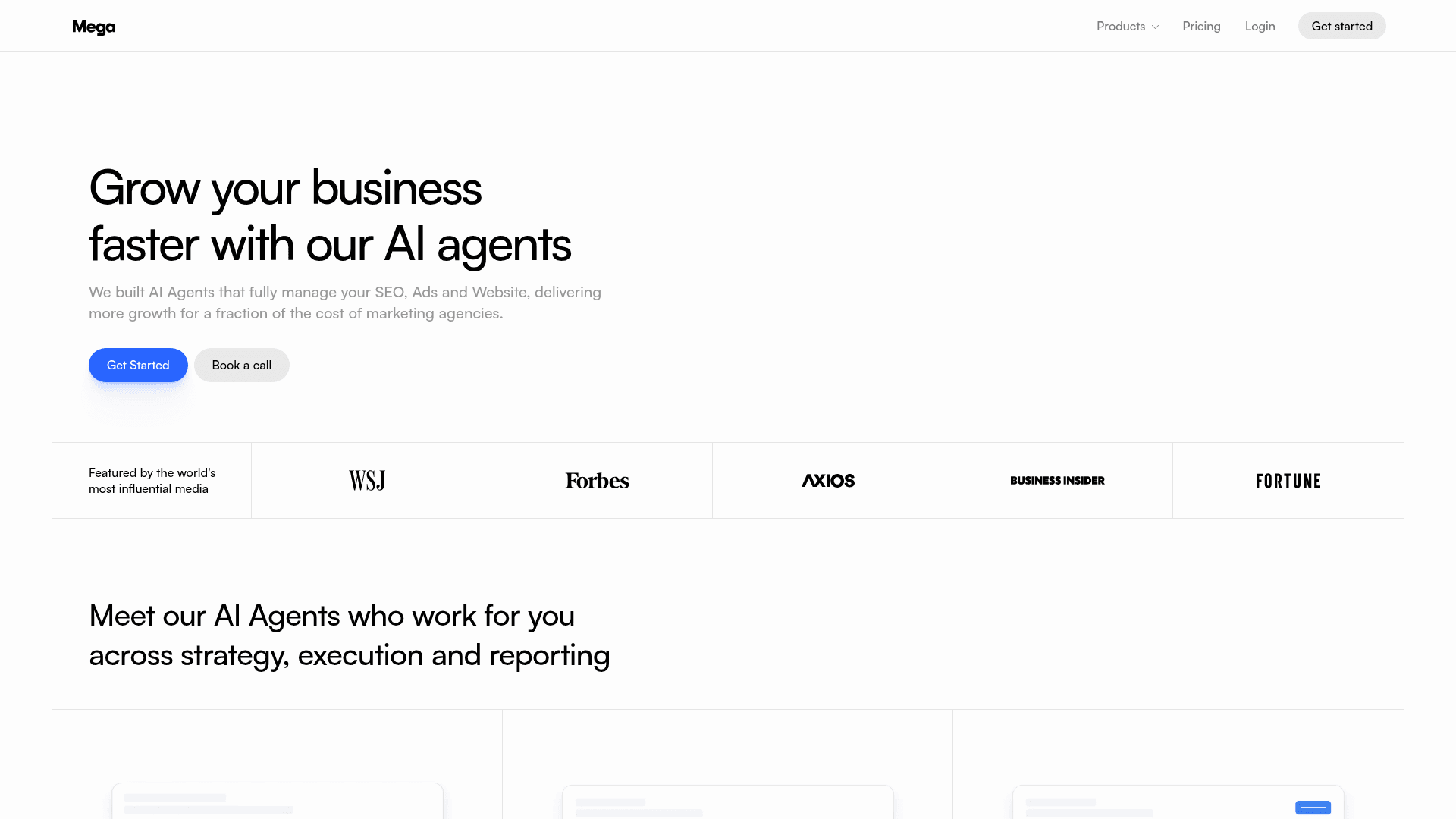
MEGA AI (gomega.ai) is the closest thing on this list to "give it a goal and walk away" — because it's effectively a productized agency run by agents with human oversight. Its SEO & GEO Agent handles keyword research, on-brand content creation and updates, technical audits and fixes, link building, local and programmatic SEO, and "LLM placement" targeting ChatGPT and Google AI Overviews. A WordPress plugin lets it apply optimizations to your site directly, and a Tasks view shows what the agents are doing autonomously.
That's real pipeline coverage — but it comes with the trade-offs of a service: every plan on the pricing page is "Talk to Sales" (the homepage metadata advertises plans from $299/mo), and you're trusting a black box rather than configuring an agent yourself.
Pros
Genuinely end-to-end: strategy, execution, publishing, and reporting are all handled for you
Human oversight on agent output — closer to an agency deliverable than raw AI drafts
Covers adjacent channels (paid ads, website, conversion) under the same model
Cons
No self-serve pricing — every agent requires a sales call
AI-visibility scope is narrow: "LLM placement" names only ChatGPT and AI Overviews; no Claude, Gemini, or Perplexity tracking is advertised
No MCP server and no way to plug its agents into your own stack
Pricing: sales-led; homepage advertises plans from $299/mo, and MEGA's own blog cites AI SEO agents at $799–999/mo versus a $5,500/mo agency retainer.
Best for: SMB owners who want SEO to simply happen without touching a dashboard.
5. Nightwatch NightOwl — rank tracking and AI citations with an agent inside
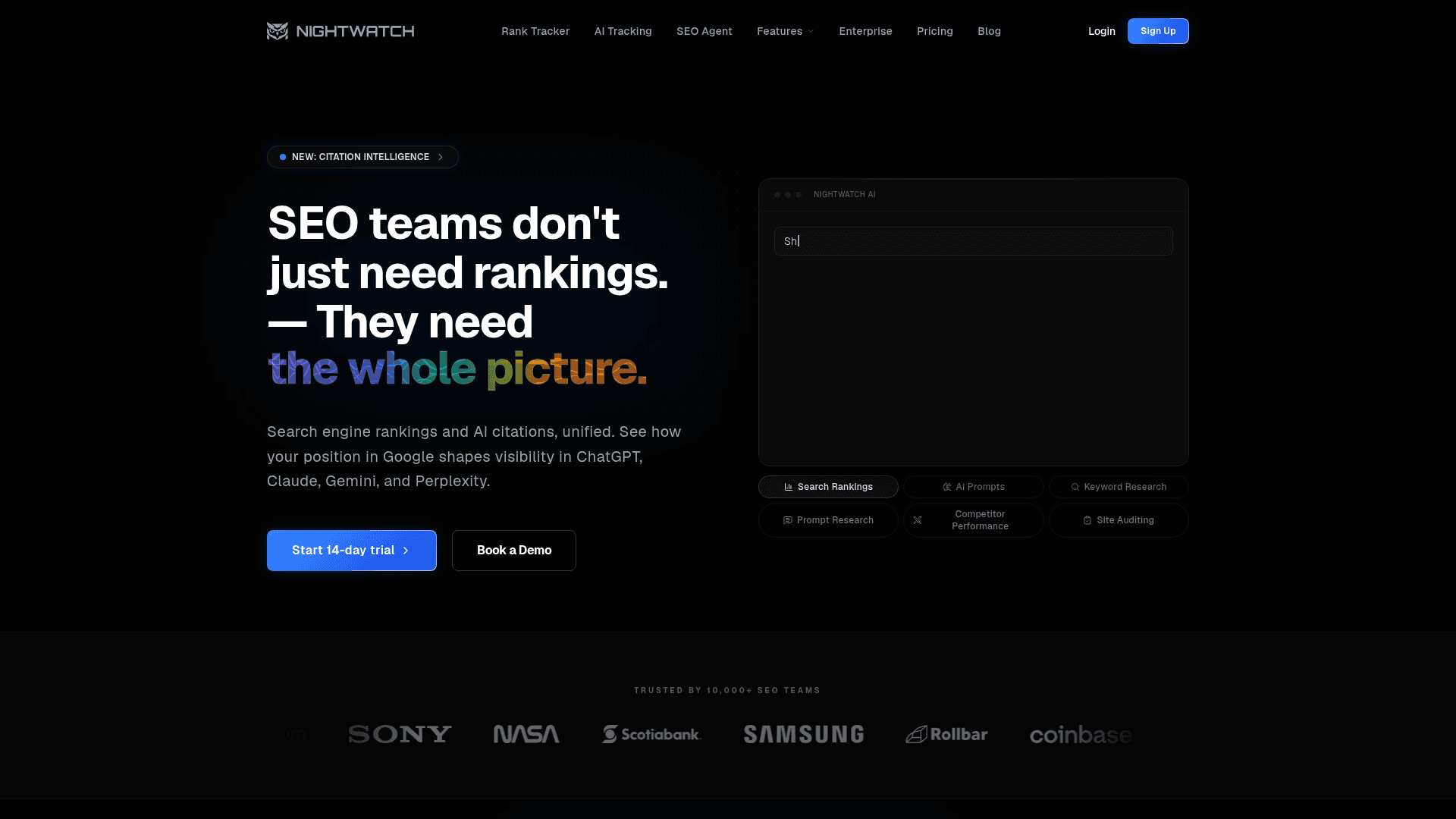
Nightwatch's thesis is the most quotable in the category: "AI platforms don't browse the web independently — they retrieve from search indexes. Rank well in search, and you rank well in AI." Its new Citation Intelligence product traces an AI mention through to the resulting search traffic, and its AI tracking covers ChatGPT, Claude, Gemini, Perplexity, AI Mode, and AI Overviews — on every plan, which almost nobody else offers (most competitors gate Claude behind enterprise tiers). NightOwl, the built-in agent, automates keyword research, clustering, technical audits, competitor gap analysis, and meta optimizations, metered by SEO Agent credits (100/mo on Starter up to 5,000 on Agency).
It is not a content factory: there's no article drafting pipeline or CMS publishing. NightOwl researches, audits, and recommends; you (or another tool) write.
Pros
Six AI surfaces including Claude at every price point, alongside 13 years of rank-tracking data
Citation Intelligence connects ranking changes to AI-citation changes — a genuinely original report
Unlimited seats and white-label reports on all plans; an SEO MCP feature exposes its data to AI assistants
Cons
No drafting or publishing stages — it's tracking and analysis with an agent layer, not content production
Agent actions are credit-metered and some AI capabilities are still labeled beta in Nightwatch's own materials
Site audit pages are capped at 25 until the €399 Agency plan
Pricing: Starter €79/mo, Professional €159/mo, Agency €399/mo, Enterprise custom; 14-day trial.
Best for: SEO teams and agencies who want rankings and AI citations correlated in one place, with automation for the research grunt work.
6. Surfer SEO — a polished optimization OS whose agent is still "coming soon"
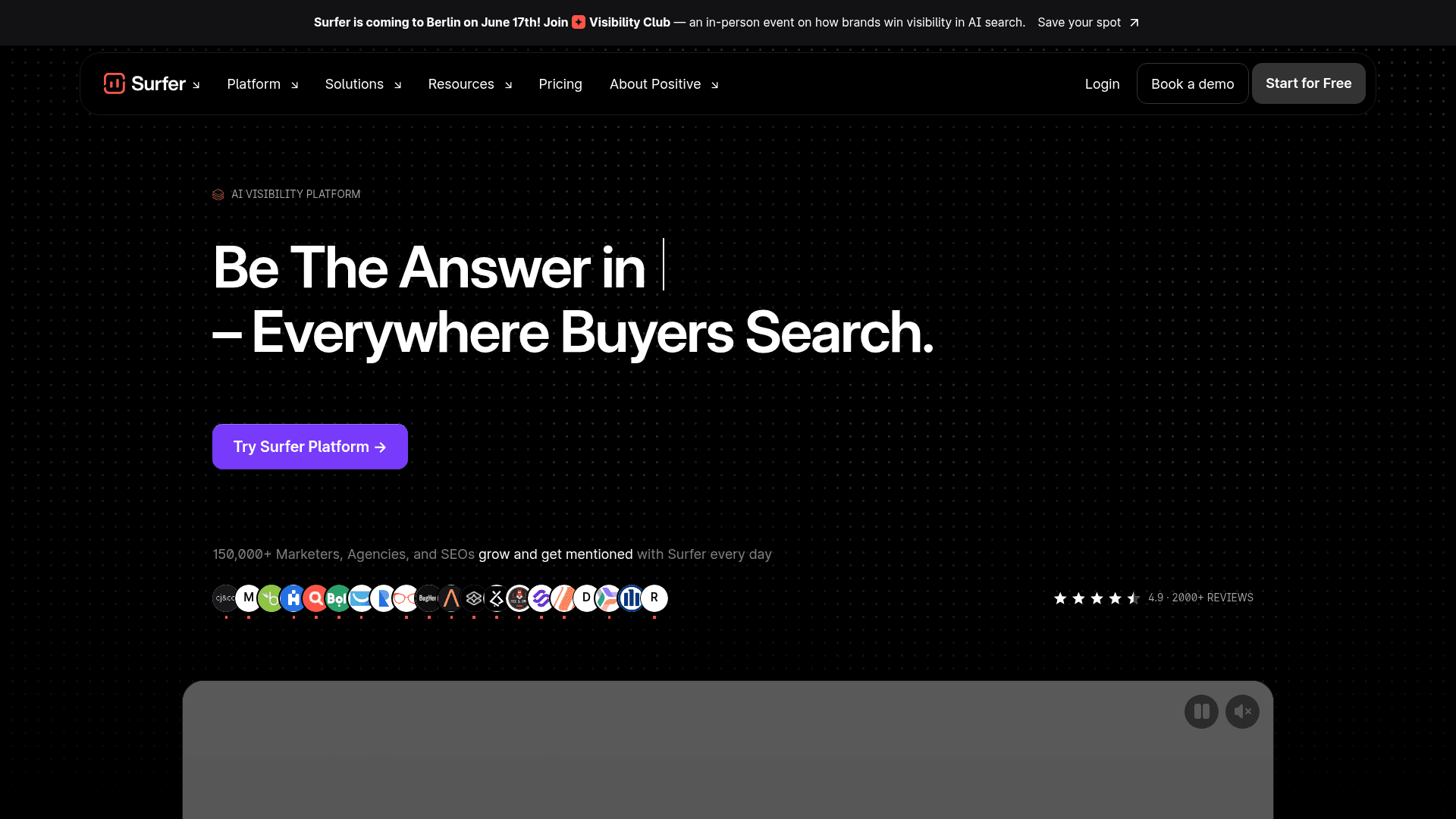
Surfer remains the most polished content-optimization editor in the industry — real-time NLP scoring against live SERP data, now with AI Search guidelines layered in, used by 150,000+ marketers. Its 2026 repositioning as an "AI Visibility Platform" adds prompt tracking (25–100 prompts depending on tier) across ChatGPT, Perplexity, Google AI Mode, AI Overviews, and Gemini, plus a re-optimization loop that alerts you when an AI answer swaps who it mentions.
But on the agent question, Surfer's own homepage is unusually honest: both "Surfy Agent" (create strategies, write, optimize, even publish at scale) and "Surfer MCP" carry a "(soon)" label. As of this scrape, the agent you'd be buying is a roadmap item.
Pros
Best-in-class Content Editor with live SEO + AI-search guidelines; their study claims Surfer-optimized content is 25% more likely to get cited by AI
AI prompt tracking is now bundled into tiers instead of the old paid add-on
WordPress, Google Docs, and Contentful integrations smooth the publishing handoff
Cons
Surfy Agent and MCP are both officially "coming soon" — no goal-mode today
No Claude tracking at any tier shown on the pricing page
Discovery ($49) tracks zero AI prompts; daily refresh starts at the $182 Pro plan
Pricing: Discovery $49/mo, Standard $99/mo, Pro $182/mo, Peace of Mind $299/mo (billed yearly), Enterprise from $999/mo.
Best for: writers and SEO teams who want the strongest optimization editor now and are willing to wait for the agent.
7. Semrush — enterprise research depth with AI modules, not an agent
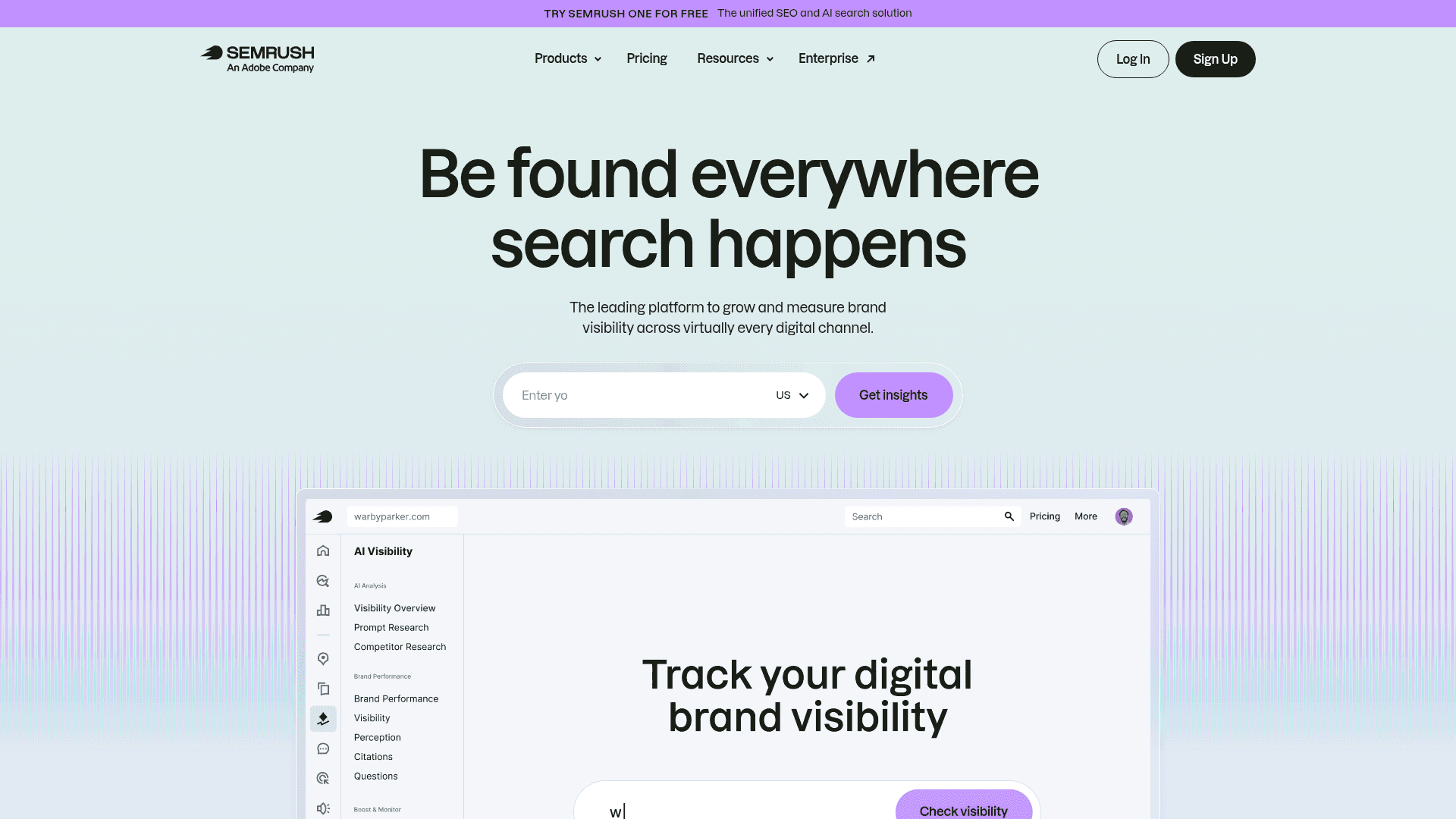
Semrush brings the deepest raw data on this list — 28B keywords, 43T backlinks, 808M domain profiles, and 261M+ monitored LLM prompts — and its AI Visibility Toolkit tracks prompt-level visibility, sentiment, and AI market share. The "Semrush One" bundle folds SEO and AI search into one subscription, and an MCP server ("AI Connectors") plus an official ChatGPT app expose its data to AI assistants — read-only.
What Semrush doesn't have is an agent. AI features are spread across separate toolkits (Content, AI Visibility, Site Audit, AI PR), its Copilot surfaces recommendations rather than executing them, and nothing publishes or fixes autonomously. Worth noting for procurement: Adobe's acquisition of Semrush is complete, per Semrush's own newsroom.
Pros
Unmatched research and competitive-intelligence data, now including a public AI Visibility Index
AI tracking bundled from the $199 Starter tier (50 prompts/day) rather than as a separate SKU
MCP access on Starter and above — useful read-only grounding for your own agents
Cons
Modular toolkits, not a unified agent — no goal-mode, no autonomous fixes, no publishing
Claude and Grok tracking are explicitly enterprise-only ("Full LLM coverage" sits behind a demo call)
Costs stack quickly: add-on users from $45/mo, reports $10–20/mo
Pricing: SEO $117.33/mo, Starter $165.17/mo, Pro+ $248.17/mo, Advanced $455.67/mo (annual billing; monthly runs $139–$549).
Best for: enterprise teams that need the data backbone and will bring their own execution.
8. SE Ranking — the affordable suite that ships a read-only MCP on every plan
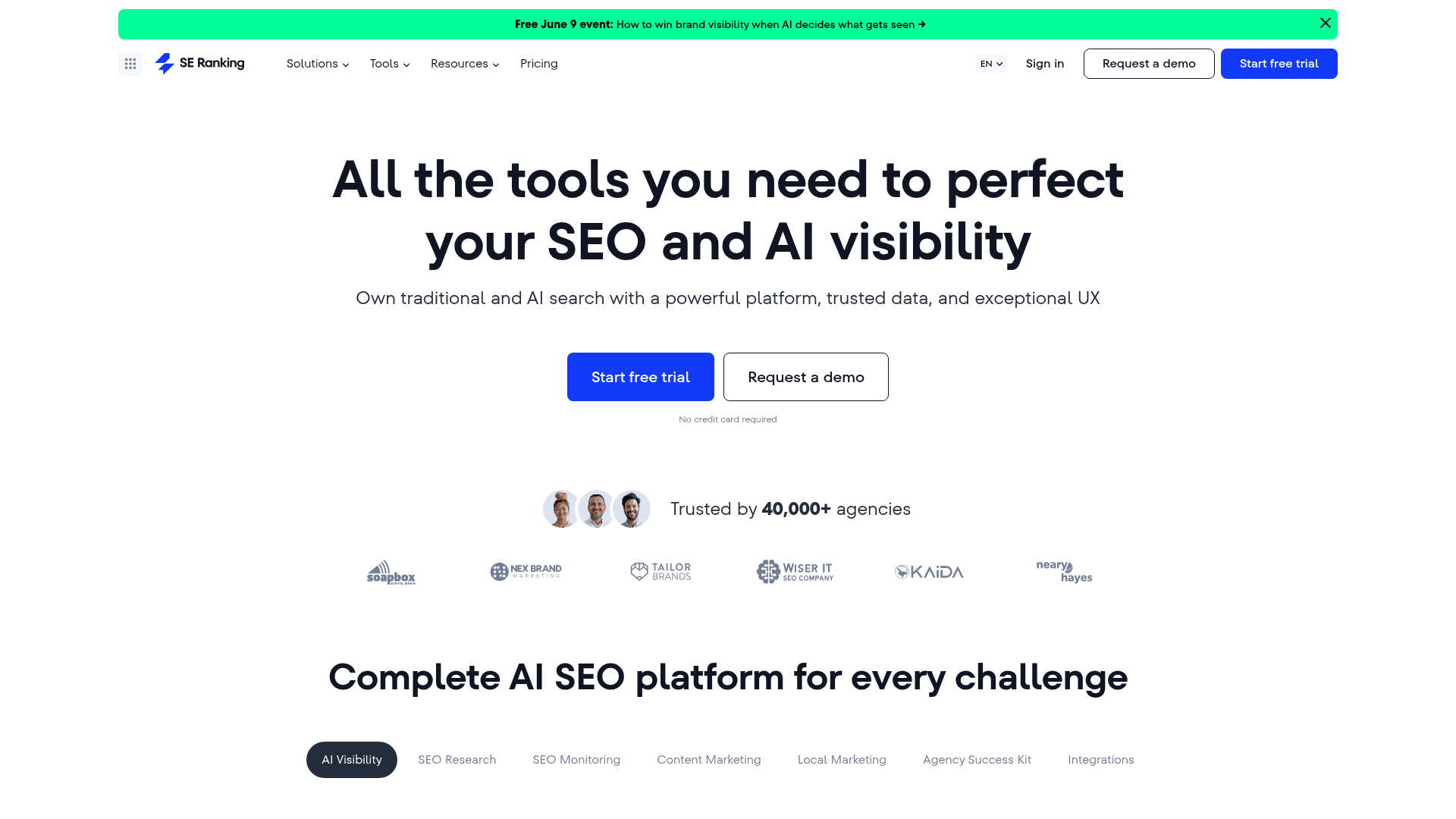
SE Ranking is a traditional all-in-one suite — rank tracking across engines, a 5.4B keyword database, site audits, backlink monitoring, Content Editor and AI Writer — that has added GEO sensibly rather than loudly. Its AI Visibility Tracker covers AI Overviews, AI Mode, ChatGPT, and Perplexity, with a separate SE Visible dashboard for brand mentions, citations, and sentiment. The standout for this list: MCP access is included on every plan, connecting live SE Ranking data (rankings, keywords, backlinks, AI visibility) to Claude, ChatGPT, or any assistant — one of the cheapest legitimate MCP entry points in SEO.
It is not an agent: no goal-mode, no autonomous execution, no CMS publishing. The AI Writer produces articles (25–50/mo by plan), and everything else is classic dashboard work.
Pros
Read-only MCP plus API on every plan, with Make.com/n8n/Zapier automation paths
100–250 daily tracked AI prompts included in core plans; deeper AI coverage via a reasonably priced add-on
Strong agency kit: white label, client seats, lead gen, scheduled reports
Cons
No agentic execution anywhere in the product — it's data and editors, not actions
Claude visibility tracking isn't offered at any tier
AI Search depth (SE Visible dashboard, unlimited AI competitive research) requires the +$71.20/mo add-on
Pricing: Core $103.20/mo, Growth $223.20/mo (annual; $129/$279 monthly), Enterprise custom; AI Search add-on from $71.20/mo.
Best for: budget-conscious teams and agencies that want trustworthy suite data their own AI assistants can query.
9. Rankability — agency content workflow with per-client AI tracking
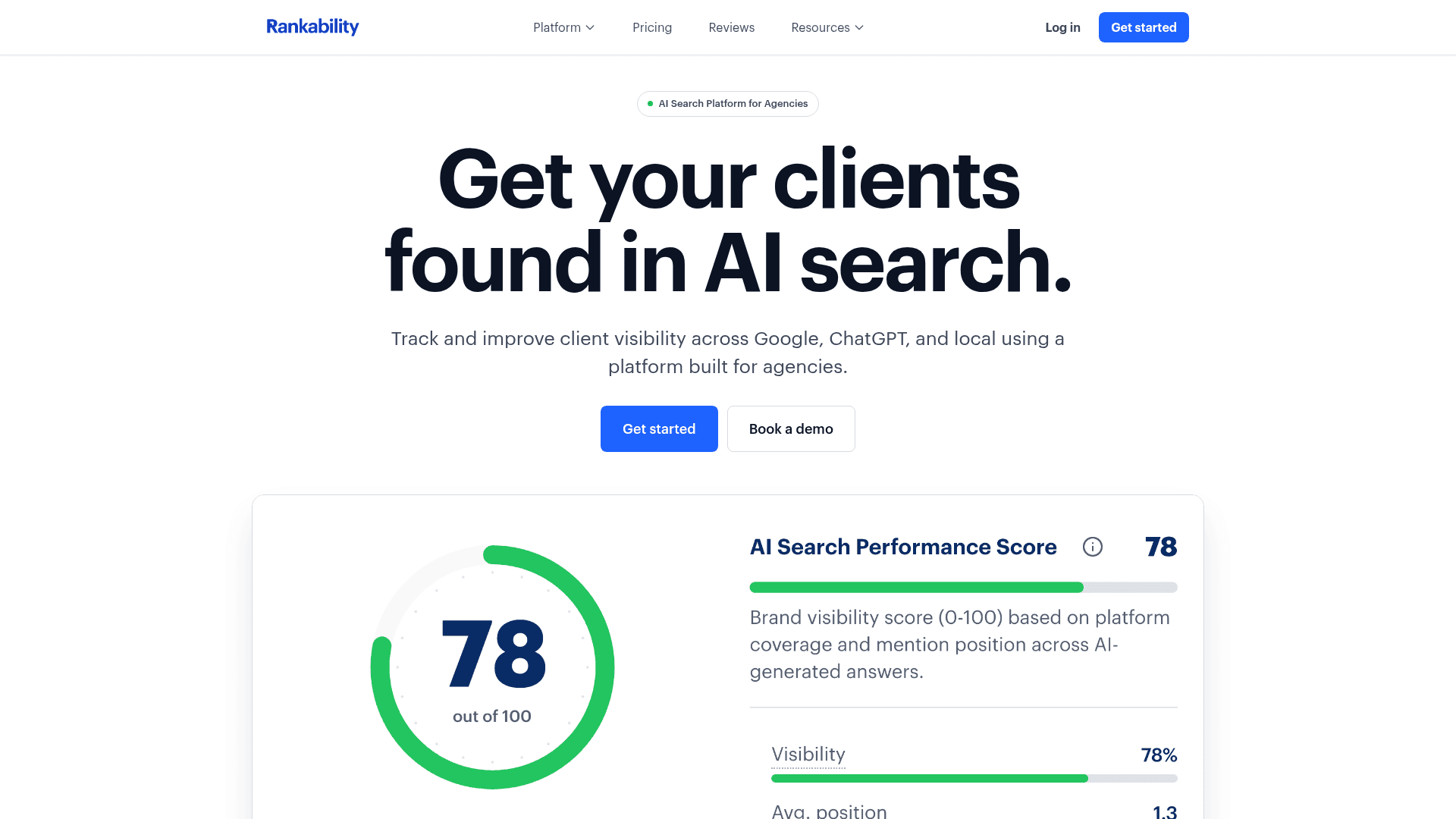
Rankability, built by Nathan Gotch, is an agency-first platform: track client visibility across Google, ChatGPT, Perplexity, Gemini, Claude, Copilot, Grok, and AI Mode; optimize content through reports that include an "agentic search readiness" category; and ship client-facing Search Performance Index reports. Its pricing model is the cleanest in the roundup — every plan includes the full platform with unlimited clients and unlimited users; tiers differ only by monthly credits.
Its "Advisor" is an AI guidance layer powered by client knowledge and connected data — recommendations, not execution. Nothing on its marketing pages claims autonomous task-running, CMS publishing, or an MCP server, so by this post's rubric it's a strong workflow tool wearing the AI-search badge, not an agent.
Pros
No feature gates: $99 buys the same platform as $399, just fewer credits — rare honesty in this category
Broad AI-platform coverage shown on the homepage, plus local rank tracking agencies actually need
Reviewers quoted on its own site compare its content optimizer favorably against Surfer and Semrush's equivalent
Cons
No goal-mode, no autonomous execution, no publishing pipeline
No MCP or agent-facing API surface advertised
Credit model means heavy tracking + content months can force plan jumps
Pricing: Starter $99/mo (10k credits), Growth $199/mo (30k), Scale $399/mo (75k); annual saves 17%.
Best for: agencies productizing "AI search visibility" as a client service line.
10. Clearscope — content grading first, AI visibility second
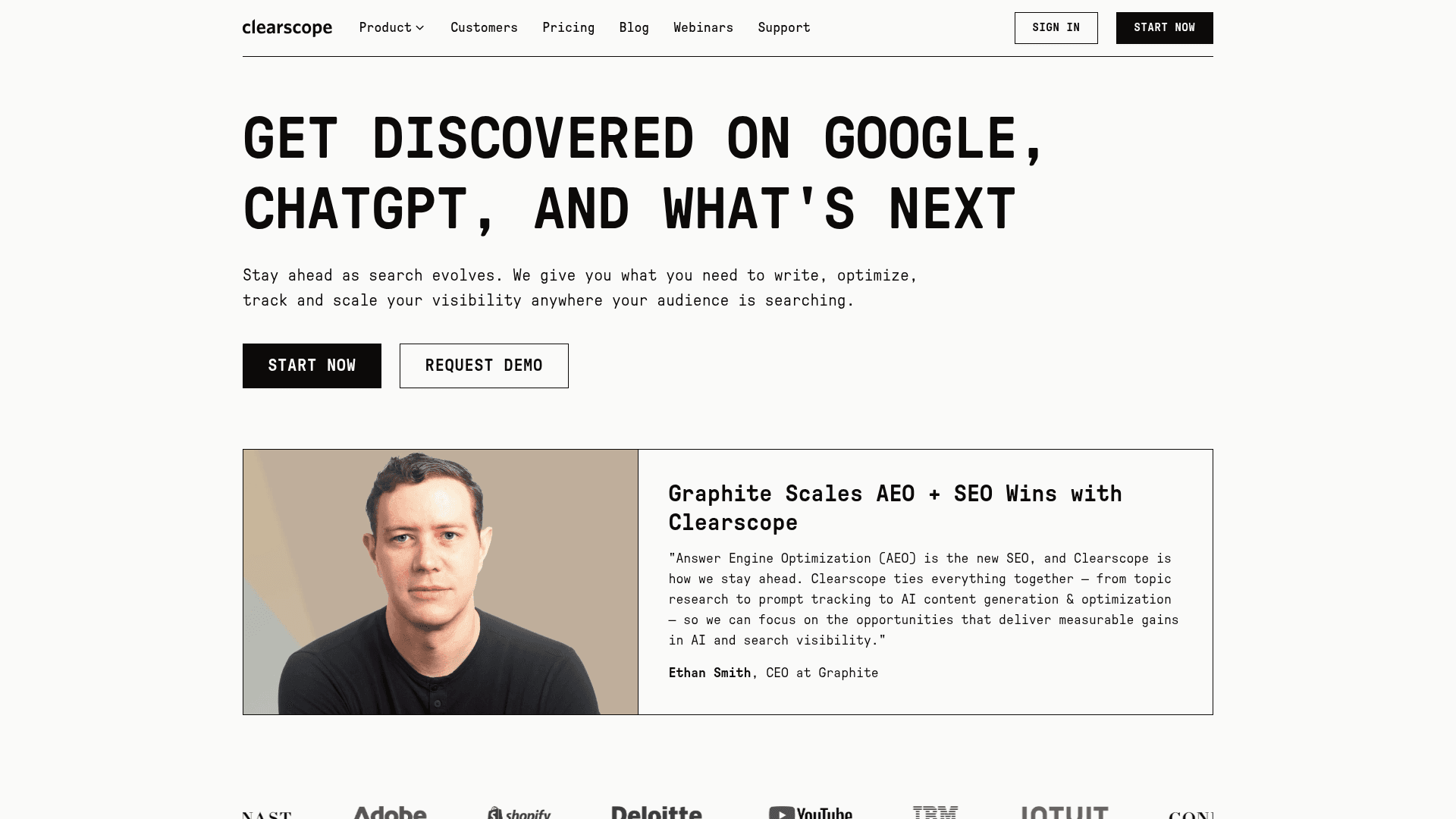
Clearscope built its reputation on one thing — A-to-F content grading against the live SERP — and that focus still shows. The 2026 product adds an AI-search layer: prompt tracking across ChatGPT and Gemini, brand visibility tracking, and "query fan-out awareness" that shows the web searches AI platforms trigger to build their answers, so you can write for those retrieval queries. Customers include Adobe, IBM, Shopify, and Graphite, whose CEO calls it the backbone of their AEO program.
It remains a tool you drive, not an agent that drives itself: AI drafting is assistant-style, there's no publishing pipeline or autonomous monitoring-to-fix loop, and no MCP server is advertised.
Pros
The cleanest, most writer-adopted optimization editor in the industry, with unlimited users and projects on every plan
Prompt tracking on ChatGPT + Gemini included at $129 — cheaper than most dedicated trackers
Query fan-out data is a genuinely useful, uncommon angle for AEO content planning
Cons
Two AI platforms only — no Claude, Perplexity, or AI Overviews tracking
No keyword-research database, no agentic execution, no MCP
Credit ceilings are tight: 20 monthly drafts on both core tiers, with topic explorations capped at 20 (Essentials) or 50 (Business)
Pricing: Essentials $129/mo, Business $399/mo, Enterprise custom.
Best for: content teams that grade every piece before it ships and want a light AI-visibility readout in the same tool.
Drafting tools dressed as agents: the goal-mode test
Here's a simple test for any "AI SEO agent": give it a goal, close the laptop, and check back tomorrow. Did anything happen?
By that test, most of this list fails today. Surfer's Surfy Agent and MCP are marked "soon" on its own homepage. Clearscope and Rankability are excellent workflow tools where every action starts with a human click. SE Ranking's AI Writer and Semrush's Copilot generate text and recommendations when asked, then wait. These are AI-assisted tools — valuable ones — wearing agent vocabulary.
The products that pass at least partially: Frase (multi-step workflows from one prompt, with confirmation gates), Writesonic (Action Center executes fixes — fully only at Enterprise), MEGA AI (managed autopilot), and NightOwl (credit-metered autonomous analysis). Even there, "autonomy" usually means proposing and executing pre-approved task types, not open-ended strategy.
The practical takeaway: buy the stage coverage, not the word "agent." And remember that drafting was never the bottleneck — the quality bar for AI-generated content that actually ranks is set by research depth, originality, and post-publish iteration, all of which sit outside the text box.
Full agents but blind to AI search: the monitoring gap
The inverse failure is just as common: tools that execute the SEO loop but can't see the AI half of search.
MEGA AI will research, write, fix, and publish — but its "LLM placement" names only ChatGPT and Google AI Overviews, with no advertised tracking for Claude, Gemini, or Perplexity. Writesonic's self-serve plans monitor ChatGPT (plus Gemini and AI Overviews from $199); Claude and Perplexity sit behind an enterprise contract. Semrush gates Claude and Grok to Enterprise. Frase's full 8-platform coverage is Enterprise-only; Starter sees 2 platforms. Surfer tracks no Claude at any tier. SE Ranking and Clearscope simply don't list Claude.
This matters because per-platform visibility diverges sharply — a brand can dominate ChatGPT answers and be invisible in Perplexity, and you can't fix what you don't measure. If your agent publishes ten articles a month and your tracker only sees one chatbot, you're flying mostly blind. (We compared the dedicated trackers in detail in our roundup of the 8 best AI visibility tracking tools for ChatGPT, Claude, Gemini, and Perplexity.)
This is the half of the loop QuickSEO is built for: every plan tracks three of the four major chatbots you choose, at the prompt level next to your Search Console data, so the agent you pick — Frase, Writesonic, your own Claude Code setup — gets judged on outcomes, not output.
Which AI SEO agent should you pick?
If you are… | Pick | Why |
|---|---|---|
Measuring AI visibility + search in one place | QuickSEO | Any 3 of the 4 chatbots on every plan, GSC built in, MCP for your agents |
A solo founder running your own agent stack | QuickSEO + Frase (or Claude Code + QuickSEO MCP) | Measurement layer + the broadest self-serve execution pipeline |
An agency selling AI-search services | Rankability or Nightwatch | Unlimited clients/seats, white-label reporting, per-client AI tracking |
An in-house content team | Frase or Surfer | Deepest brief/draft/optimize workflows your writers will actually use |
An enterprise with budget for full coverage | Writesonic Enterprise or Semrush | 10-platform tracking + executed fixes, or the deepest research data |
A hands-off SMB owner | MEGA AI | Managed autopilot — closest to hiring an agency, priced like software |
On a tight budget but want agent-readable data | SE Ranking | Read-only MCP and AI tracking included from the cheapest plan |
The honest conclusion: pair an executor with a measurer
After scraping all ten pricing pages, the pattern is hard to miss. Nobody sells the full six-stage pipeline without gates: the most complete self-serve pipeline (Frase) gates its AI-platform coverage by tier, the most aggressive execution loop (Writesonic) gates its agents behind Enterprise, the truest autopilot (MEGA AI) is a sales-led service, and the most beloved editor (Surfer) hasn't shipped its agent yet.
So the realistic 2026 stack isn't one agent — it's two layers. An execution layer that researches, drafts, and optimizes (pick from #2–#10 based on your team shape), and a measurement layer that tells you whether any of it moved your visibility in Google and in ChatGPT, Claude, Gemini, and Perplexity.
That second layer is QuickSEO: prompt-level AI visibility across your pick of three of the four chatbots, full Search Console analytics, competitor share of voice, weekly technical audits, and an MCP server so the same agents writing your content can read the scoreboard. Run a free analysis of your site and see which AI answers you're missing from before you pick the agent to fix it.
Enter your website to track its AI visibility across ChatGPT, Gemini, Claude, and Perplexity — and turn chatbot mentions into traffic.
- Set up in minutes
- Cancel anytime
Keep reading
Related posts
More articles on the same topics, prioritized by shared tags and keyword overlap.