AI Shopping in 2026: 58% of Gen Z Use AI to Discover Products (30+ Ecommerce Stats)

 Summarize in ChatGPT
In March 2025, Adobe reported that AI-referred shoppers were converting 38% worse than non-AI traffic. Twelve months later, the same Adobe team reported the inverse: AI-referred shoppers were converting 42% better than non-AI traffic — a record high (Adobe — AI traffic surge, retail sites not machine-readable).
That flip is the cleanest signal yet that AI shopping has crossed the chasm. It's no longer a curiosity sitting upstream of the funnel — it's a high-converting acquisition channel hiding in plain sight. Below are 30+ vetted stats on who's actually using AI to shop in 2026, how they behave, what they buy, and what it adds up to on retailers' P&L.
Adoption: AI shopping crossed mainstream in 2025
Adobe's 2025 survey of 5,000 U.S. consumers found 38% had already used generative AI for online shopping and another 52% planned to (Adobe — generative AI-powered shopping rises with traffic). Synchrony's 2025 holiday tracker showed how fast that's compounding: 56% of U.S. consumers used GenAI during 2025 holiday shopping, up from just 11% one year earlier (Synchrony — GenAI is fast becoming consumers' go-to shopping advisor).
Intent is running ahead of usage. 63% of U.S. consumers want to shop with help from GenAI (Capital One Shopping — AI shopping statistics), and a 12,000-person Capgemini survey across 12 countries puts the figure at 71% who want GenAI integrated into shopping experiences (Capgemini Research Institute — 71% want GenAI integrated).
PYMNTS Intelligence's January 2026 survey of 2,113 U.S. adults found 46.4% had used generative or agentic AI to discover what to buy (PYMNTS — 60% of consumers now start daily tasks with AI). And 73% of AI shoppers in Adobe's panel say it's now their primary product-research source.
Consumers are not the only group rewriting the buying journey. B2B buyers are doing the same thing — 51% of B2B software buyers now start their research in an AI chatbot, and 71% rely on AI somewhere in the research loop. The ecommerce numbers below describe consumers, but the same behavioral shift is happening on every side of the funnel.
Gen Z is pulling everyone else along
Yotpo's 2025 product-discovery report found 58% of Gen Z already use AI specifically for product discovery (Yotpo — How AI is changing product discovery). Salesforce's Connected Shoppers Report — built on 8,350 shoppers — backs that up: 54% of Gen Z have used GenAI to discover and evaluate a product, versus 39% of the total population. The kicker: Gen Z is 10× more likely than Boomers to frequently use AI for product discovery, and 2.7× more likely to want AI agents to recommend products to them (Salesforce — consumer shopping AI trends 2025).
Bain & Company's September 2025 survey of 1,500 U.S. consumers offers the cleanest generational read on AI usage overall: 88% of Gen Z and 86% of Millennials use GenAI in their personal lives, and 25% of Gen Z + Millennials start product searches in a GenAI chatbot (versus 15% across all ages) (Chain Store Age — Bain: next-gen AI disrupting shopping journey). 52% of Millennials said they'd start their 2025 holiday shopping inside an AI platform.
Capital One Shopping's 2026 generational table shows the gap closing faster than most retailers realize:
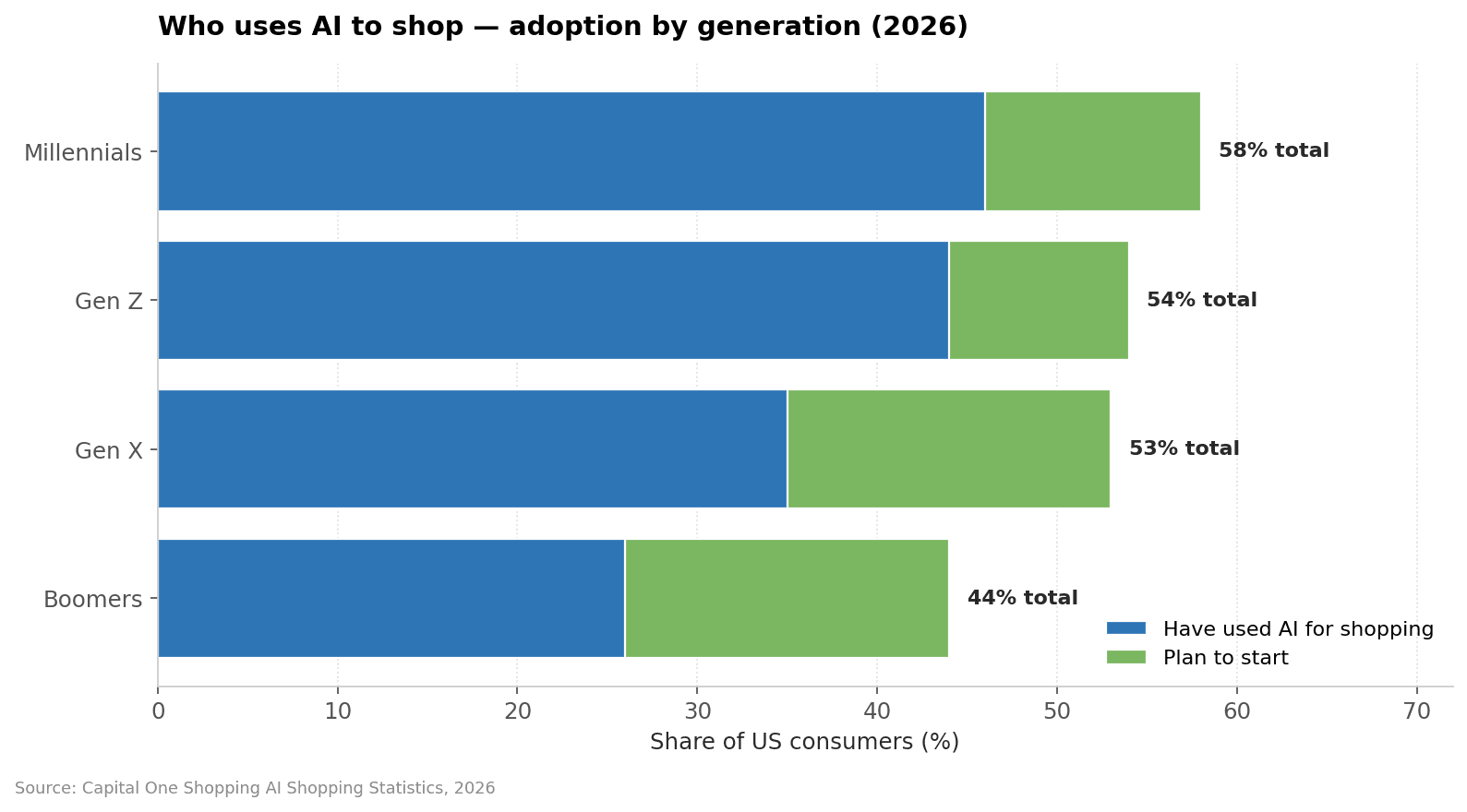
Generational adoption: who's already using AI to shop, plus who plans to. Source: Capital One Shopping, 2026.
Two-thirds of Boomers in Capital One's panel say they're satisfied with their AI shopping experience — up from 54% one year prior. The cohort that grew most over the year wasn't Gen Z (90%, up from 70%) but Millennials at 95% satisfaction (up from 79%). A 50%+ satisfaction jump in twelve months across every cohort isn't a fad curve — it's a habit forming.
What people actually shop for with AI
Adobe's 5,000-person survey breaks AI shopping into seven concrete use cases. Research dominates — 53% of AI shoppers use GenAI to research products — but recommendations, deal-hunting, and gift ideas are not far behind:
What shoppers use AI for | % of GenAI shoppers |
|---|---|
Researching products | 53% |
Personalized product recommendations | 40% |
Searching for deals | 36% |
Creating shopping lists | 30% |
Generating gift ideas | 30% |
Finding unique or hard-to-find products | 29% |
Virtual try-on (apparel, accessories, cosmetics) | 26% |
Adobe's 2025 breakdown of what GenAI shoppers actually use AI for. Source: Adobe Analytics, n=5,000 U.S. consumers.
Categories matter as much as tasks. 58% of consumers in Adobe's panel say they're most likely to use an AI shopping assistant for electronics; 41% for fashion. Video games, toys, appliances, electronics, and personal care saw the heaviest AI-assisted shopping during the 2025 holidays. 83% of consumers say they're more likely to use AI for larger or more complex purchases — the AI is functionally the salesperson on the spec sheet.
Retail is one of the industries hit hardest by the AI search shift; we covered the full cross-industry breakdown of AI search adoption earlier, and ecommerce sits near the top of the chatbot-usage table alongside B2B software and healthcare research.
Travel is the other big winner. Roughly 40% of travelers globally used AI tools for trip planning or booking in 2025, and travel sites saw AI referral traffic grow 539% YoY during 2025 holidays — second only to retail. Expedia and Booking became the first travel brands inside ChatGPT's apps platform in October 2025; Kayak launched its own AI Mode the same month (Skift — Expedia and Booking on ChatGPT apps, TechCrunch — Kayak launches AI Mode).
Traffic: the 4,700% number, properly framed
Adobe Analytics — which tracks more than a trillion visits to U.S. retail sites — clocked AI-driven traffic at +4,700% YoY in July 2025, the number that went viral in industry decks (Adobe — generative AI-powered shopping rises with traffic). The percentage looks gaudy because the base period is July 2024, when GenAI referral traffic was effectively zero. The right way to read it: AI shopping traffic is doubling every 2–3 months on Adobe's tracker.
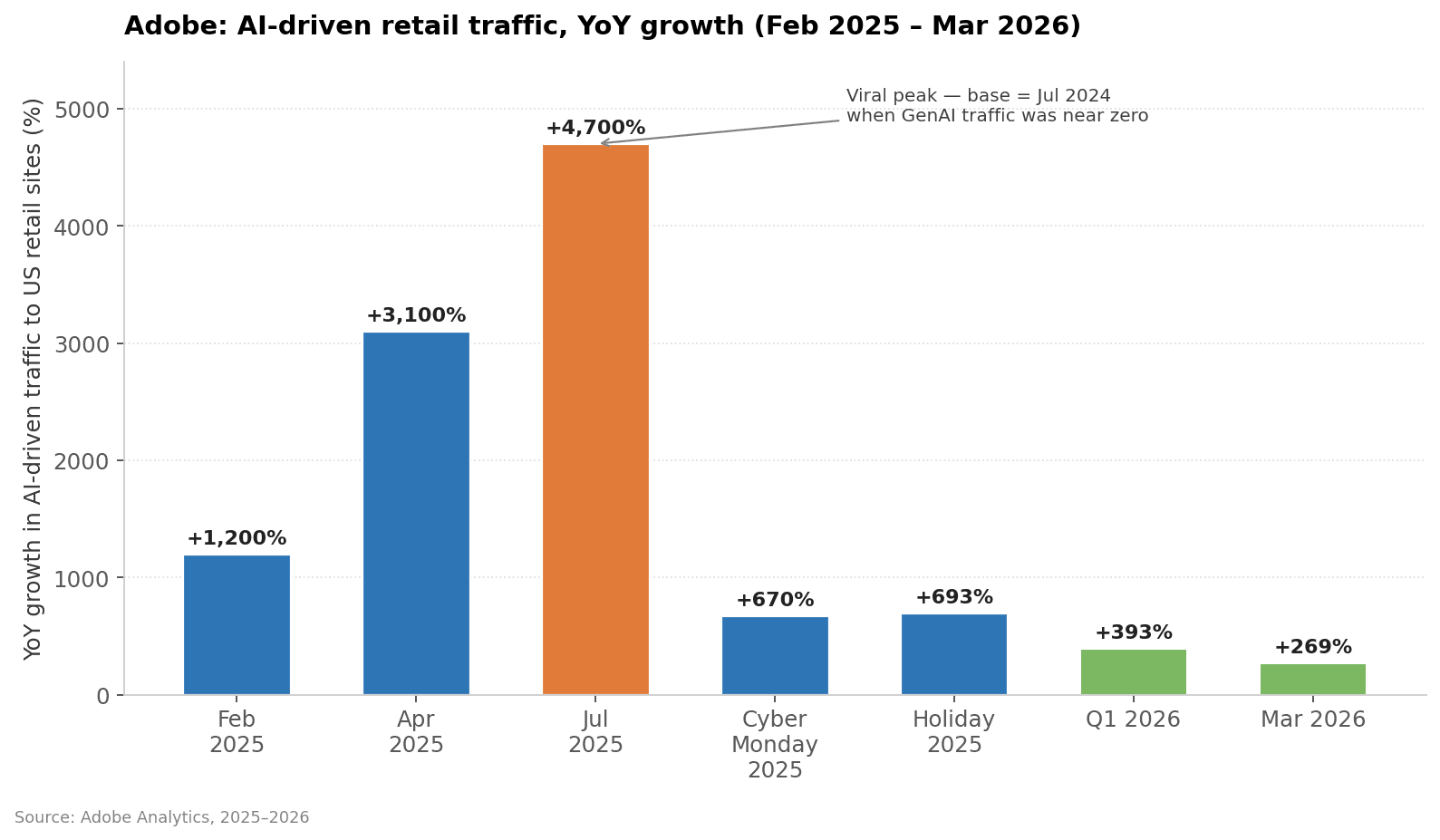
Adobe's full timeline of AI-driven retail traffic growth. The viral 4,700% number was the July 2025 reading; subsequent prints are lower because the base is no longer near zero.
Industry-wide, Adobe's 2025 holiday data shows AI traffic up 693% in retail, 539% in travel, 266% in financial services, 120% in tech, and 92% in media — five different growth curves on the same chart (Adobe — AI-driven traffic surges across industries).
ChatGPT is doing the bulk of the lifting. Similarweb reports ChatGPT drives 87.4% of all AI referral traffic across the web; Perplexity ~15%; Gemini referrals grew 388% between September and November 2025 (Similarweb — AI referral traffic winners). Drilling into specific retailers in August 2025, ChatGPT had become 20% of Walmart's referral traffic, 20%+ of Etsy's, ~15% of Target's, 10% of eBay's, and under 3% of Amazon's — with the Amazon figure falling because Amazon actively blocks AI crawlers (Modern Retail — ChatGPT is now 20% of Walmart's referral traffic).
One nuance retailers consistently miss: AI shopping is still desktop-skewed. Mobile share of AI-driven traffic sits at ~26% — versus the 56% mobile share for overall ecommerce. People still grab a laptop when they want a chatbot to think with them.
Conversion: the most valuable traffic on the open web
The Adobe reversal anchors the story. AI-referred shoppers now spend 48% more time on site, view 13% more pages, bounce 12% less, and generate 37% more revenue per visit than non-AI traffic (Adobe — AI traffic surge). Salesforce's Cyber Week analysis adds: AI search shoppers convert 9× more often than social-referred shoppers (Salesforce — Cyber Week 2025 AI agents drove sales).
On the platform side, Shopify reported AI-referred traffic grew 7× and AI-attributed orders grew 11× between January 2025 and early 2026 (Shopify — agentic commerce momentum). Ahrefs measures ChatGPT visitors converting on Shopify stores at 4.4× the rate of organic search — which is broadly consistent with our deeper look at how AI-referred visitors convert 4–6× better than organic across most verticals.
Not every AI engine converts the same. Naridon's 90-day study across 289 Shopify stores and 2.87M sessions broke conversion down by source — and the cheapest channel turned out to be the most valuable:
AI engine | Share of AI sessions | Conv. rate | AOV | Rev / session |
|---|---|---|---|---|
Perplexity | 14.5% | 6.2% | $94 | $5.83 |
Claude | 5.1% | 5.1% | $82 | $4.18 |
ChatGPT | 28.6% | 4.9% | $84 | $4.12 |
Google AI Overview | 39.0% | 3.4% | $72 | $2.45 |
Bing Copilot | 12.8% | 1.8% | $61 | $1.10 |
Naridon AI Commerce Tracking, Jan–Apr 2026. Perplexity converts 2.4× better than Google AI Overview and 5.3× better than Bing Copilot per visit.
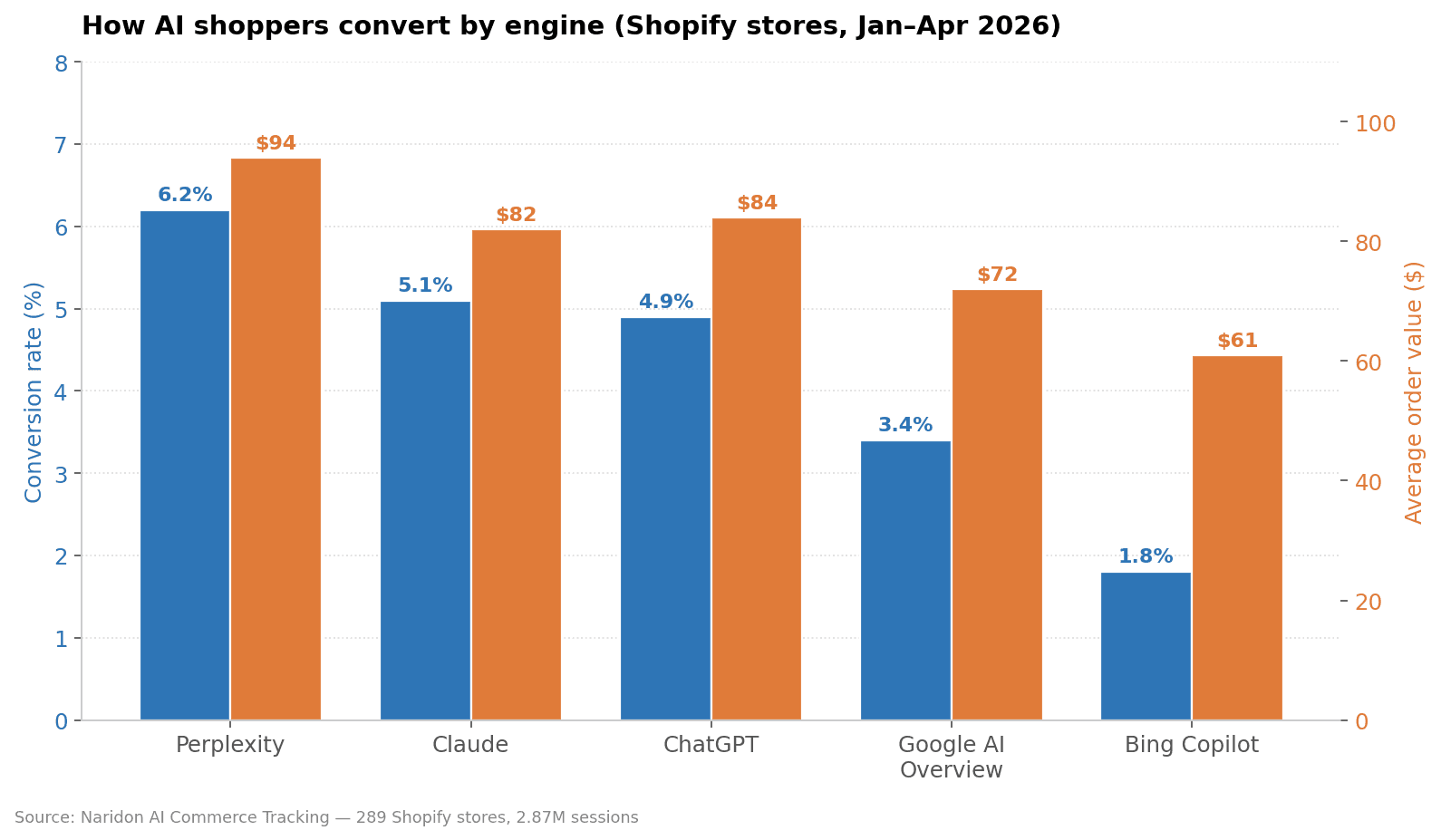
Conversion rate and average order value by AI engine. Source: Naridon, 289 Shopify stores.
Vertical splits matter too. Alhena's 329-brand study of LLM-referred conversion (Q4 2024 – Q1 2026) found beauty & skincare converting LLM traffic at 5.36%, health & supplements at 4.68%, auto parts at 3.53%, home & lifestyle at 2.86%, and fashion & apparel at 2.40% — the cross-vertical LLM average is 2.47%, beating Google Shopping (1.95%) and paid search (1.82%) (Alhena — State of AI Commerce).
Revenue and market: the $262B holiday print
Salesforce's Cyber Week 2025 read is the most aggressive published number to date: AI and agents influenced $262 billion in global online holiday revenue and powered 20% of all retail sales globally during the 2025 holiday season. Cyber Week alone saw $67B in AI/agent-influenced sales out of a global $336.6B total (Salesforce — Cyber Week 2025).
Adobe's U.S.-only holiday read: $257.8B online holiday spend, up 6.8% YoY, with Cyber Monday hitting $14.25B — the largest ecommerce day in history. AI conversion was 31% higher than non-AI overall, 38% higher on Black Friday, and 54% higher on Thanksgiving (Adobe Newsroom — 2026 holiday shopping season).
Looking forward, Precedence Research's January 2026 update sizes the AI-in-ecommerce market at $9.01B in 2025, growing to $74.93B by 2035 at a 23.59% CAGR (Precedence Research — AI in e-commerce market). McKinsey is more aggressive: agentic commerce could account for $1 trillion of U.S. retail revenue by 2030 (McKinsey — winning in the age of AI search).
Brand-level proof points back the macro: Amazon's Rufus assistant hit 250M+ users in 2025 with monthly actives up 140% and interactions up 210% YoY; Amazon is on pace for $10–12B in incremental annual sales from Rufus alone (Fortune — Amazon Rufus drives $10B in extra sales). Tatcha's AI shopping concierge now generates 11.4% of Tatcha's revenue at 3× the conversion rate and 38% higher AOV. Klarna's AI assistant handles two-thirds of customer-service chats, the equivalent of 700–850 FTEs, and added an estimated $40M to 2024 profit.
Where the shopping is happening (platform snapshot)
Every major AI assistant launched commerce features in the back half of 2025. The short version:
ChatGPT (~900M WAU as of Feb 2026): Shopping in Search launched April 2025; Instant Checkout — partnering Etsy plus 1M+ Shopify merchants — launched September 2025; Shopping Research launched November 2025. Search Engine Land found ChatGPT carousels source ~83% of their products from Google Shopping's top-40 results.
Google AI Mode (100M+ MAU, 1B+ monthly queries): Universal Commerce Protocol (UCP) launched in January 2026 with Shopify, Visa, Mastercard, Amex; agentic checkout via Google Pay shipped in November 2025. AI Overviews now appear on 14% of shopping queries — a 5.6× increase from late 2024.
Perplexity (30–45M MAU): Instant Buy via PayPal/Venmo launched November 2025 — free for all U.S. users, replacing the older Pro-only "Buy with Pro" feature.
Microsoft Copilot (~420M MAU): Copilot Search added shopping features in April 2025; Copilot Checkout launched January 2026 with in-chat purchasing, no redirect.
Amazon Rufus (250–300M users): "Buy for Me" agent purchases from external merchants on the user's behalf (announced April 2025); Auto-Buy / agentic features rolled in November 2025.
Walmart Sparky: launched June 2025; ~50% of Walmart app users had tried it within six months.
Shopify Agentic Storefronts (Winter '26 release, December 2025): makes any Shopify store sellable inside ChatGPT, Google AI Mode, Microsoft Copilot, Gemini, and Perplexity via UCP and the Agentic Commerce Protocol.
The trust gap (where retailers can still win)
Headline trust numbers are surprisingly strong: 85% of AI shoppers say it improved their shopping experience, 73% say it's now their primary product-research source. 94% of consumers in PartnerCentric's December 2025 panel said they were satisfied with their last AI-assisted purchase, with an average AI-shopper spend of $408 (PartnerCentric — AI shopping statistics & trends).
But trust drops sharply when you move from recommendations to autonomous purchases. Bain found only 25% of consumers would trust a known retailer's agentic AI to manage their end-to-end shopping journey. 76% of consumers in PartnerCentric's panel had data-privacy concerns; 78% believe ads influence AI recommendations. Even so, 42% would let an AI agent purchase on their behalf if it guaranteed the best price (eMarketer — Gen Z shoppers lead generations in AI use for purchases).
What this means if you sell online
Adobe's April 2026 "Citation Readability" benchmark found the average retailer's product pages score only 66% on machine-readability, and homepages score 75% — meaning roughly a quarter of retail content is invisible to the LLMs that are driving the new traffic. The top retailer scores 82.5%; the bottom 54.2%.
Three practical takeaways from the data above:
Treat your product feed and structured data as an AI distribution channel. ChatGPT carousels pull ~83% of products from Google Shopping top-40 results — Merchant Center cleanliness is now an AI placement input.
Build for citation, not just for click-through. The Adobe conversion reversal happened because intent-loaded AI shoppers land on retailers ready to buy — but only when the retailer's pages were readable enough to be cited in the first place.
Track where chatbots send shoppers — and where they send your competitors. Walmart at 20% of ChatGPT referrals (Aug 2025) versus Amazon under 3% was the headline; AI visibility is now its own KPI.
Where Google Search Console still fits
If your Google rank tracker is still your only signal, you're missing the channel that's growing 2.5× every quarter and converting 42% better than the rest of your funnel.
Whatever share of search AI answers end up taking, Google Search Console is still where you see the clicks Google actually sends you. QuickSEO puts Search Console for every website you run on one free dashboard. See all your sites in one place →
The bottom line
AI shopping is no longer the upstream-funnel curiosity it was a year ago. It's high-intent, high-AOV, high-conversion traffic — and it now influences a fifth of global retail sales during peak periods. The retailers banking that compounding now will keep compounding it as ChatGPT, Perplexity, Gemini, Amazon Rufus, and Microsoft Copilot move from "product research" to "agentic checkout" over the next twelve months.
QuickSEO shows clicks, impressions, keywords and pages for every website you manage, compared with the period before.
- Unlimited websites on the free plan
- No credit card needed
Try it yourself
Related free tools
Free SEO tools related to the topics covered in this article.
Keep reading
Related posts
More articles on the same topics, prioritized by shared tags and keyword overlap.