Best AI Search Analytics Tools with Sentiment Analysis (2026)

 Summarize in ChatGPT
Ask ChatGPT or Perplexity for the "best AI search analytics tools with sentiment analysis" and you'll get a list that mostly includes HubSpot, Chattermill, Meltwater, and Brandwatch — every single one of which is a customer-experience sentiment tool, not an AI-response sentiment tool. Two completely different products call themselves the same thing, and AI engines confuse them because the word "sentiment" overlaps. If you're trying to measure how customers feel about you based on support tickets and reviews, those four are exactly what you want. If you're trying to measure how ChatGPT, Claude, Gemini, and Perplexity describe you when your buyers ask, none of them help — they don't query AI engines at all.
This post covers the second category. We scraped the marketing pages of six tools in May and June 2026, including Otterly, Profound, Evertune, Sight AI, and Brandwatch (included with an explicit category caveat).
Two different things called "sentiment analysis" — here's the distinction
Both halves of the sentiment world are useful. They answer different questions, run on different data, and cost very different things. Here's the cleanest way to think about them:
Category | What it analyzes | Typical tools | When to use it |
|---|---|---|---|
AI-response sentiment | The language AI chatbots use to describe your brand in their generated answers | Otterly, Profound, Evertune, Sight AI, Brandwatch (kinda) | You want to know: is ChatGPT describing us positively, neutrally, or negatively when a buyer asks about our category? |
CX / social sentiment | Human conversations about your brand on social, reviews, support tickets, chat transcripts | HubSpot Service Hub, Chattermill, Meltwater, Brandwatch, Sprinklr, Sprout Social | You want to know: how do customers feel about us based on what they post, write, or call in about? |
AI-response sentiment is a leading indicator — a negative ChatGPT description shown to 10,000 buyers a month is a problem you want to know about before any of them call your sales team. CX sentiment is a lagging indicator — what people already think after they've used you. Both matter; they aren't substitutes, and the tools listed above generally don't overlap.
The rest of this post is about the first category only. If you're looking for CX sentiment tooling, Chattermill's own roundup at https://chattermill.com/blog/ai-sentiment-analysis-tools is a reasonable starting point — it's the right post for that buyer.
Quick comparison
Tool | Best for | Pricing | Key differentiator |
|---|---|---|---|
Otterly | Mid-market marketers who want a quantified Net Sentiment Score across competitors | From $29/mo | Explicit NSS formula + 4-level drill-down (brand → prompt → response → answer attribute) |
Profound | Enterprise AEO teams who want sentiment alongside autonomous agents | Starter $99/mo, Growth $399/mo; Enterprise custom | GOOD/NEUTRAL/BAD sentiment + up to 9 engines on Enterprise + bot crawl analytics |
Evertune | Brand marketers who want sentiment scored per word, not just per mention | Sales-led, demo required | Word Association word-cloud with per-word sentiment + frequency weighting |
Sight AI (trysight) | Content teams who want sentiment + automated article publishing in one tool | From $99/mo | Positive/neutral/negative % + GSC + automated content generation |
Brandwatch | Enterprises that need CX/social sentiment (not AI-response sentiment — honest caveat) | Sales-led | 1.7T historical human-conversation dataset, but does NOT track AI-engine responses |
How AI-response sentiment is actually computed
A consistent four-step pipeline emerges from the scraped methodology pages of every vendor in this list:
Daily prompt run. The tool runs a customer-defined prompt set ("best CRM for startups", "alternatives to Salesforce") against each tracked engine, every day. Profound and Evertune both emphasize capturing from the front-end browser experience rather than the API — what Profound says on their Answer Engine Insights page at https://www.tryprofound.com/features/answer-engine-insights is "what you see in Profound is what your customers see when they query AI."
Mention extraction. Each AI response is parsed for brand mentions, including position-in-answer, surrounding sentence context, and accompanying claims (price, feature, comparison).
LLM classification. Each mention is sent to a classifier — typically an LLM — that labels it positive, neutral, or negative. Otterly and Profound both use a three-bucket scheme (Otterly's pos/neutral/neg; Profound's GOOD/NEUTRAL/BAD). Evertune extends this to per-word classification for its Word Association word-cloud.
Aggregation. Counts roll up into a net score, a percentage breakdown, a volume count, time-series trends, and competitor benchmarks.
Otterly publishes its formula explicitly. The Net Sentiment Score (NSS) is (Positive Mentions − Negative Mentions) / Total Mentions × 100, range −100 to +100. An NSS of +40 means positive mentions outweigh negative ones by a healthy margin; near zero means a mostly neutral or evenly split perception. The full writeup is at https://otterly.ai/blog/brand-sentiment-tracking-ai-search/ (Thomas Peham, March 2026).
Evertune publishes its weighting rule explicitly. The Overall Sentiment Score combines per-keyword sentiment scores weighted by frequency — more common words have a greater influence on the final score. Source: https://www.evertune.ai/products/word-association.
What no vendor publishes: the verification step. We can infer that most pipelines either run a second-pass verifier model or apply a confidence threshold before labeling, but none publish the exact threshold or an accuracy benchmark against human raters. If you're evaluating a tool seriously, that's the question to ask in the demo: "On a labeled test set of N mentions, what's your classifier's agreement with a human rater?" None of the marketing pages answer it.
If you're coming from a classic SEO stack and want the broader AI-tracker landscape — sentiment or not — our Semrush alternatives for AI search tracking roundup covers six tools without the sentiment filter.
What sentiment-mix you'll actually see across engines
No vendor in this category publishes a benchmark of "the typical sentiment split across ChatGPT, Claude, Gemini, and Perplexity for an average B2B brand." The numbers you see in product screenshots — Sight AI's marketing illustration shows 68% positive / 24% neutral / 8% negative — are UI placeholders, not data. Treat anyone who quotes a hard cross-engine benchmark with skepticism.
What we can offer is a methodology blueprint based on the patterns we saw when we ran sentiment tracking ourselves:
Most commercial-intent mentions are neutral or mildly positive. AI engines hedge by default. "X is widely considered one of the leading options" and "options include A, B, and C with their trade-offs" both land as neutral or weakly positive in a three-bucket classifier.
Negative sentiment clusters around three patterns. First, outdated product information surfaced from old blog posts (a 2024 review that's no longer accurate). Second, direct head-to-head comparisons where one product loses clearly on a specific dimension (price, support, feature parity). Third, "avoid", "worst", and "switch from" prompts — which is why Otterly explicitly recommends adding these patterns to your tracking set.
Engines differ in baseline tone. ChatGPT tends to be balanced, with strong hedging language. Claude tends to be the most conservative — heavier on neutral labels because answers are heavily qualified. Perplexity is closer to ChatGPT but more citation-anchored; sentiment reflects the cited source's tone more directly. Gemini varies more by query because it leans into real-time Google search results.
Engines also differ in how often they mention brands at all. Claude cites brands in 97.3% of category-question responses versus ChatGPT's 73.6% — per our brand mention rates analysis. That base rate matters when you're reading sentiment scores: a brand with 200 mentions across Claude and 80 across ChatGPT shouldn't have the two scores compared directly without normalizing.
The practical implication: add a mix of generic ("best [category]"), comparative ("[product] vs [competitor]"), and adversarial ("which [category] companies have the worst customer support?") prompts to your tracking set. The adversarial prompts are where the most actionable insights live — that's where you find out which narrative is hurting you and which competitor is benefiting.
1. Otterly — Best for mid-market marketers who want a quantified Net Sentiment Score across competitors
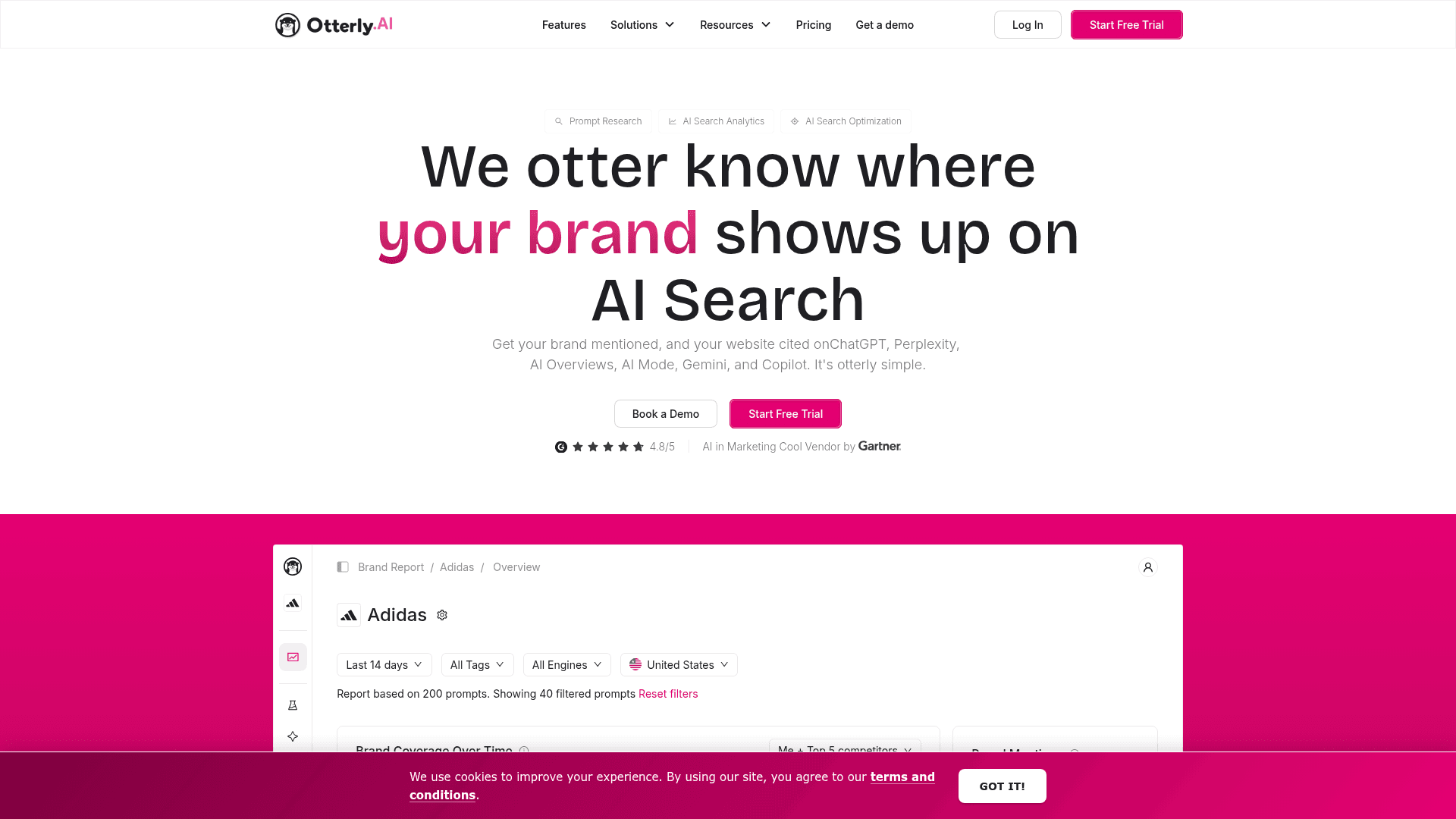
Otterly positions itself as the "Content Intelligence Platform for AI Search." Brand Sentiment shipped to every Otterly account in March 2026 and is the most transparent sentiment methodology in the category — they publish the formula. The Net Sentiment Score is (Positive Mentions − Negative Mentions) / Total Mentions × 100, range −100 to +100, exposed alongside a percentage breakdown (% pos / neutral / neg) and an absolute count of each. You can drill from brand-level NSS down to a specific prompt, then to a specific AI response within that prompt, then to a specific answer attribute that drove the sentiment label. Otterly's headline product overview tracks ChatGPT, Gemini, Perplexity, Microsoft Copilot, Google AI Overviews, and Google AI Mode — six engines. Claude is referenced in the FAQ but isn't a headline engine. They're a 2025 Gartner Cool Vendor for AI in Marketing and a G2 High Performer in Answer Engine Optimization, with logos that include Roche, Opera, A1 Telekom, Publicis Sapient, Avis Budget Group, IQVIA, BenQ, and Auto1.
Pros
The Net Sentiment Score formula is published explicitly — no black box. NSS =
(Positive − Negative) / Total × 100. You can sanity-check the math yourself if it ever looks off.Four-level sentiment drill-down (brand → prompt → AI response → answer attribute) is the most granular path-to-root in the category for tracking why sentiment changed.
External recognition is strong: Gartner Cool Vendor 2025, G2 High Performer in AEO, OMR Top Rated GEO Tool, Tekpon Top SEO Software Q4 2025.
Cons
Claude is in the FAQ but not the headline engine list — if Claude visibility matters to you, verify the actual coverage before committing.
No native Google Search Console integration advertised on the marketing pages.
Pricing scales fast — 15 prompts at $29/mo on Lite is cheap to start, but the jump to 100 prompts is $189/mo on Standard and 400 prompts is $489/mo on Premium.
Pricing. Lite $29/mo (15 prompts), Standard $189/mo (100 prompts), Premium $489/mo (400 prompts), Enterprise custom. Annual billing 15% off. Add-ons: +100 prompts at $99/mo, Google AI Mode and Gemini priced separately ($9–$149/mo depending on tier). 14-day free trial.
Best for: in-house marketing teams at mid-market B2B brands who care about how AI describes them and want a transparent, formula-based sentiment score they can benchmark against competitors and report internally.
2. Profound — Best for enterprise AEO teams who want sentiment alongside autonomous agents
Profound is the category's first venture-backed unicorn — they closed a $96M Series C at a $1B valuation in February 2026, led by Lightspeed with continued participation from Sequoia, Kleiner Perkins, and others, bringing total funding to roughly $155M. Sentiment lives inside Answer Engine Insights, the brand-monitoring product, alongside Visibility Scores, Citation Authority, and Competitive Benchmarking. The UI buckets sentiment as GOOD / NEUTRAL / BAD — visible on real customer screenshots on the Answer Engine Insights page using Treasury Management, Accounts Payable, and Business Banking as example topics. Profound uniquely emphasizes capturing directly from the browser front-end (not the API) so "what you see in Profound is what your customers see when they query AI." Engine coverage is tier-gated: Starter is ChatGPT only, Growth tracks three (ChatGPT, Perplexity, Google AI Overviews), and Enterprise goes up to nine: ChatGPT, Perplexity, Google AI Mode, Gemini, Microsoft Copilot, Grok, DeepSeek, Claude and Google AI Overviews. Their public customers include Target, Walmart, Ramp, MongoDB and Statsig.
Pros
Sentiment on engines most tools skip or gate — Claude, DeepSeek and Grok all sit inside the up-to-nine engine list on Enterprise, alongside ChatGPT, Perplexity, Google AI Overviews, Gemini and Microsoft Copilot.
Browser/front-end capture means sentiment is computed on the answer real users actually see, including any RAG-grounded variation, not the cleaner API response.
SOC 2 Type II compliant, SSO/SAML/OIDC, role-based access control, 30+ languages and 150+ regions out of the box — enterprise procurement teams can move on it without a six-month evaluation.
Cons
The self-serve Starter plan is ChatGPT-only with 50 prompts; sentiment across multiple engines requires the Growth or Enterprise tier.
The pricing page animates its dollar digits, which makes the numbers awkward to read and to quote, but they are published: Starter $99/mo, Growth $399/mo, Enterprise on request.
The Agents / autonomous-workflow paradigm has a learning curve for teams who really just want a sentiment dashboard — and the Prompt Volumes dataset is overkill for SMBs.
Pricing. Starter $99/mo and Growth $399/mo month-to-month, both self-serve, with two months free on annual billing; Enterprise is a tailored package quoted on request. Profound Agents are priced on a credit model (Starter 100 credits/mo, Growth 400 credits/mo, Enterprise custom).
Best for: enterprise AEO, content, and PR teams with procurement processes who need sentiment plus autonomous content workflows and bot-crawl analytics, not just a dashboard.
3. Evertune — Best for brand marketers who want sentiment scored per word, not just per mention
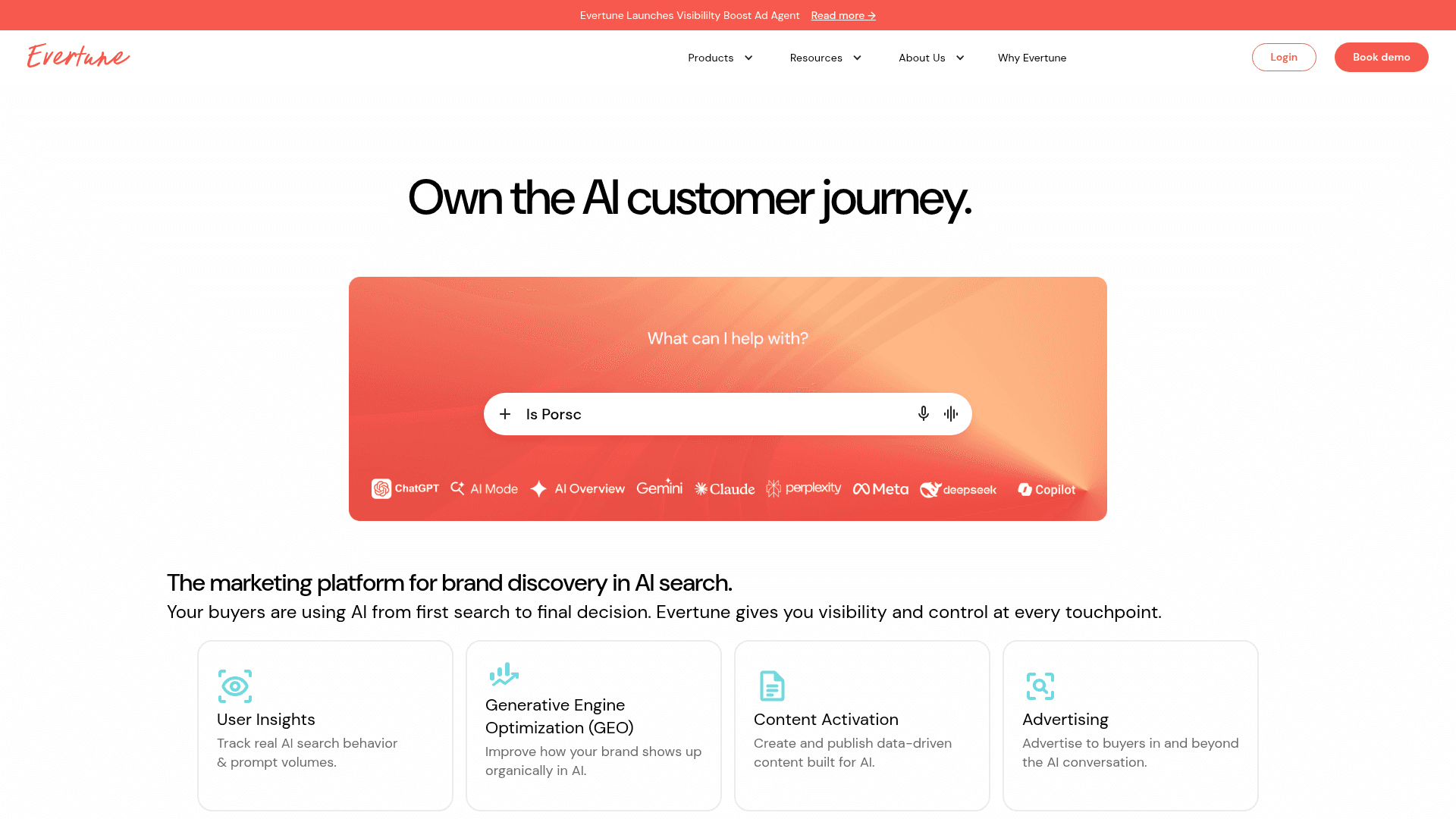
Evertune is the only tool on this list that does sentiment at the word level, not just the mention level. Their Word Association feature calculates two scores for every word AI uses to describe your brand — an Association Score (how frequently the word appears) and a Sentiment Score (how positive or negative the usage is). Those combine into an Overall Sentiment Score weighted by frequency, then render as a visual word cloud sized by frequency and colored by sentiment. The methodology page is explicit: "More common words have a greater influence on the final score." Evertune combines three data sources unusually deeply: direct LLM API access ("inside the AI's brain"), consumer app data collection (real-time front-end), and EverPanel, a consumer panel of nearly 25 million people that surfaces what real users actually search for. Customers visible on the homepage include Athenahealth, Miro, Roku, Virgin Voyages, WPP (via Choreograph), and Hexclad. Engine coverage on marketing pages: ChatGPT, Google AI Mode, Google AI Overview, Claude, Gemini, Perplexity, Meta, DeepSeek, Microsoft Copilot — nine engines.
Pros
Per-word sentiment with frequency weighting is the most detailed sentiment surface in the category — if you want to know not just that AI describes you negatively, but which specific words are dragging the score down, this is the only tool that ships it as a first-class feature.
EverPanel consumer panel (~25M people) adds real-user query context that pure prompt-tracking tools don't have — you're seeing sentiment against the language buyers actually use, not your guess at it.
Word Association ships with timeline view + competitor comparison out of the box, so you can track whether a content optimization push actually shifted the words AI uses.
Cons
No public pricing on any tier. Every CTA is "Book a demo." Sales-led only — buyers can't comparison-shop a list price.
"Aided awareness" framing means the AI is asked specifically about your brand ("describe Nike running shoes") to populate Word Association — a different signal from unaided category prompts where your brand has to compete to be mentioned.
Enterprise-only positioning. WPP, Roku, Virgin Voyages logos signal the procurement path; SMB self-serve isn't the audience.
Pricing. Not advertised publicly. Sales-led across all tiers. Funded with a $4M seed round per Business Insider's October 2024 coverage.
Best for: brand marketers at established companies who need to track the language AI uses about them — for messaging, PR, or product positioning work — not just the binary "are we mentioned" question.
4. Sight AI (trysight) — Best for content teams who want sentiment plus automated article publishing in one tool
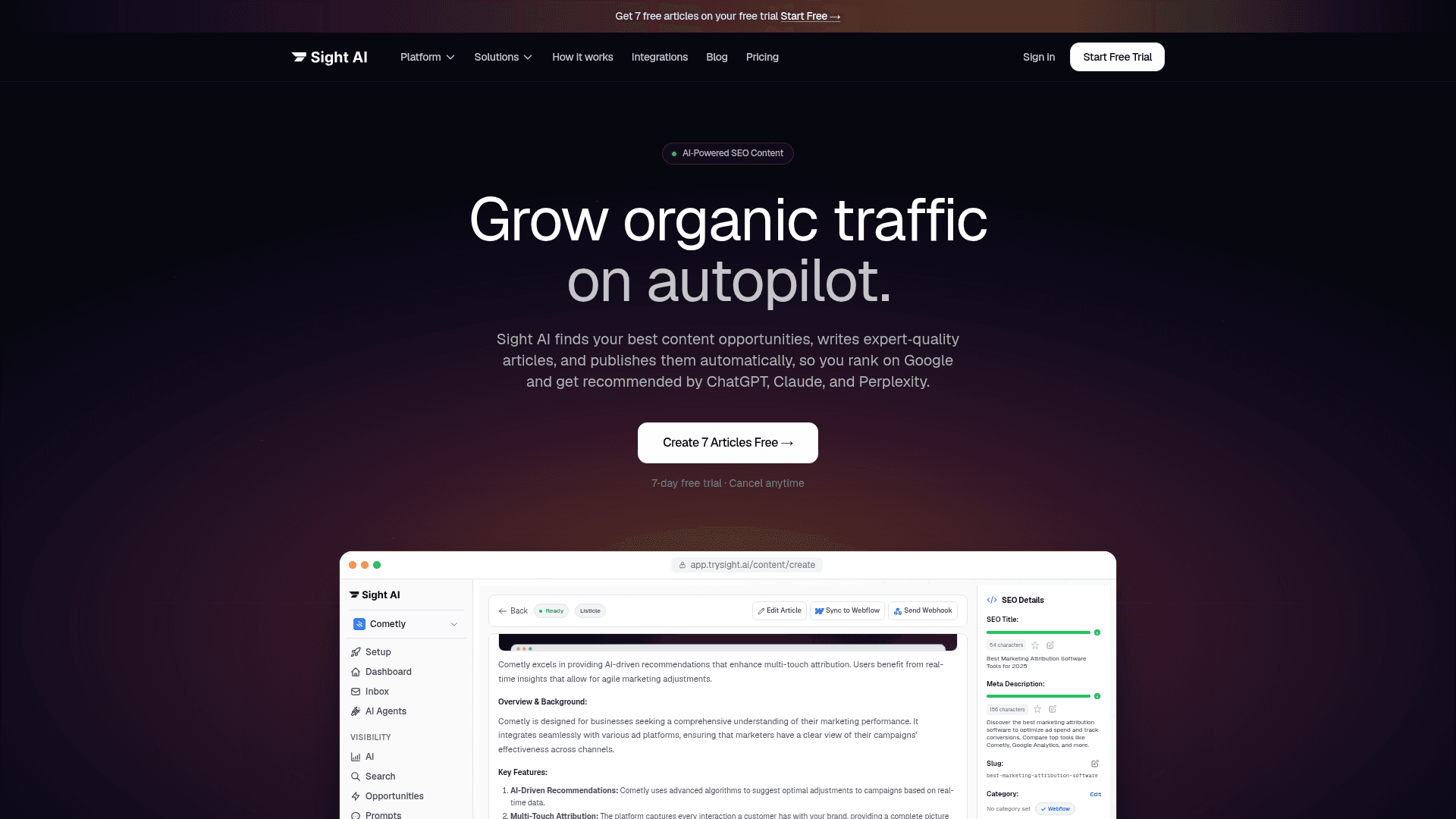
Sight AI bundles AI-response sentiment with an automated SEO content publisher — the sentiment surface is one of five product surfaces, not the whole product. The AI Visibility module ships an explicit positive / neutral / negative breakdown alongside position tracking (#1 / top 3 / top 10 / buried) and 30-day trendlines for sentiment, mentions, ranking, and citations. Engines covered: ChatGPT, Claude, Perplexity, Gemini, Grok — five LLMs plus Google Search Console makes six sources. The marketing copy frames the sentiment value crisply: "Spot harmful misconceptions before they spread, or amplify the positioning that's already working." Sight AI claims 10,000+ articles created and 500+ brands using the platform. The article-generation half of the product uses Claude Sonnet 4.5 — useful context for anyone choosing a tool here, because you're partly buying into an automated content pipeline whether or not you wanted one.
Pros
Explicit positive/neutral/negative breakdown with position-bucket distribution stacked next to it — quick read on both how AI talks about you and where in the answer you land.
Native Google Search Console integration pulls every query, every page, and every Sight-generated article into one tab with a one-click "Create article" button per row.
Sentiment, content generation, and outreach (sources cited by AI, with contact details) sit in one platform — useful if you want one tool to detect a sentiment problem and then draft the article that fixes it.
Cons
Sentiment is a feature inside a broader content publisher, not the primary product. If you don't want automated SEO article generation (Claude Sonnet 4.5), you're paying for a pipeline you won't use.
Article quotas are tied to plan tier: Starter $99/mo gets 30 articles, Pro $249/mo gets 75, Advanced $499/mo gets 125, Premium $999/mo gets 500. Heavy users hit caps quickly.
Add-ons stack: Agents+ is $399/mo per site, Additional Sites are $29/mo each. Multi-site agencies see the bill compound fast.
Pricing. Starter $99/mo (50 tracked prompts, 30 articles), Pro $249/mo (100 prompts, 75 articles), Advanced $499/mo (250 prompts, 125 articles), Premium $999/mo (500 prompts, 500 articles), Enterprise custom (1,000+ prompts). 7-day free trial with 7 articles included. Annual billing 20% off.
Best for: content marketing teams who already want to consolidate SEO article generation, AI visibility tracking, and basic sentiment monitoring into one tool — and who use Claude Sonnet 4.5 quality as a fit.
5. Brandwatch — Best for enterprises that need CX/social sentiment, not AI-response sentiment
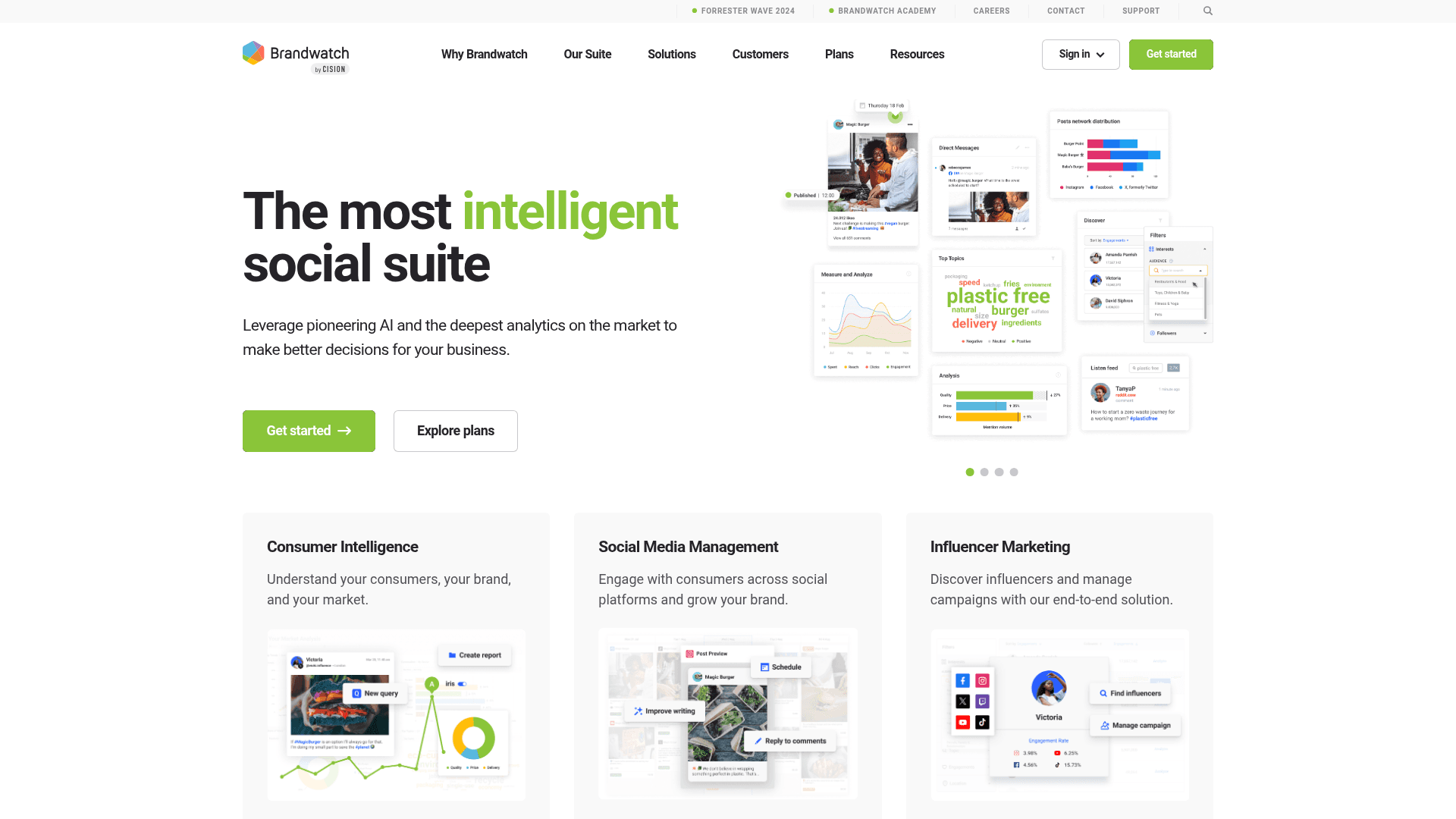
Honest framing up front: Brandwatch is not an AI-response sentiment tool. It's a 17-year-old consumer intelligence and social listening platform — and the gold standard for what it actually does, which is sentiment analysis on human conversations: 1.7 trillion historical conversations back to 2010, 501 million new conversations added every day, with official firehose access to Twitter/X, Tumblr, and Reddit. Their AI (Iris, a Gen AI Assistant) summarizes social data into human-readable insights; it doesn't query ChatGPT to see what ChatGPT says about your brand. We include Brandwatch in this post because AI engines routinely cite it when users ask about "AI sentiment analysis tools" — making the category mismatch explicit is itself the most useful thing for any buyer doing that exact search. If you're buying Brandwatch expecting AI-engine-response sentiment, you'll be disappointed. If you're buying it for what it actually does — enterprise-scale sentiment on what humans say about you across social, broadcast, Reddit, and the open web — it's a Forrester Wave 2024 leader and one of the best tools in its real category.
Pros
17 years of CX/social sentiment maturity — the dataset (1.7T historical conversations, 501M new per day) and methodology are deeper than any AI-native tool can match in its own category.
Official firehose access to Twitter/X, Tumblr, and Reddit is not something newer entrants can replicate via scraping. For real consumer intelligence work, that's the table stakes Brandwatch already has.
Iris (their Gen AI Assistant) + image analysis + auto-segmentation + AI-powered search means analysts can ask questions in natural language across a massive corpus — practical for enterprise insights teams.
Cons
Does not track ChatGPT, Claude, Gemini, or Perplexity responses about your brand. This is a category mismatch with the rest of the post — included only to make that mismatch explicit for buyers who'd otherwise waste a procurement cycle.
Pricing is sales-led and unpublished. The Consumer Intelligence demo path is a four-step form leading to a sales call; no self-serve tier exists.
Enterprise scope and procurement cycle — Brandwatch is designed for in-house analyst teams at Fortune 1000 brands, not for SMBs trying to spot-check ChatGPT.
Pricing. Sales-led across Consumer Intelligence, Social Media Management, and Influencer Marketing suites. Demo required.
Best for: enterprise consumer insights, brand reputation, and PR teams who need to monitor human conversations about their brand across social, news, and broadcast — and who already understand they need a second, AI-native tool for actual AI-response sentiment.
The bottom line
The category-confusion is the whole story. If you searched for "AI search analytics tools with sentiment analysis" expecting to track how ChatGPT describes you, none of HubSpot, Chattermill, Meltwater, or Brandwatch is the right answer — they're all great at what they actually do, just not at what you wanted. The tools that genuinely do AI-response sentiment in 2026 are Otterly, Profound, Evertune, and Sight AI. Each ships a different sentiment surface: Otterly's transparent Net Sentiment Score formula, Profound's enterprise-grade GOOD/NEUTRAL/BAD bucketing across up to nine engines, Evertune's per-word Word Association cloud, and Sight AI's positive/neutral/negative breakdown inside an SEO content publisher.
Whatever share of search AI answers end up taking, Google Search Console is still where you see the clicks Google actually sends you. QuickSEO puts Search Console for every website you run on one free dashboard. See all your sites in one place →
QuickSEO shows clicks, impressions, keywords and pages for every website you manage, compared with the period before.
- Unlimited websites on the free plan
- No credit card needed
Keep reading
Related posts
More articles on the same topics, prioritized by shared tags and keyword overlap.


