Top 6 AI Search Analytics Platforms for SEO Agencies Managing Multiple Sites (2026)

 Summarize in ChatGPT
Your clients used to ask one question: "Where do we rank on Google?" Now they ask two. The second one — "Are we showing up when someone asks ChatGPT or Perplexity about our category?" — is the one most agencies can't answer yet. And answering it across a portfolio of 10, 30, or 100 client sites is a fundamentally different job than tracking a single brand. You need bulk runs, per-client dashboards, white-label reports, and pricing that doesn't punish you for adding an analyst or a client.
To build this list, we scraped each tool's homepage and pricing pages in May 2026 and pulled the agency-relevant facts straight from their own marketing — multi-site limits, white-label reporting, per-seat policy, and which AI engines each one actually tracks. Every claim below traces back to what the vendor publishes.
What SEO agencies actually need from an AI search analytics tool
A tool that's great for a single in-house brand can be miserable to run an agency on. The features that matter for a portfolio are different from the features that demo well for one brand:
A multi-site portfolio view. You manage many client sites. You need to see them all without logging into a separate account for each one, and you need to spot a problem (a citation drop, a ranking slide) across the whole portfolio at a glance.
White-label client reporting. The report your client opens should carry your logo and colors, not the vendor's. This is the difference between looking like a strategic partner and looking like a reseller.
Per-client dashboards and role-based access. Each analyst — and ideally each client — should see only their own scope. Role-based access control (RBAC) is what keeps Client A from seeing Client B's data.
No per-seat tax. If every analyst you add costs another $45–$99/month, the tool quietly eats your retainer margin. The agency-friendly tools moved to unlimited seats for exactly this reason.
Exports and integrations. CSV, Looker Studio, Google Analytics, and Search Console connectors are non-negotiable for plugging AI-visibility data into the client reports you already send.
If you want the broader business context behind these requirements — margins, churn, and where the money is — our breakdown of the state of the SEO agency industry in 2026 lays out the numbers agencies are operating against this year.
The other number worth keeping in your head is cost-per-managed-site. Most round-ups dodge it, but it's the math you actually run: a $399/month plan that covers 100 client sites is $4 per site; a $99/month plan that covers one brand is $99 per site. We've flagged that economics for each tool below.
Quick comparison: 6 AI search analytics platforms for agencies at a glance
Tool | Best for | Pricing | Key differentiator |
|---|---|---|---|
Nightwatch | Agencies running many small client sites who need white-label | Public, €79–€399/mo + Enterprise | White-label reports and unlimited seats on every paid plan |
Profound | Brands and agencies that want the deepest AEO data set | Self-serve obfuscated; agencies → Enterprise | Prompt Volumes + Answer Engine Insights across up to 9 engines |
ZipTie | Consultants focused on Google AI Overviews | Public, $69–$159/mo | Detailed AI Overviews + ChatGPT + Perplexity coverage |
BrightEdge | Enterprise teams unifying SEO and AEO | Enterprise, demo-only | Data Cube research engine + AI Hyper Cube market intelligence |
Conductor | Global enterprises running AEO at scale | Enterprise, usage-based, demo-only | Unified AEO + SEO + site monitoring + agent stack |
ScriptBee | B2B revenue teams who want AI visibility inside an outbound motion | From $699/mo, sales-led | AI-visibility tracking bundled with visitor de-anonymization and outreach |
1. Nightwatch — rank tracking and AI visibility with white-label on every plan
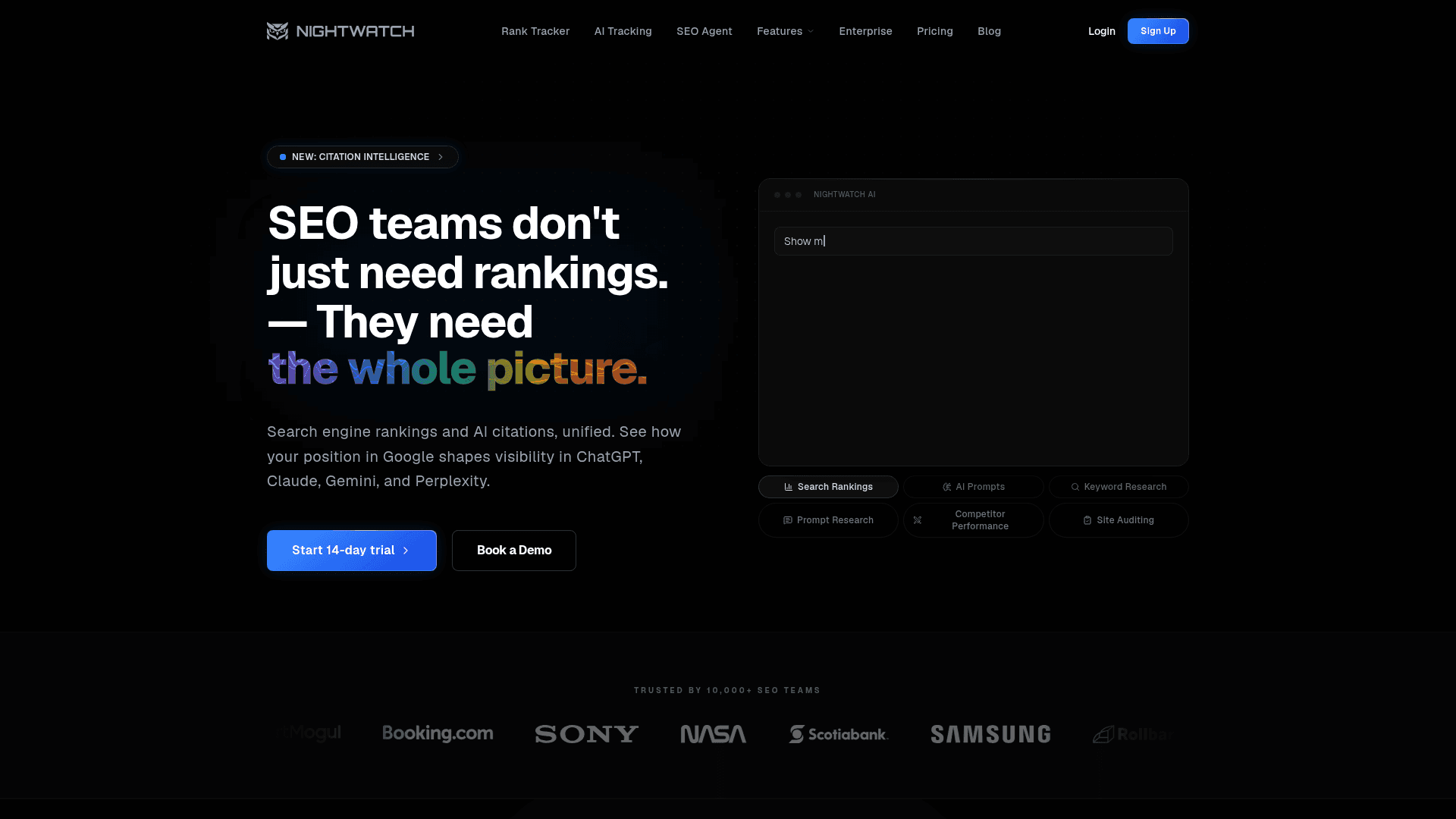
Nightwatch is the most agency-native tool on this list, and it gets there by leaning on 13 years of rank-tracking infrastructure. It unifies rankings across Google, Bing, YouTube, DuckDuckGo, and Yahoo (107,000+ locations) with AI visibility across ChatGPT, Claude, Gemini, and Perplexity. Its standout feature, Citation Intelligence, connects a brand's Google SERP rankings to its AI citations — the thesis being that AI engines cite what already ranks, so a ranking drop predicts a citation drop. For agencies, the headline is the commercial model: white-label reporting and unlimited user seats are included on every paid plan, and there's a 20% recurring partner commission.
Pros:
White-label reports (your logo, colors, scheduled delivery, shareable live links) are included on every plan, not sold as an add-on.
Unlimited user seats on every plan — add your whole team and your clients without per-seat fees eroding margin.
Website allowances scale aggressively for portfolios: 5 → 25 → 100 → unlimited across the tiers.
Cons:
Tracking is quota-based (keywords, AI prompts), and the AI-prompt allowances are modest at the lower tiers (50 on Starter, 150 on Professional).
It originated as a rank tracker, so AI visibility — while genuinely integrated — is the newer half of the product.
The interface carries a lot of SEO surface area, which can be more than a pure AI-visibility engagement needs.
Pricing snapshot: Public pricing from €79/month (Starter) through €159 (Professional) and €399 (Agency, 100 websites), plus a custom Enterprise tier. White-label and unlimited seats unlock at the Professional tier.
Best for: Agencies running many client sites who want Google rankings and AI visibility unified, with white-label reporting and no per-seat math.
2. Profound — the deepest AEO data set, built for brands and enterprise agencies
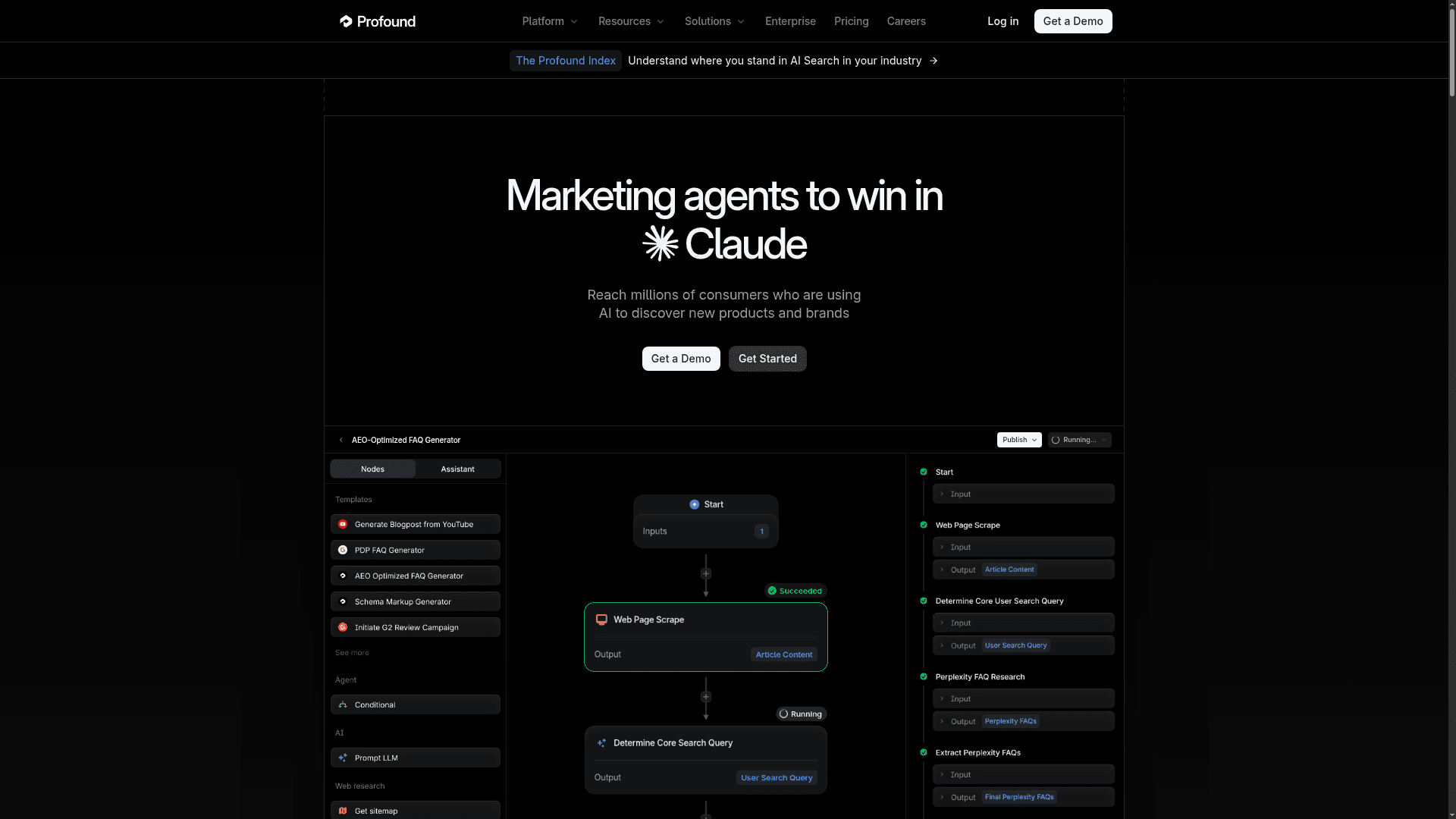
Profound is the heavyweight of pure answer-engine optimization. It tracks how brands appear across a long list of engines — ChatGPT, Perplexity, Claude, Gemini, Copilot, Google AI Mode, Grok, DeepSeek, and Google AI Overviews — and pairs that with Prompt Volumes (what millions of people actually ask AI), Answer Engine Insights, Agent Analytics (how AI bots crawl your site), and autonomous content Agents. It's a depth play. The catch for agencies is structural: the self-serve Starter plan tracks ChatGPT only with a single seat, the Growth plan covers three engines and three seats, and tracking multiple companies plus API access only arrive on the custom Enterprise plan. Profound's own FAQ describes an agency model priced "per client workspace," so multi-client work is routed through Enterprise sales rather than a self-serve agency tier.
Pros:
Arguably the deepest AEO data on the market, including Prompt Volumes and bot-level Agent Analytics that most competitors don't offer.
Tracks up to 9 answer engines on Enterprise — the widest engine coverage in this comparison.
A "per client workspace" structure on agency plans is purpose-built for running separate client environments.
Cons:
The self-serve Starter plan is ChatGPT-only with one seat, so meaningful multi-engine, multi-client work means an Enterprise contract.
Dollar pricing is obfuscated on the pricing page and agencies are funneled to a demo — no transparent self-serve agency tier.
White-label client reporting isn't advertised on its marketing pages; exports are CSV/JSON on Growth and above.
Pricing snapshot: Self-serve Starter and Growth tiers (with on-page dollar amounts obscured) plus a custom Enterprise plan; agencies and multi-company tracking land on Enterprise.
Best for: Brands and larger agencies that want the most comprehensive AEO data set and can operate inside an enterprise contract.
3. ZipTie — focused AI Overviews, ChatGPT, and Perplexity tracking
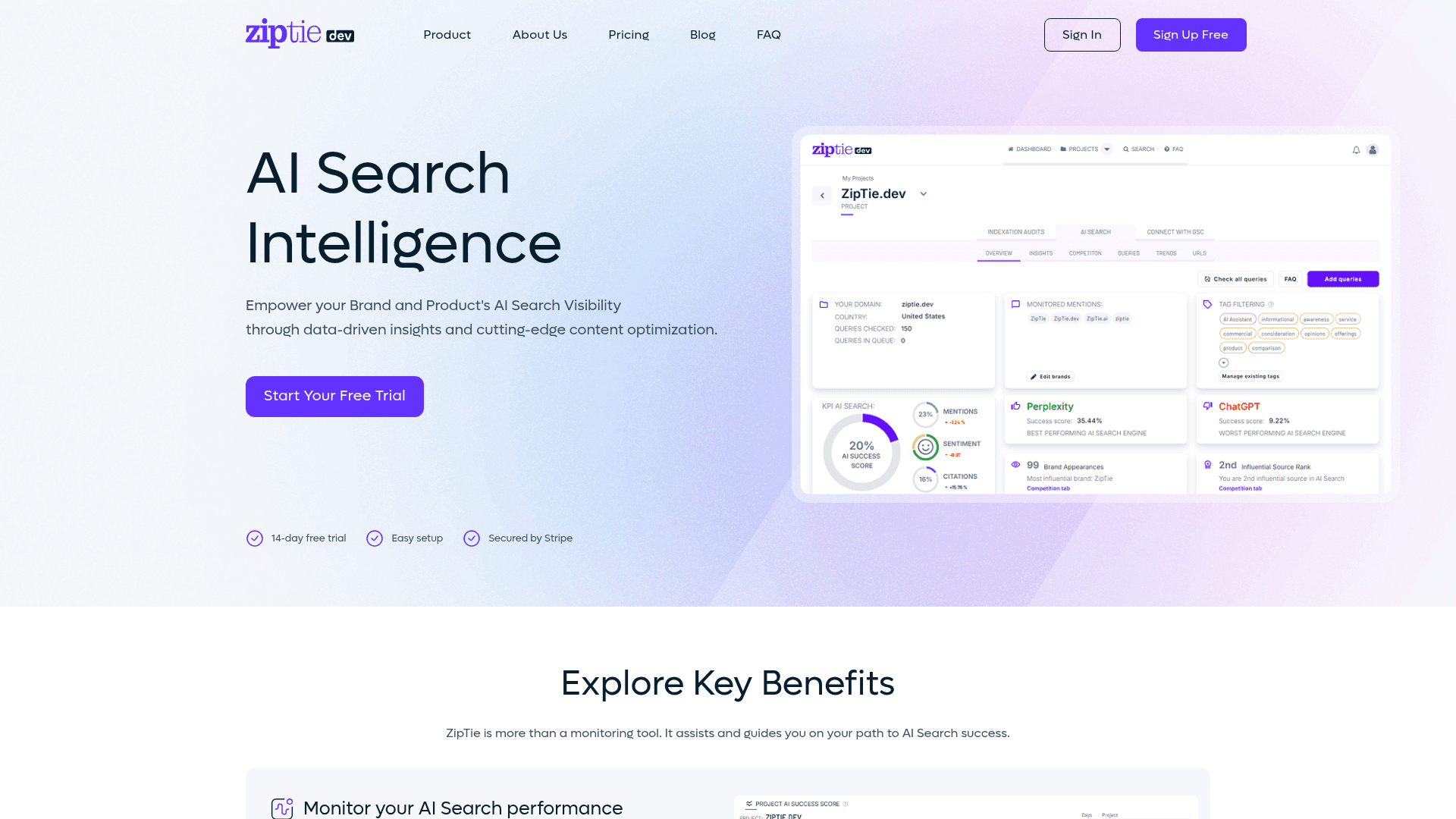
ZipTie has carved out a clear niche: deep, accurate tracking of Google AI Overviews, ChatGPT, and Perplexity. It monitors brand mentions, sentiment, citation tracking, competitive benchmarking, and AI Overview coverage, then assigns each tracked query an "AI success score" that weights visibility against commercial value so you know what to optimize first. It mimics real user behavior rather than relying on APIs, and it's earned endorsements from well-known SEO practitioners — Lily Ray, Aleyda Solis, and Kevin Indig — several of whom explicitly mention using it to monitor client sites in AI Overviews. Data is organized by "Project," with category-level and query-level drill-downs.
Pros:
Among the most detailed coverage of Google AI Overviews specifically, plus ChatGPT and Perplexity, with sentiment and source attribution.
Transparent, accessible public pricing and a content-optimization module that turns tracking into action.
Credible practitioner endorsements from consultants who run client work, plus optional GEO consulting.
Cons:
Engine coverage is narrower — its marketing pages advertise ChatGPT, Perplexity, and Google AI Overviews, but not Claude or Gemini chatbot tracking.
It's organized around "Projects" rather than a true multi-client console; no white-label reporting, RBAC, or per-client workspaces are advertised.
Plans are metered by AI Search checks, which can constrain a large portfolio without a custom plan.
Pricing snapshot: Public plans at $69 (Basic), $99 (Standard), and $159 (Pro) per month, differentiated by monthly AI Search checks; custom plans on request.
Best for: SEO consultants and small agencies whose clients care most about Google AI Overviews and who want transparent, affordable pricing.
4. BrightEdge — the enterprise SEO and AEO suite
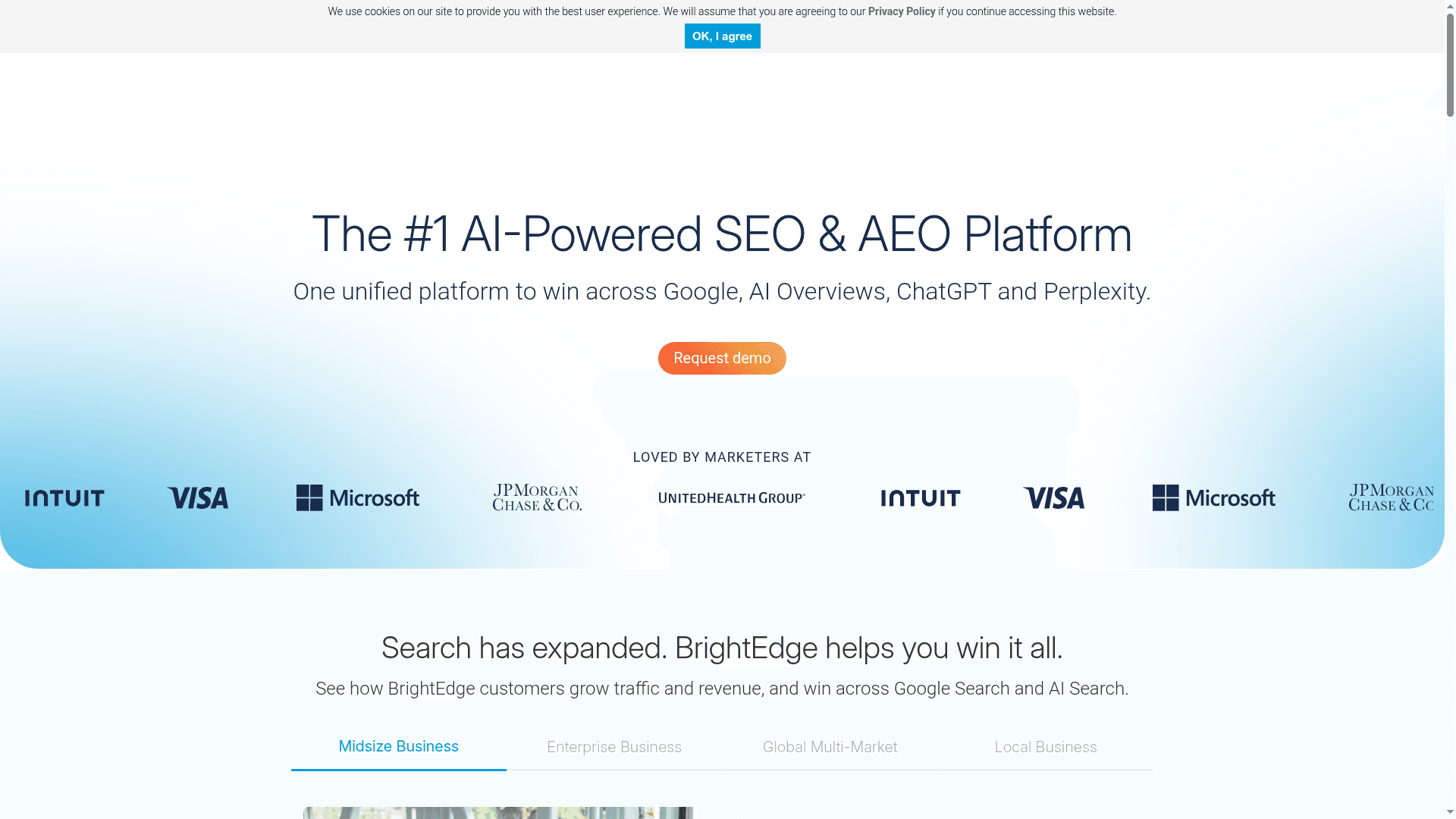
BrightEdge is one of the original enterprise SEO platforms, now repositioned around AI search. Its Data Cube research engine claims over 4 billion data points and a decade of history, and its newer AI Hyper Cube surfaces "AI search demand" — which brands get mentioned or cited across ChatGPT and Google AI Overviews, and the sentiment around those responses. Layer on Copilot (AI recommendations), Autopilot (automated on-site optimizations), StoryBuilder reporting, and even Amazon rankings, and you have a full-spectrum platform. It's also firmly enterprise: demo-only, no public pricing, and built for large single brands rather than a long tail of small client sites. If you're weighing enterprise SEO platforms more broadly, our list of Semrush alternatives for AI search tracking covers where these heavyweight suites fit.
Pros:
Deep, mature data and research tooling (Data Cube) that few newer AI-visibility tools can match.
AI Hyper Cube adds genuine AI-search market intelligence — mentions, citations, and sentiment across ChatGPT and Google AI Overviews.
A dedicated agency program and unified SEO + AEO workflows with enterprise governance.
Cons:
No public pricing and a demo-led sales motion; effectively inaccessible for small agencies on a self-serve budget.
Its AI-visibility engine naming centers on ChatGPT and Google AI Overviews rather than the full ChatGPT/Claude/Gemini/Perplexity set on its marketing pages.
Built for large single brands, not for managing a portfolio of small client sites with per-client white-label reporting.
Pricing snapshot: Enterprise pricing only, available through a demo and sales process; no self-serve or published per-site rates.
Best for: Large agencies and in-house enterprise teams that need a mature, all-in-one SEO + AEO platform and have the budget for it.
5. Conductor — enterprise AEO at scale with usage-based pricing
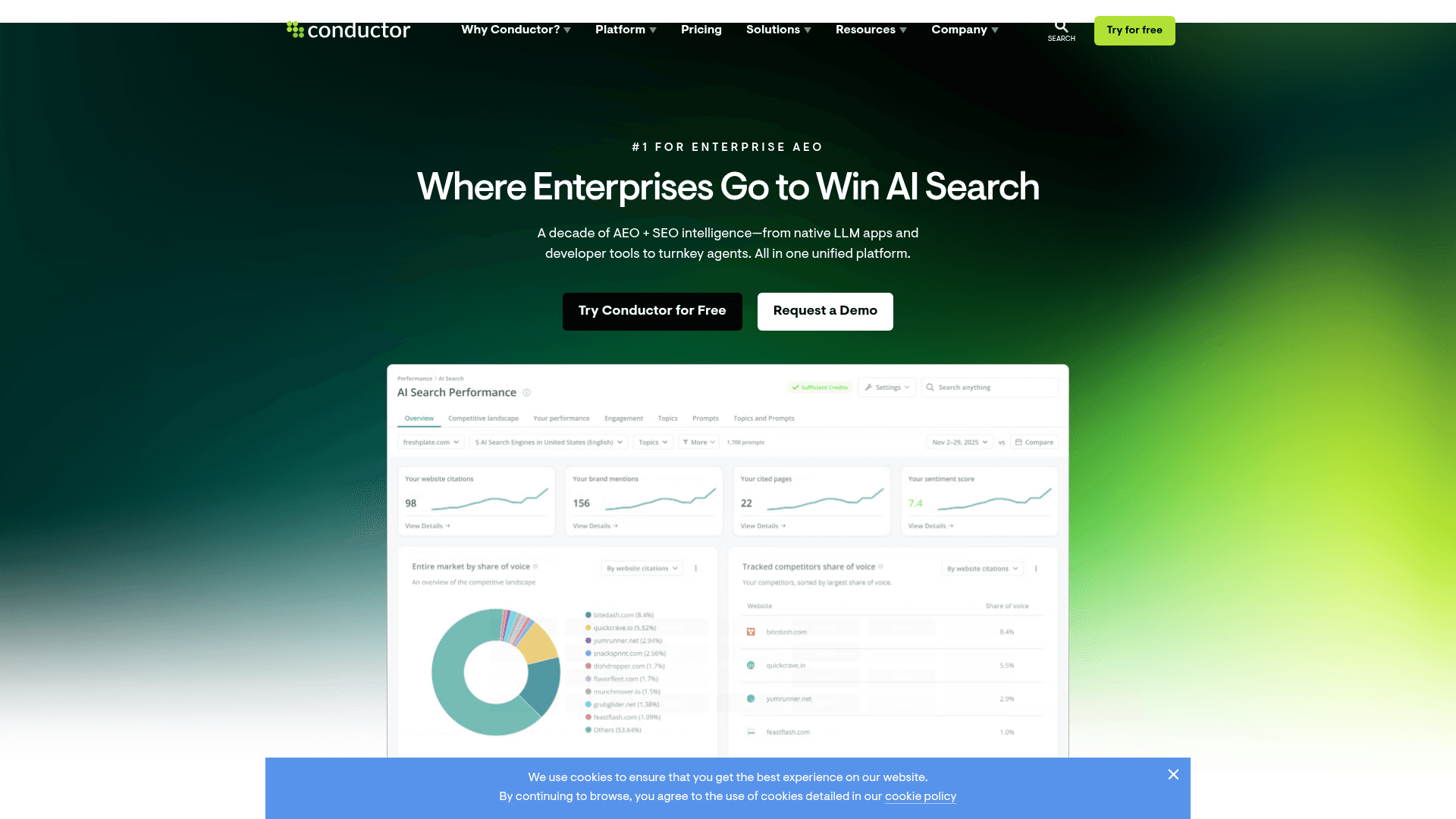
Conductor markets itself as "#1 for Enterprise AEO" and backs it with a decade of search data and a roster of brands like Verizon, Adidas, and Microsoft. The platform splits into Conductor Intelligence (AI and search visibility across ChatGPT, Gemini, Copilot, Claude, and traditional search), Conductor Creator (AI content), Conductor Monitoring (24/7 site health, including how AI bots crawl your site), and AgentStack (LLM apps, a Data API, and an MCP server). Pricing is usage-based and demo-led, and critically for agencies, tracked websites are capped — 3 on Essentials, 5 on Growth, 10+ on Enterprise — while role-based access control is an Enterprise-only feature.
Pros:
Broad AI-engine coverage (ChatGPT, Gemini, Copilot, Claude) tied directly to traffic, conversions, and revenue.
Strong technical layer: 24/7 site monitoring with AI-crawler log analysis, plus an MCP server and Data API for agencies building their own workflows.
Usage-based pricing aligns cost to value rather than seat count.
Cons:
Website caps (3 / 5 / 10+) make it a poor fit for agencies with many small client sites on anything but a costly Enterprise contract.
Role-based access control — essential for separating client data — is gated to the Enterprise tier.
No public pricing; it's a demo-and-contract motion aimed at enterprises.
Pricing snapshot: Usage-based Essentials, Growth, and Enterprise tiers with no published dollar amounts; pricing and website limits are set through sales.
Best for: Global enterprises (or the agencies serving them) running AEO at scale, where deep monitoring and governance matter more than per-site cost.
6. ScriptBee — AI visibility inside a B2B revenue platform
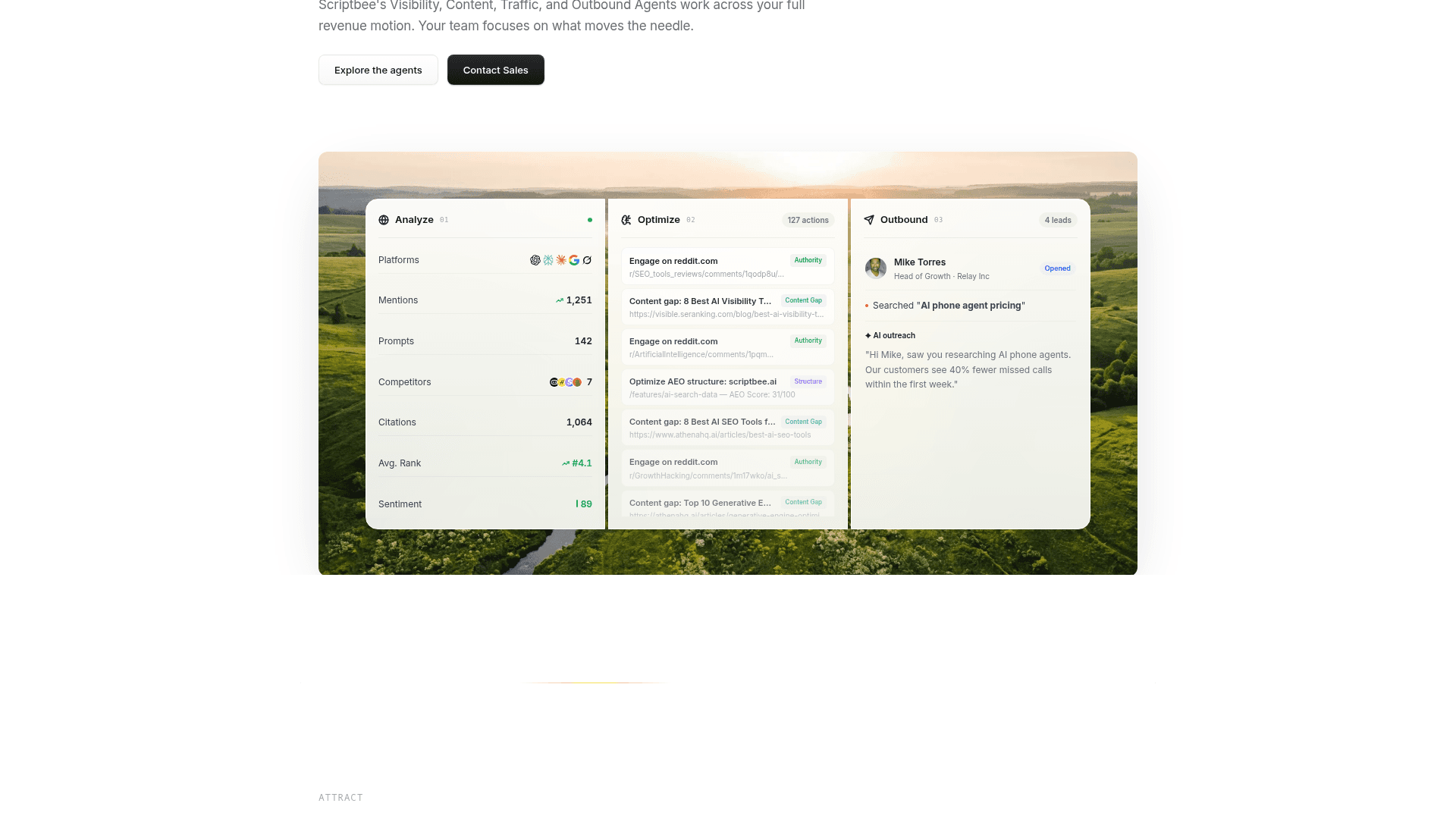
ScriptBee is the outlier here, and it's worth understanding why it shows up in AI-search conversations. It's not a pure AI-visibility tracker — it's a full B2B revenue and ABM platform whose "Visibility Agent" is one module among several. That agent tracks where a brand appears across ChatGPT, Perplexity, Claude, Google AI Mode, and Grok, with a Platform Visibility Matrix, Share of Voice, citation share, and AI-discovered competitors. But it sits alongside website-visitor de-anonymization, contact enrichment, and automated outbound. The whole thing is aimed at a single company's revenue motion — driving high-intent traffic and turning it into pipeline — rather than at an agency reporting AI visibility to many clients.
Pros:
Tracks AI visibility across five engines and ties it directly to lead generation and outbound — useful if your client engagement includes demand gen.
A genuinely broad platform: visitor identification, enrichment, intent scoring, and multi-channel sequencing in one place.
Integrations with CRMs, GA, Search Console, and Looker Studio for plugging into a revenue stack.
Cons:
It's built for a single company's ICP and revenue motion, not for agencies running AI-visibility reporting across many client brands.
No white-label client reporting, per-client workspaces, or agency partner program is advertised on its marketing pages.
Entry pricing starts at $699/month on annual billing and is sales-led, with no transparent self-serve tiers.
Pricing snapshot: Plans start from $699/month on annual billing, sold through a sales conversation; no public self-serve tiers or per-site pricing.
Best for: B2B teams (or agencies running full-funnel revenue engagements) who want AI visibility bundled with visitor identification and outbound automation.
How to choose the right AI search analytics platform for your agency
Match the tool to the shape of your book of business, not to the longest feature list:
Many small client sites that need white-label reports? Nightwatch is the natural fit — it's built for multiple sites and ships white-label and unlimited seats on every paid plan.
One large brand with budget? Profound, Conductor, and BrightEdge give you the deepest data and governance, at enterprise prices and with website caps that suit a single big domain rather than a portfolio.
Clients fixated on Google AI Overviews? ZipTie's specialized coverage and transparent pricing are hard to beat for a small, focused engagement.
Engagements that blur into demand gen? ScriptBee folds AI visibility into a full revenue and outbound platform.
Then run the cost-per-managed-site math. An enterprise suite that caps you at 5 websites can cost more per client site than a self-serve tool that covers 25 or 100 — and the white-label, RBAC, and per-seat policies decide whether the tool protects your margin or quietly erodes it.
Whatever share of search AI answers end up taking, Google Search Console is still where you see the clicks Google actually sends you. QuickSEO puts Search Console for every website you run on one free dashboard. See all your sites in one place →
QuickSEO shows clicks, impressions, keywords and pages for every website you manage, compared with the period before.
- Unlimited websites on the free plan
- No credit card needed
Keep reading
Related posts
More articles on the same topics, prioritized by shared tags and keyword overlap.