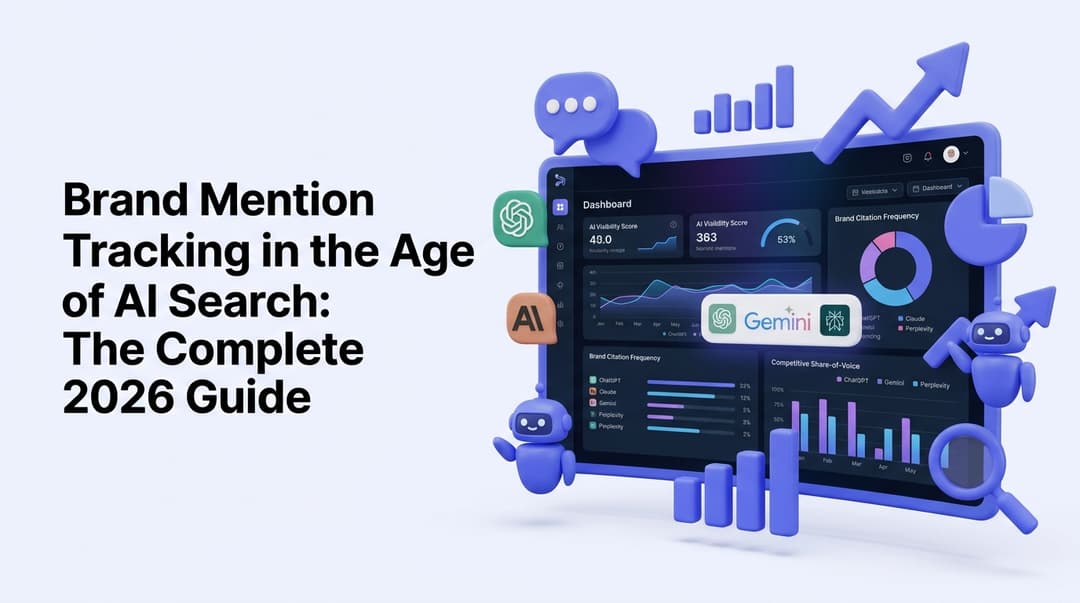
Brand Mention Alerts: The Complete 2026 Guide to Monitoring Your Brand Everywhere

 Summarize in ChatGPT
Your brand is being talked about right now — in Reddit threads, news articles, blog posts, and AI chatbot answers. The question is: do you know about it?
Brand mention alerts are the system that closes that gap. In 2026, they've evolved from simple Google Alerts into sophisticated, multi-channel monitoring pipelines that watch everything from social media to ChatGPT responses. And if you're not running them, you're flying blind at exactly the moment when brand visibility matters more than ever.
This guide covers everything you need to know: what brand mention alerts are, why they matter enormously for SEO and AI visibility, how to set them up correctly, and how to turn every alert into a tangible growth opportunity.
What Are Brand Mention Alerts?
A brand monitoring tool is a software solution that tracks and identifies your brand mentions across the internet, including social media platforms, forums, websites, review platforms, and more. Brand mention alerts are the real-time notifications that fire whenever your brand appears in any of these locations.
A brand mention is any reference to your brand name, product, or website — with or without a hyperlink. That means:
Linked mentions — where someone references your brand with a clickable URL
Unlinked mentions — where your brand name appears in text without a link
Social mentions — tags, hashtags, and name-drops across social platforms
AI citations — where ChatGPT, Gemini, Perplexity, or Claude reference your brand in an answer
Brand mentions can appear in articles, blogs, forums, social media, videos, podcasts, or other platforms. In 2026, both Google and AI platforms use these mentions as trust and authority signals to rank sites higher.
Why Brand Mention Alerts Matter More Than Ever in 2026
The AI Search Revolution Has Changed the Stakes
Brand mentions shape not only public perception, but also LLM visibility. The more your brand is consistently mentioned across credible sources, the more likely it is to appear in AI-generated answers, recommendations, and search results powered by tools like ChatGPT, Gemini, or Perplexity.
This is a seismic shift. For years, SEOs obsessed over backlinks. But the data now points in a different direction.
An extensive 2025 study of 75,000 corporate brands found that unlinked web mentions have a 0.664 correlation with visibility in AI Overviews. Traditional backlinks showed a much weaker 0.218 correlation in the same study. This tells us that next-generation search platforms are increasingly rewarding brands with strong organic conversational footprints rather than those with large static link profiles.
Put simply: being talked about matters more than being linked to — at least as far as AI search is concerned.
Unlinked Mentions Are an Underrated SEO Signal
Unlinked mentions — where a brand name appears in text without a hyperlink — help large language models associate a company with a topic, judge its authority, and decide whether to cite it. In 2026, these mentions often matter more than backlinks for AI visibility. AI search engines read meaning, not just link graphs.
AI models analyze the context and frequency of your brand name across the web, not just linked references. This means every editorial mention, forum discussion, and video transcript contributes to how AI systems understand and recommend your brand.
If you're not tracking unlinked mentions, you're missing a massive piece of your authority footprint.
Real-Time Reputation Management
For PR, comms, and marketing teams, media monitoring matters because it provides the visibility needed to manage brand reputation, measure campaign impact, and respond quickly to emerging issues. Without systematic monitoring, teams operate with blind spots — a negative article could gain traction before anyone on the team sees it, or a successful product mention could go unnoticed and unamplified.
Brand mention alerts turn your reactive PR team into a proactive one.
What to Track with Brand Mention Alerts
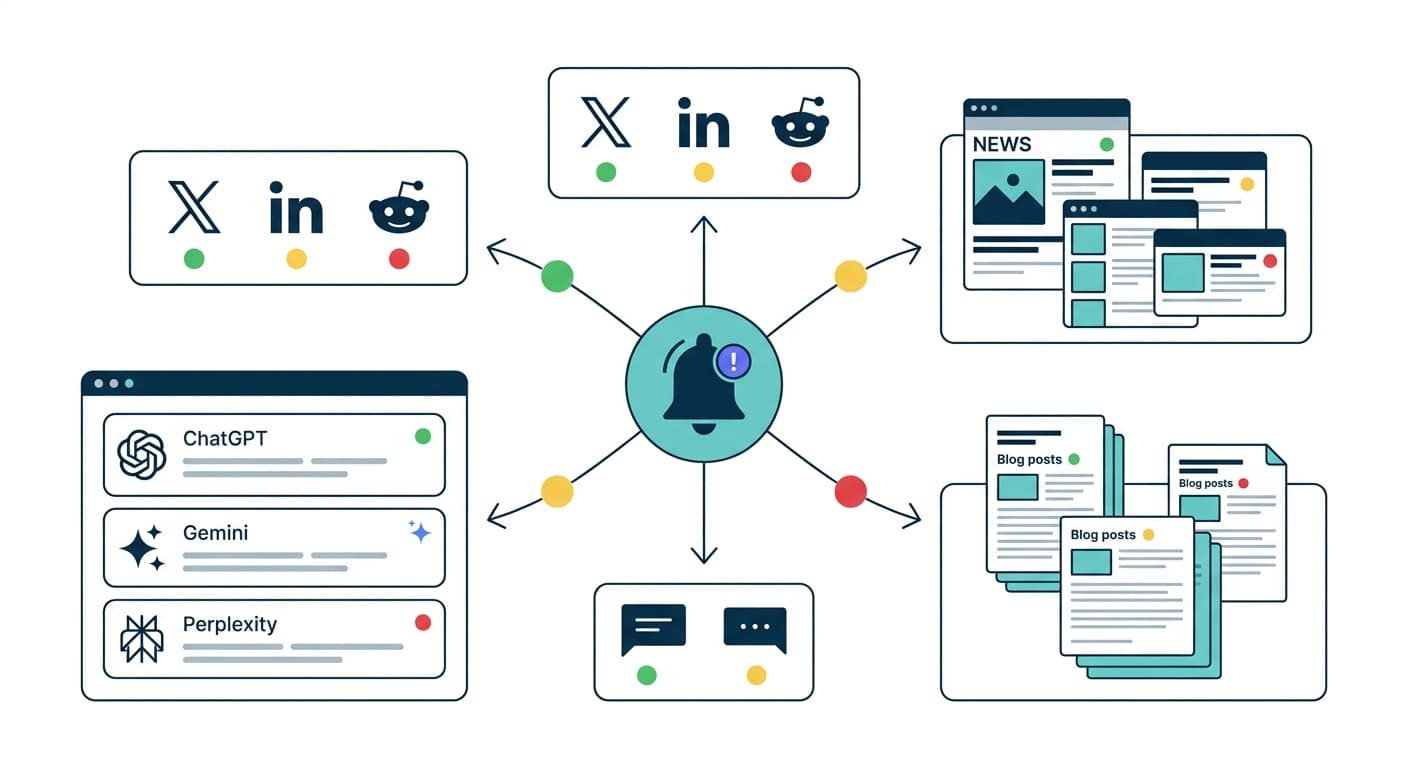
Setting up alerts is only useful if you're tracking the right things. Here's a complete list of what your monitoring setup should cover:
Your Brand Identity
Exact brand name (e.g., "YourBrand")
Common misspellings — people will misspell it, and those mentions still count
Product or service names
Founders' and executives' names
Branded slogans or taglines
Your Competitive Landscape
Competitor brand names — you can also use monitoring tools to track your competitors' brand mentions as well, giving you a real-time window into their PR wins and reputation risks
AI Chatbot Presence
This bit is newer but really matters now. Pick five to ten questions your customers might actually ask an AI, then go type those prompts into ChatGPT or Perplexity and see if your brand shows up.
How to Set Up Brand Mention Alerts: A Step-by-Step Approach
Step 1: Start with the Free Baseline
Google Alerts is a free, basic brand monitoring tool that sends email notifications when your brand is mentioned across Google search results.
To set up Google Alerts, visit alerts.google.com and create alerts for your brand name, key products, and executive names. Put quotation marks around your exact brand name and add a couple of variations, including the misspellings people always type.
This is your starting point — not your finish line.
Step 2: Layer in a Dedicated Monitoring Tool
For a better understanding of where and how your brand is mentioned, you need advanced social listening — to track mentions across social media, online publications, forums, podcasts, and even AI-generated content from tools like ChatGPT, Claude, and Gemini. The truth is, Google Alerts misses most of that.
Paid tools like Brand24, Sprout Social, Semrush's Brand Monitoring, or newer ones like Alertmouse track mentions across social media, blogs, news, and forums in one dashboard.
The rise of AI has transformed brand monitoring tools from simple alert systems into intelligent platforms that analyze sentiment, predict crises, identify influencers, and surface actionable SEO opportunities automatically. In 2026, the best tools do not just tell you that someone mentioned your brand; they tell you whether the mention is positive or negative, how large the audience is, whether a backlink was included, and what you should do about it.
Step 3: Configure Alert Frequency and Delivery
Best practice for alert configuration:
High-priority alerts (your brand name, negative sentiment): Real-time or hourly
Competitor mentions: Daily digest
Industry keyword mentions: Weekly digest
Set up alerts and automation — get Storm Alerts, weekly reports, or Slack updates to stay up to date. Monitor beyond social media: track news, blogs, forums, reviews, communities, podcasts, and video platforms where deeper conversations happen.
Step 4: Set Up AI-Specific Monitoring
Traditional brand monitoring tools cover the web. But you also need visibility into what AI chatbots are saying about you. In 2026, leading platforms also track how your brand shows up inside ChatGPT, Gemini, Perplexity, Claude, and Copilot — which puts them ahead of most legacy monitoring suites.
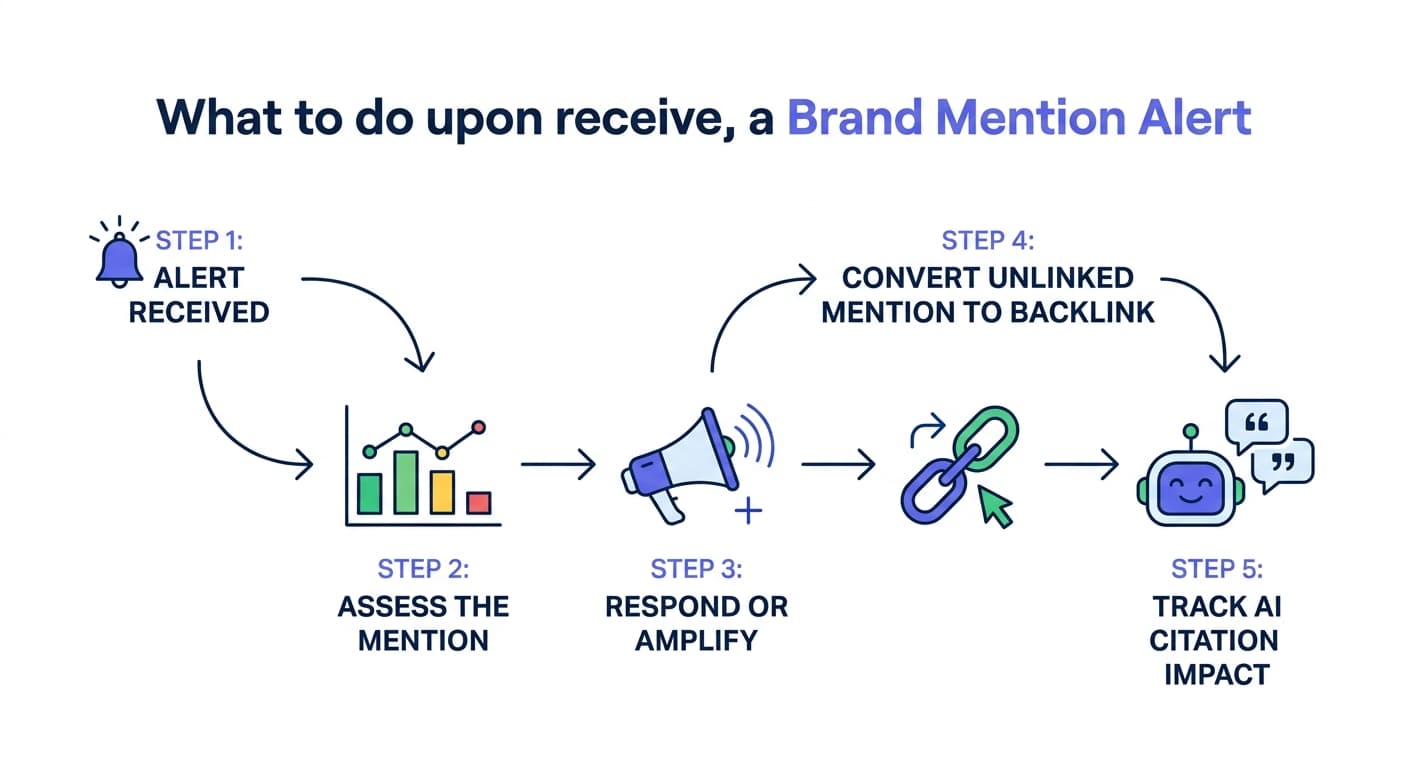
What to Do When You Get a Brand Mention Alert
Getting the alert is just step one. The real value comes from acting on it.
1. Positive Mentions: Amplify Them
When someone says something great about you, don't let it sit quietly. Share the mention on your own social channels, reply to thank the author, and consider featuring it as a testimonial or case study. This amplification signals social proof and can generate additional organic mentions.
2. Negative Mentions: Respond Quickly
Brand monitoring is no longer optional in 2026 — it's a strategic necessity. Organizations that monitor sentiment in real time, detect reputation threats early, and act on competitive intelligence see measurable improvements in customer loyalty, retention, and market share.
When you spot a negative mention, respond with empathy and a path to resolution — publicly where possible, so other readers see your commitment to customer experience.
3. Unlinked Mentions: Reclaim Them as Backlinks
This is one of the highest-leverage SEO moves you can make. Sometimes, a writer will mention your brand but forget to include a link. This is a "low-hanging fruit" opportunity.
Here's the process:
Check the domain authority of the site. Find the contact information for the editor or author. Send a polite email thanking them for the mention. Gently ask if they would mind adding a link so their readers can easily find your original resource. Many editors are happy to make this small update, turning a valuable mention into an even more valuable backlink.
Every unlinked brand mention is a potential backlink waiting to be claimed.
4. Competitor Mentions: Mine for Opportunity
When a competitor is mentioned positively, analyze why. What narrative are they winning? When they're mentioned negatively, look for the gap your brand can fill — and craft content that addresses the pain point their customers are expressing.
The AI Visibility Angle: Brand Mentions as Training Signals
Here's something most SEOs haven't fully absorbed yet: brand mention alerts now have a direct line to your AI search visibility.
LLMs extract entities from text and map them to topics during training and retrieval. An unlinked mention in a respected industry article still feeds that map. The model doesn't need a clickable URL to learn that a brand is associated with, for example, content governance or AI visibility tracking.
Context decides how much a mention is worth. A brand named once in a low-quality directory adds little. The same brand named inside a detailed analysis from a recognized publication, surrounded by relevant terms, gives the model a strong, usable signal. Quality of placement now outranks raw mention volume.
The practical implication: your goal shouldn't just be to get mentioned more. It should be to get mentioned in the right places, with the right context. Think industry publications, analyst reports, comparison articles, and authoritative how-to guides — the kinds of sources AI models are trained on and retrieve from.
Our detailed post on how ChatGPT cites sources goes deep on the mechanics of how these decisions get made.
Setting Up an Effective Brand Mention Alert Stack in 2026
Here's a recommended stack depending on your stage:
For Startups and Small Businesses
Tool | Purpose | Cost |
|---|---|---|
Google Alerts | Web mention baseline | Free |
Brand24 | Social + web listening | From $49/mo |
For Growth-Stage Brands
Tool | Purpose | Cost |
|---|---|---|
Ahrefs Alerts | Backlink + web mention tracking | Ahrefs subscription |
Semrush Brand Monitoring | Integrated SEO + mention tracking | Semrush subscription |
Brand24 or Mention | Social listening + sentiment | From $49/mo |
For Enterprise Teams
The strongest options available in 2026 for teams that need reliable, scalable brand mention tracking across news, social, broadcast, and print are Meltwater, Cision, Talkwalker, Brandwatch, and Muck Rack. Each serves a slightly different use case: Meltwater leads on breadth of sources, Muck Rack is the go-to for PR teams focused on journalist relationships, Brandwatch excels at deep consumer intelligence, Talkwalker offers strong social listening at a more accessible price point, and Cision bundles media monitoring with press release distribution.
Common Mistakes with Brand Mention Alerts
Even seasoned marketers make these errors:
Only tracking exact brand names — You need to track misspellings, abbreviations, and product names too. People may mispronounce your brand name, but they still talk about it, and you need to be aware of that.
Ignoring unlinked mentions — In 2026, untagged mentions impact AI visibility, and you can turn such mentions into backlinks.
Relying solely on Google Alerts — Google Alerts is limited to Google search results; there's no sentiment analysis, social monitoring, or advanced features.
Not acting on alerts — Monitoring without a response workflow is a missed opportunity at every turn.
Skipping AI chatbot monitoring — Your brand might be invisible in ChatGPT even if you rank on page 1 of Google. These are now separate surfaces that require separate tracking.
Doing one-off audits instead of continuous monitoring — Teams run a big first audit, find 20–40 unlinked opportunities, convert 3–5 to links, and then the audit stops happening. The compounding value comes from monthly cadence, not one-off deep dives.
Turning Brand Mention Alerts into an SEO Growth Engine
The brands that win in 2026 treat brand mention alerts not as a defensive tool, but as an offensive growth lever. Every alert is a data point that tells you:
Who's in your category conversation (and who isn't talking about you yet)
Which publishers cover your space and could be outreach targets
What sentiment is shifting and why
Whether your AI chatbot visibility is growing or stagnating
Which competitor weaknesses you can exploit with better content
Brand mentions build entity authority and AI visibility that backlinks alone cannot provide, making them a non-negotiable part of any complete SEO strategy in 2026.
Conclusion
Brand mention alerts have graduated from a PR nice-to-have into a core pillar of modern SEO strategy. In 2026, every mention of your brand — linked or unlinked, on a blog or inside a ChatGPT answer — is a signal that shapes your authority, your AI visibility, and ultimately your organic growth.
The brands that build a systematic, always-on monitoring stack will compound their advantage month after month. Those that don't will find themselves invisible in the places their customers are increasingly turning to for recommendations.
Set up your alerts. Act on every signal. And make sure you're not just tracking Google — track the AI chatbots too. That's where the next decade of search discovery is being built.
Whatever share of search AI answers end up taking, Google Search Console is still where you see the clicks Google actually sends you. QuickSEO puts Search Console for every website you run on one free dashboard. See all your sites in one place →
QuickSEO shows clicks, impressions, keywords and pages for every website you manage, compared with the period before.
- Unlimited websites on the free plan
- No credit card needed
Try it yourself
Related free tools
Free SEO tools related to the topics covered in this article.
Keep reading
Related posts
More articles on the same topics, prioritized by shared tags and keyword overlap.