Content Gap Analysis: The Complete 2026 Guide to Finding & Filling Your Biggest SEO Opportunities

 Summarize in ChatGPT
In a crowded content landscape where millions of new articles are published every day, creating content blindly is one of the most expensive mistakes a marketer can make. Content gap analysis is the strategic process that tells you exactly where the opportunities are — the topics your competitors are ranking for that you haven't addressed, the questions your target audience is asking that your website doesn't answer, and the funnel stages where your content library leaves potential customers without the information they need to convert.
Done well, content gap analysis is one of the highest-ROI activities in all of SEO. But in 2026, "done well" means something fundamentally different than it did even two years ago. Today, a content gap isn't just a missing keyword on Google — it's also a missing citation in ChatGPT, a brand invisible to Perplexity, or a topic skipped over by Gemini. This guide walks you through the full modern framework: from traditional keyword gaps to the emerging AI visibility gap that most teams are still flying blind on.
What Is Content Gap Analysis?
Content gap analysis is a strategic process that identifies the missing content on your website that your target audience is searching for, or that your competitors are already ranking for. More precisely, it helps you find topics your audience cares about that you haven't covered or could cover better — showing where your content is absent, thin, outdated, unclear, or misaligned with what people want.
There are several distinct types of content gaps you need to watch for:
Topical gaps — entire subjects your site doesn't cover but competitors do
Depth gaps — you have content on a topic, but it only scratches the surface while competitors provide comprehensive guides
Format gaps — you're answering the right question through the wrong medium (e.g., a written article when a comparison table or interactive tool would perform better)
Quality gaps — your content covers the topic, but it's thin, outdated, unclear, or otherwise low in quality
AI visibility gaps — in 2026, the gap extends beyond Google's blue links; websites may rank well in traditional search results but fail to appear in AI-generated responses, a new and growing dimension of content gaps that requires distinct strategies to address
A more complete, comprehensive content library covering a topic thoroughly from multiple angles signals topical authority to Google — meaning the entire cluster of related content receives a collective authority boost as your topic coverage deepens. This is why content gap analysis is one of the most lever-rich investments in long-term SEO authority building.
Why Content Gap Analysis Matters More Than Ever in 2026
The search landscape has shifted dramatically. The traditional model of "identifying a missing keyword and writing a blog post" was designed for Search Engines — tools that retrieve documents. We are now operating in the economy of Answer Engines — systems that synthesize information. The most profound shift of 2026 has been the transition of major platforms from retrieval to synthesis.
The numbers back this up:
810 million people use ChatGPT daily, Google AI Overviews reach 1.5 billion monthly users, and AI referral traffic is growing roughly 1% month over month across all industries.
Semrush projects that AI-search visitors will overtake traditional search visitors by 2028. Gartner's nearer-term call: roughly 25% of organic search traffic shifts toward AI assistants and chatbots by the end of 2026.
Around 93% of AI search sessions end without a website click, and AI Overviews reduce clicks to the top-ranking page by 58%, making answer visibility more important than traditional rankings.
And perhaps most alarming for brands who think Google rankings are enough: a study of 150 SaaS companies found that 44% of Google top-10 brands get zero ChatGPT citations for the same keywords, while 81% of ChatGPT-recommended brands aren't in Google's top 10.
According to a Semrush study on SEO and AI traffic, nearly 90% of the webpages ChatGPT cited were outside Google's top 20 organic results for related queries. That also means a page can perform well in organic search and still be missing from AI-generated answers.
The strategic implication is clear: your content gap analysis in 2026 must address both dimensions — traditional search rankings and AI citation visibility.
The 2026 Content Gap Analysis Framework: Step by Step
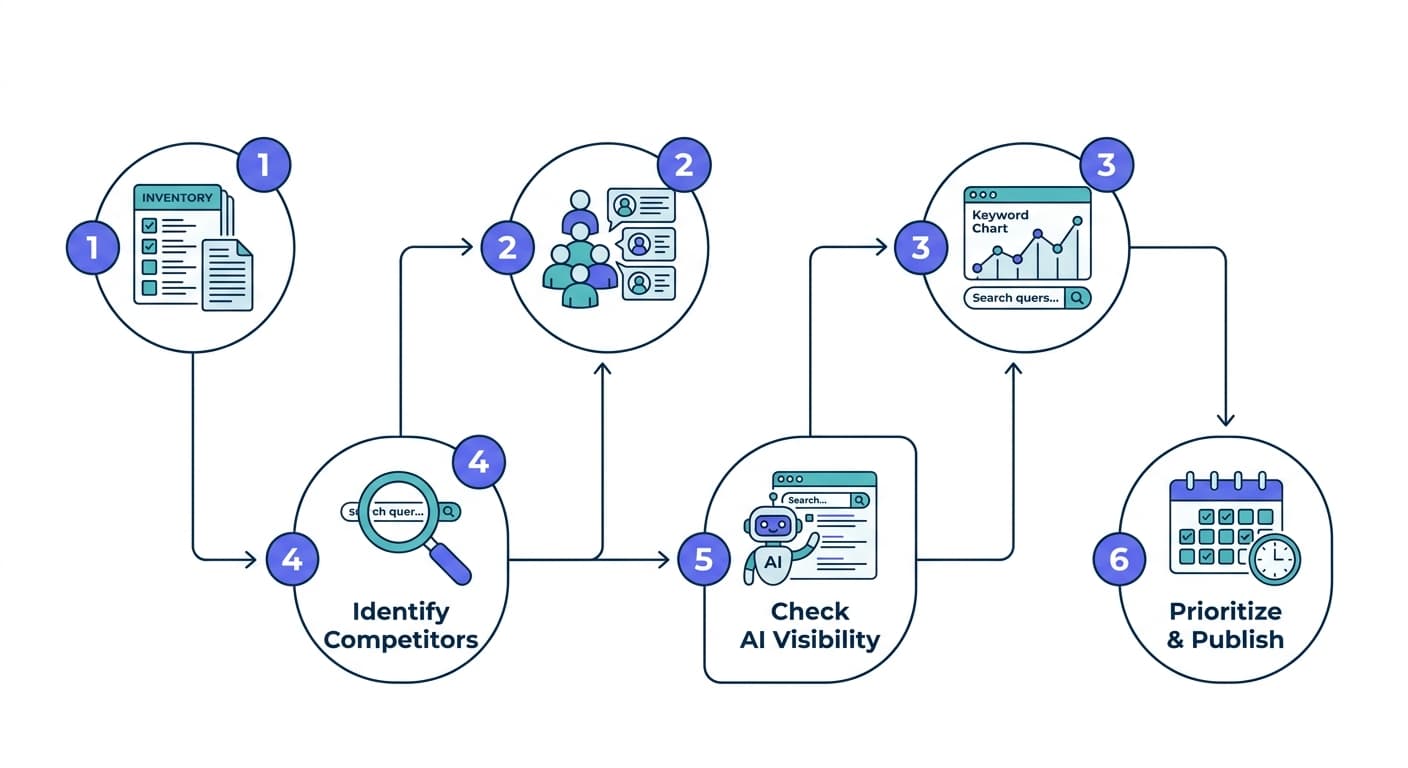
Step 1: Define Your Scope and Goals
Decide whether the analysis covers your full domain, a product category, or a single buyer journey stage. Align the scope with a business objective — lead generation, product page traffic, or topical authority in a niche.
Before diving in, ask yourself:
Are we trying to build topical authority in a specific category?
Are we targeting top-of-funnel awareness, mid-funnel comparison, or bottom-of-funnel conversion content?
Are we trying to close gaps in traditional Google rankings, AI visibility, or both?
One of the biggest mistakes teams make is filling their content calendar with "Awareness" (TOFU) content while ignoring the "Decision" (BOFU) content that actually pays the bills. Your content gap analysis must categorize every gap by where it fits in the customer journey.
Step 2: Audit Your Existing Content
You can't find what's missing until you know what you have. Export all indexed URLs and tag each by topic cluster, target keyword, and funnel stage. Tools like Screaming Frog or Ahrefs Site Audit handle this at scale.
During the audit, flag pages that are:
Ranking on page 2 or 3 but never cracked page 1
Thin or outdated (especially articles from 2023 or earlier)
Covering a topic superficially when a deeper guide is needed
Missing from topic clusters where you have strong adjacent content
QuickSEO's internal linking audit tool and thin content checker can accelerate this inventory phase significantly — helping you understand what you already have, what needs updating, and what's missing entirely.
Step 3: Identify Your Competitors
The foundation of any content gap analysis is competitor keyword research. Start by identifying your top three to five organic search competitors — the websites that rank for the majority of the same keywords you're targeting.
One important nuance: your SEO competitors are not always your business competitors. A brand that sells completely different products may rank for the same informational queries you're targeting. Look at the SERPs themselves — whoever consistently appears for your core keyword set is a content competitor, regardless of industry.
Step 4: Run the Keyword Gap Analysis
SEO content gap analysis compares your website's content and keyword rankings against competitors to identify missing topics and search opportunities. Most enterprise SEO tools have dedicated features for this:
Ahrefs Content Gap — enter your domain and up to 10 competitor domains, and it shows you every keyword where competitors rank but you don't
Semrush Keyword Gap — layers in search intent data and some content suggestions, which makes it slightly more actionable than a raw keyword list
Google Search Console (free) — shows queries where you appear but rank low (positions 5–20); these are depth or intent gaps, not full topical gaps
The 2026 filter to apply: identify keywords where competitors rank with outdated content (e.g., articles from 2023) or forum content (Reddit threads). These represent high-opportunity gaps where a structured, updated article can win.
You can also use QuickSEO's free keyword gap analyzer to quickly surface keywords your competitors own that you're missing.
Step 5: Analyze Search Intent and Content Depth
The analysis that actually drives results goes further: mapping topical authority gaps, scoring content for Information Gain, auditing format fit, and prioritizing by revenue impact rather than search volume alone.
For each gap you identify, review the top-ranking pages and ask:
What content format is winning? (guide, listicle, comparison, tool, video)
How deep does the coverage go?
Is there original data, expert quotes, or first-hand experience?
Could you write something genuinely more useful than what's already ranking?
Today, the most valuable gap often isn't a missing keyword; it's a missing perspective. To stay visible, shift focus from simple coverage to "Information Gain" — providing the unique expertise and data that Answer Engines rely on to build their responses.
Step 6: Layer In the AI Visibility Gap
This is the step that separates a 2024-era gap analysis from a 2026-era one.
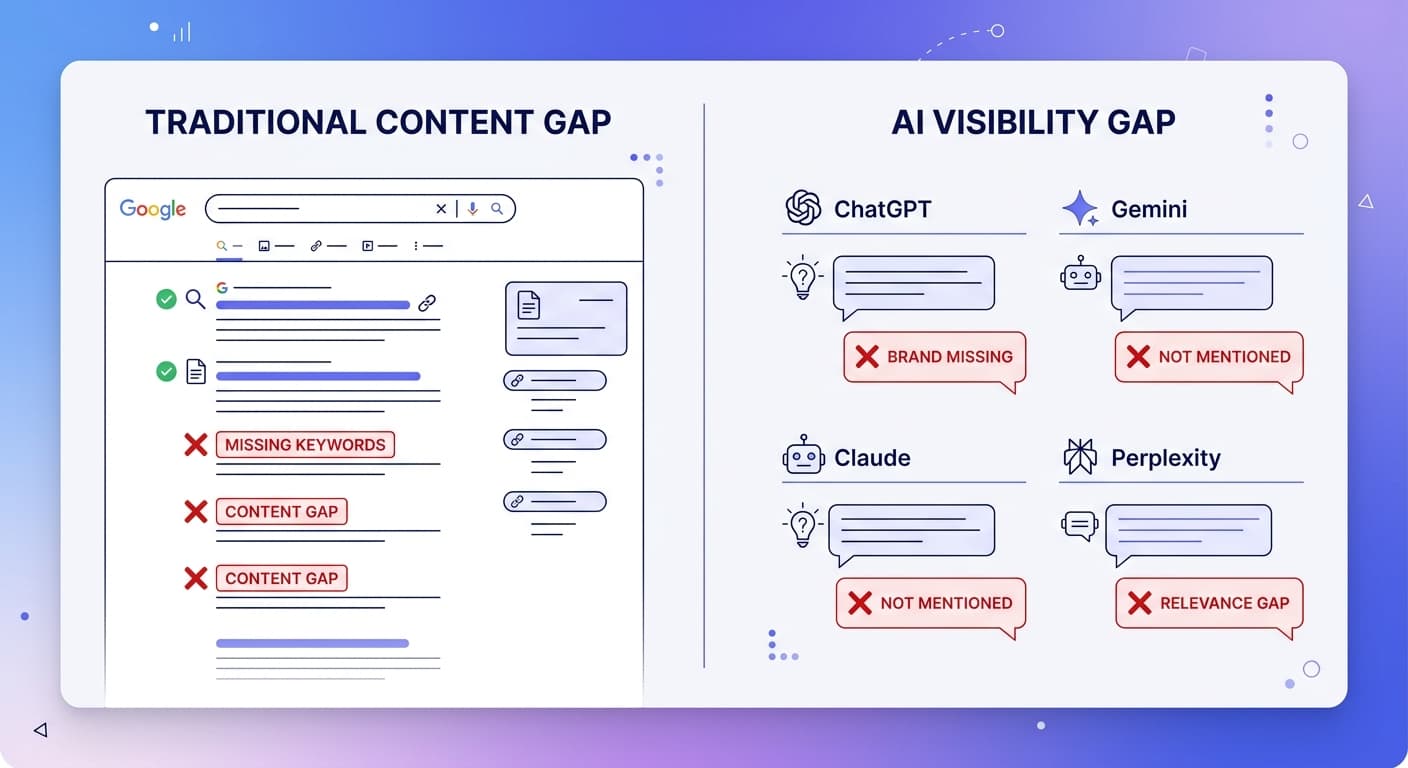
Content gap analysis in 2026 means more than finding keywords you're missing. It means understanding what information you're not providing that causes AI models to cite your competitors instead of you.
To audit your AI visibility gaps:
Search your core keywords in ChatGPT, Perplexity, Claude, and Gemini
Note which competitors appear — and which don't
Check whether your own brand is mentioned, and in what context
Identify the content formats and sources the AI platforms are drawing from
The data reveals a fragmented picture. Analysis of 680 million citations found that only 11% of domains are cited by both ChatGPT and Perplexity. Google AI Overviews and Google AI Mode cite the same URLs only 13.7% of the time. Each platform has distinct source preferences, citation mechanics, and content signals. A brand that ranks well in Google AI Overviews may be completely invisible in Perplexity or ChatGPT Search.
This means a single "AI SEO strategy" won't cut it. You need platform-specific gap audits.
Step 7: Prioritize by Business Fit and Opportunity
Not every gap is worth filling. Prioritize gaps where search intent aligns with your product, the keyword difficulty is manageable, and the traffic potential justifies the production cost.
A simple prioritization scoring model:
Factor | Weight |
|---|---|
Search volume | High |
Keyword difficulty | Medium (inverse) |
Commercial/transactional intent | High |
Competitor content freshness (older = easier) | High |
AI citation opportunity | High |
Topical relevance to core business | Critical |
High-priority targets: high search volume + low difficulty, high commercial intent, service-related keywords, and trending industry topics.
Step 8: Build the Content Plan and Execute
Map each gap to a content format (guide, comparison, FAQ, landing page), assign ownership, and set deadlines. This is where gap analysis converts to measurable output.
For the content itself, prioritize Information Gain — the unique value your article adds that doesn't already exist at scale online. Score your existing content against key Information Gain dimensions: proprietary data (surveys you ran, experiments you conducted, internal benchmarks), first-hand evidence (client results, case studies, personal experience), original frameworks, expert attribution, and freshness hooks (data or events from the last 90 days).
Common Content Gap Analysis Mistakes to Avoid
Most teams run a gap report, export a list of 200 keywords, and then freeze. That's the most common failure mode. Here are the mistakes that kill otherwise solid gap analyses:
Ignoring search intent — targeting a keyword without understanding why someone searches for it leads to content that ranks but doesn't convert
Skipping the AI visibility layer — as we've seen, Google rankings and AI citations are increasingly independent of each other
Creating keyword cannibalization — when you find 20 keywords your competitor ranks for, several of them likely belong together in a single piece of content. Publishing separate pages for near-identical keywords creates cannibalization problems where your own pages compete against each other and neither ranks well.
Treating it as a one-time exercise — content gap analysis is not a one-time audit; it's a strategic operating system for content that compounds in value over time. By systematically identifying where competitors are winning, where your audience's questions go unanswered, and where your funnel is leaking potential customers, you transform content creation from a guessing game into a precision growth engine.
Ignoring content freshness — Muck Rack's analysis of more than one million citations confirmed that the highest citation rate occurs within just seven days of publication. The implication is structural: a quarterly update cycle for key content pages is not sufficient for AI visibility. A 30-day refresh cycle for high-priority pages is the new minimum.
How Often Should You Run a Content Gap Analysis?
Most teams benefit from a full gap analysis every quarter, with lighter check-ins monthly to spot new trends or shifts in demand. If you operate in a fast-moving industry, consider tightening that to every 4–6 weeks so you can react before competitors do.
For AI visibility specifically, the cadence needs to be even tighter. Tracking weekly trends showed brand visibility declining 35.9%, citation rate declining 34.4%, and share of voice declining 34.8% — all in lockstep over just 5 weeks. This proves that AI visibility is not a "set it and forget it" metric. A brand can lose a third of its AI presence in just over a month.
Tools to Run a Content Gap Analysis in 2026
Content gap analysis tools are becoming mission-critical as search fragments across traditional SERPs, social platforms, and AI overviews. Without the right stack, it is nearly impossible to see where competitors are winning visibility, which topics your audience still needs, and how AI-enhanced search will surface content in 2026.
Here's a quick breakdown of the leading options:
Traditional Keyword Gap Tools
Ahrefs Content Gap — best for deep keyword-level competitor comparison with industry-leading backlink data
Semrush Keyword Gap — Semrush's LLM Gap Analyzer is purpose-built to identify where your content lacks visibility in large language models like ChatGPT and Gemini; pairs well with their Keyword Gap tool for a complete picture
Moz Pro — Domain Authority, Page Authority, and priority scores provide at-a-glance guidance on which opportunities are realistic to target; for teams without a senior SEO on staff, this directionality can prevent chasing impossible terms
A Free Starting Point: Google Search Console
Google Search Console — free and shows real performance data; use it to surface queries where you rank positions 5–20 (easy wins) and check for AI Overview appearances
Free QuickSEO Tools for Gap Analysis
QuickSEO offers a suite of free tools purpose-built for every stage of gap analysis:
Keyword Gap Analyzer — find keywords competitors rank for that you don't
Topical Map Generator — map out full topic clusters and identify coverage holes
Keyword Cannibalization Checker — ensure your new content doesn't compete with existing pages
Heading Gap Detector — spot structural content gaps at the page level
Entity Mention Coverage Checker — audit whether key entities are covered in your content (critical for AI citation eligibility)
Turning Gap Analysis Into AI Citations
Here's the reality that most gap analysis guides miss: finding the gap is the easy part. Closing SEO content gaps strengthens topical authority, expands organic search visibility, and helps capture traffic currently going to competitor websites. But capturing AI citations requires an additional layer of execution.
Content with statistics, citations, and quotations achieves 30–40% higher visibility in AI responses, and pages updated within 2 months earn 28% more citations than older content.
To maximize your chances of being cited across AI platforms, every piece of gap-filling content should:
Answer the core query directly in the first 100–150 words (AI models favor answer-first structure)
Include original data or unique perspectives — pure synthesis of what's already online gets filtered out
Use structured formatting — clear H2/H3 headings, bullet points, comparison tables, and FAQ sections
Be kept fresh — update high-priority pages at least monthly; fresh content published within the last 30 days was cited by Perplexity at an 82% rate in one 2026 analysis
Cover the "query fan-out" — the follow-up questions a user would naturally ask after reading a basic answer; ask a generative AI tool what the five most likely follow-up questions would be; if you cover the fan-out and your competitors don't, you're positioned for citation
The teams that treat gap analysis as a quarterly strategic exercise, rather than a keyword dump, will build the kind of content libraries that earn citations from both traditional search engines and AI platforms. And those citations compound. Every page with genuine original insight strengthens the domain's authority for everything else in the cluster.
QuickSEO is a free Google Search Console dashboard for all your websites. Connect Search Console, pick the properties you want, and see clicks, impressions, CTR and average position for every site on one screen, each compared with the previous period, with the keywords and pages behind the numbers. Connect Search Console for free →
Conclusion
Content gap analysis in 2026 is a fundamentally different discipline than it was before AI search took hold. Effective SEO content gap analysis includes identifying SEO competitors, auditing existing content, analyzing SERP intent, clustering keywords, and prioritizing opportunities. But the modern version also demands a deep look at where your brand shows up — and where it doesn't — in the AI-generated answers that now intercept your audience before they even reach a search result.
The brands winning in 2026 are those who understand that Google rankings and AI citations operate on different logic, run regular gap audits across both channels, and have a systematic process for turning those gaps into published, citation-worthy content at scale.
The gap is your roadmap. Start using it.
QuickSEO shows clicks, impressions, keywords and pages for every website you manage, compared with the period before.
- Unlimited websites on the free plan
- No credit card needed
Try it yourself
Related free tools
Free SEO tools related to the topics covered in this article.
Keep reading
Related posts
More articles on the same topics, prioritized by shared tags and keyword overlap.