Citation Gap Analysis: The Complete 2026 Guide to Winning AI Citations

 Summarize in ChatGPT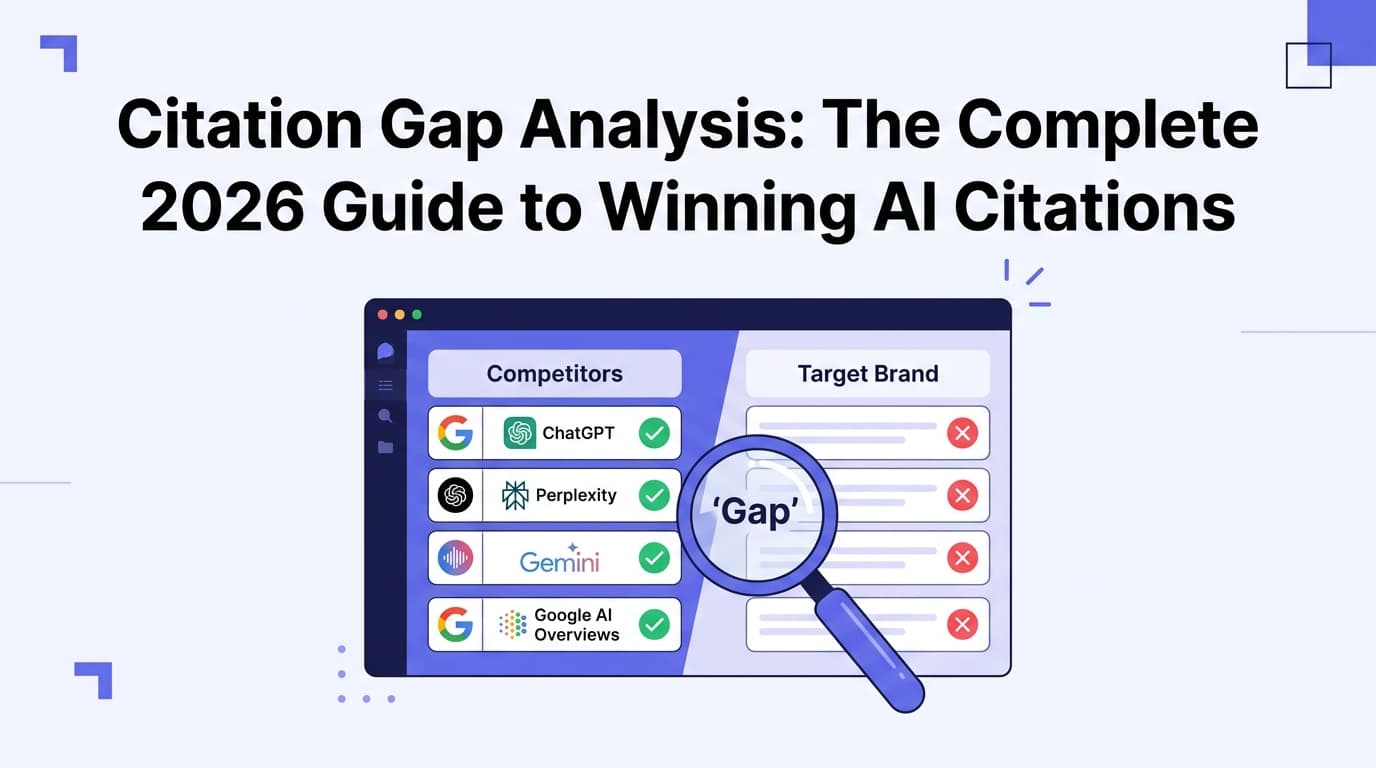
Your brand ranks on page one of Google. Your SEO is solid. But when someone asks ChatGPT, Perplexity, or Gemini which solution they should choose in your category — your name never comes up.
That's a citation gap. And in 2026, it may be costing you more customers than any keyword ranking you've lost.
According to Similarweb's 2026 AI Brand Visibility Report, 35% of US consumers now use AI tools at the product discovery stage, compared to just 13.6% who use traditional search. By the time a buyer reaches Google, their shortlist is already half-formed — shaped by whatever ChatGPT or Perplexity told them. If you're not in those AI answers, you're not in consideration.
This guide walks through exactly what citation gap analysis is, why it matters, and — most importantly — how to run one and act on it. Whether you're an in-house SEO, a content strategist, or an agency managing multiple clients, you'll leave with a repeatable process you can start executing today.
What Is Citation Gap Analysis?
AI citation gap analysis examines where your brand is absent from AI-generated responses, even when those responses directly address your market category. It's the AI-era equivalent of a keyword gap analysis — but instead of finding keywords you're missing from Google, you're finding the prompts and topics where competitors are being recommended by AI models and you aren't.
An AI visibility gap is any topic, prompt, or context where competing brands appear in AI-generated answers but yours does not. Unlike a search visibility gap, where you rank lower than a competitor, an AI visibility gap means you're completely absent.
There's an important distinction to understand upfront:
AI mention: The AI model refers to your brand by name in its response.
AI citation: The AI model links directly to a page on your website as a source.
The mention-citation gap reveals when AI knows your brand but doesn't trust your content enough to cite it. Competitive share of voice shows which brands dominate AI recommendations for real buyer questions.
Both signals matter, but citations carry more weight — they indicate that AI systems consider your content authoritative enough to surface as a verified source.
Why Citation Gaps Are a Bigger Problem Than Most Teams Realize
A brand can rank well on Google and still disappear when customers ask ChatGPT, Perplexity, Gemini, or Google AI Overviews what solutions they should consider. Research from Semrush found that only 44.3% of pages ranking in Google's top 10 traditional results appeared in at least one AI-generated answer across major platforms — meaning the majority of well-ranked pages are still completely invisible in AI discovery.
And the problem compounds quickly:
If a customer asks ChatGPT, Gemini, or Perplexity who the best option in your category is and your brand isn't in the answer, you've lost that buyer before they ever reached your site.
A 2026 study tracking LLM brand citation patterns found that only 30% of brands stayed visible from one answer to the next, and just 20% held presence across five consecutive runs — showing that citation volatility is far higher than ranking volatility.
This volatility makes consistent monitoring and active gap-closing essential — not a one-time project.
The Four Types of Citation Gaps
Before you build your analysis framework, it helps to understand the four distinct types of gaps you might find:
Topic gaps — You have no content covering a topic your competitors dominate in AI answers.
Prompt-level gaps — You have relevant content, but it isn't structured in a way AI can extract and cite.
Sentiment gaps — AI mentions your brand, but the context is neutral or negative compared to competitor mentions.
Platform gaps — You're cited on one AI platform (e.g., Google AI Overviews) but invisible on others (e.g., Perplexity or ChatGPT).
Analysis of 680 million citations found that only 11% of domains are cited by both ChatGPT and Perplexity. Google AI Overviews and Google AI Mode cite the same URLs only 13.7% of the time, despite reaching similar conclusions. Each platform has distinct source preferences, citation mechanics, and content signals.
This is why a multi-platform approach is non-negotiable in 2026.
Step-by-Step: How to Run a Citation Gap Analysis
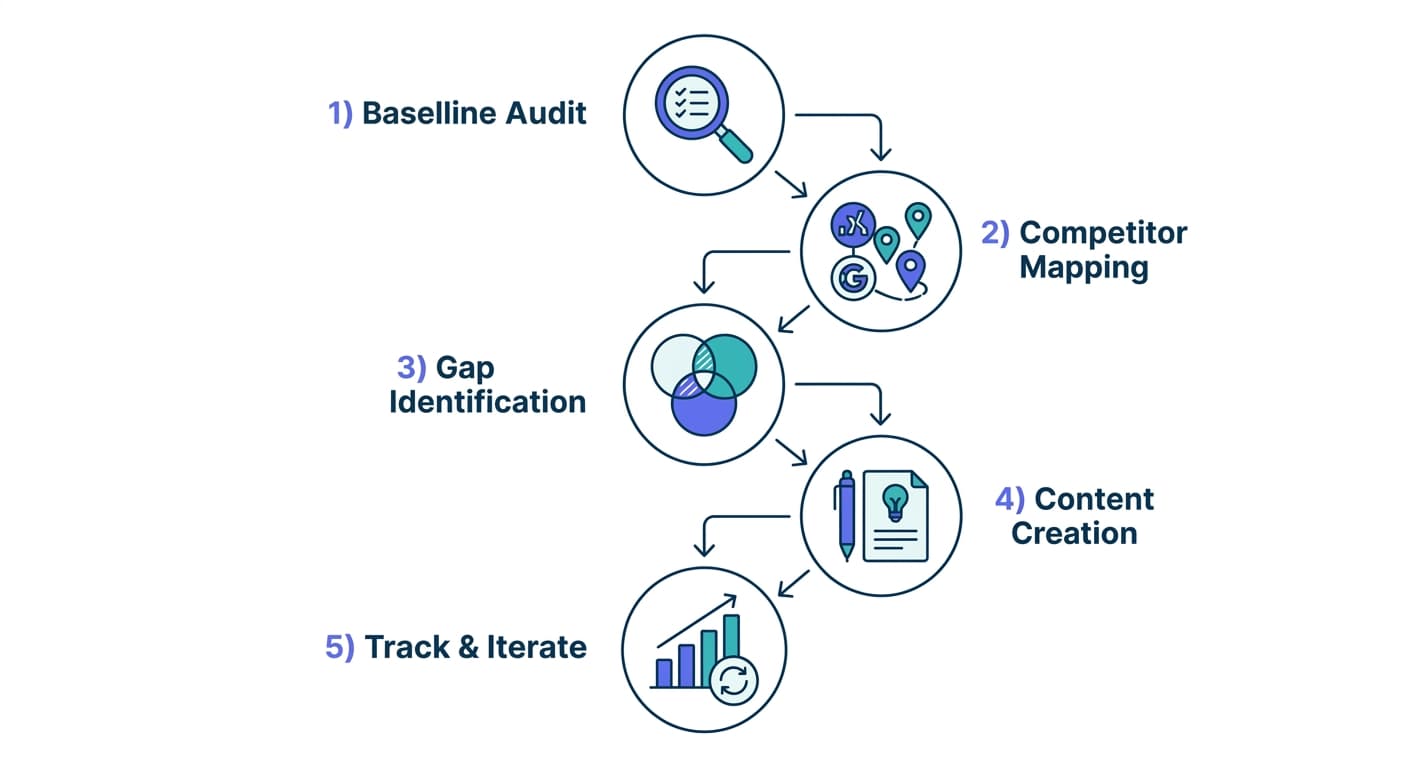
Step 1: Establish Your Baseline
Before you can identify gaps, you need to know where you currently stand.
At minimum, cover ChatGPT (GPT-4 and o-series), Perplexity, and Google AI Mode. These three represent the highest-volume AI search surfaces for B2B queries as of 2026. Claude and Gemini direct are secondary but worth including in thorough audits.
For each platform, run 20–30 buyer-intent prompts relevant to your category. For each prompt-platform combination, log: (a) whether your brand was mentioned in the answer text, (b) whether a URL from your domain was cited as a source link, (c) your brand's placement position in the answer, and (d) which competitors were cited instead of or alongside you.
Pro tip: Run each prompt at least twice per platform. AI answers are non-deterministic, and a single run is closer to a coin flip than a measurement.
Step 2: Map Your Competitors' Citation Territory
Once you have a baseline, the next step is to understand who IS getting cited — and why.
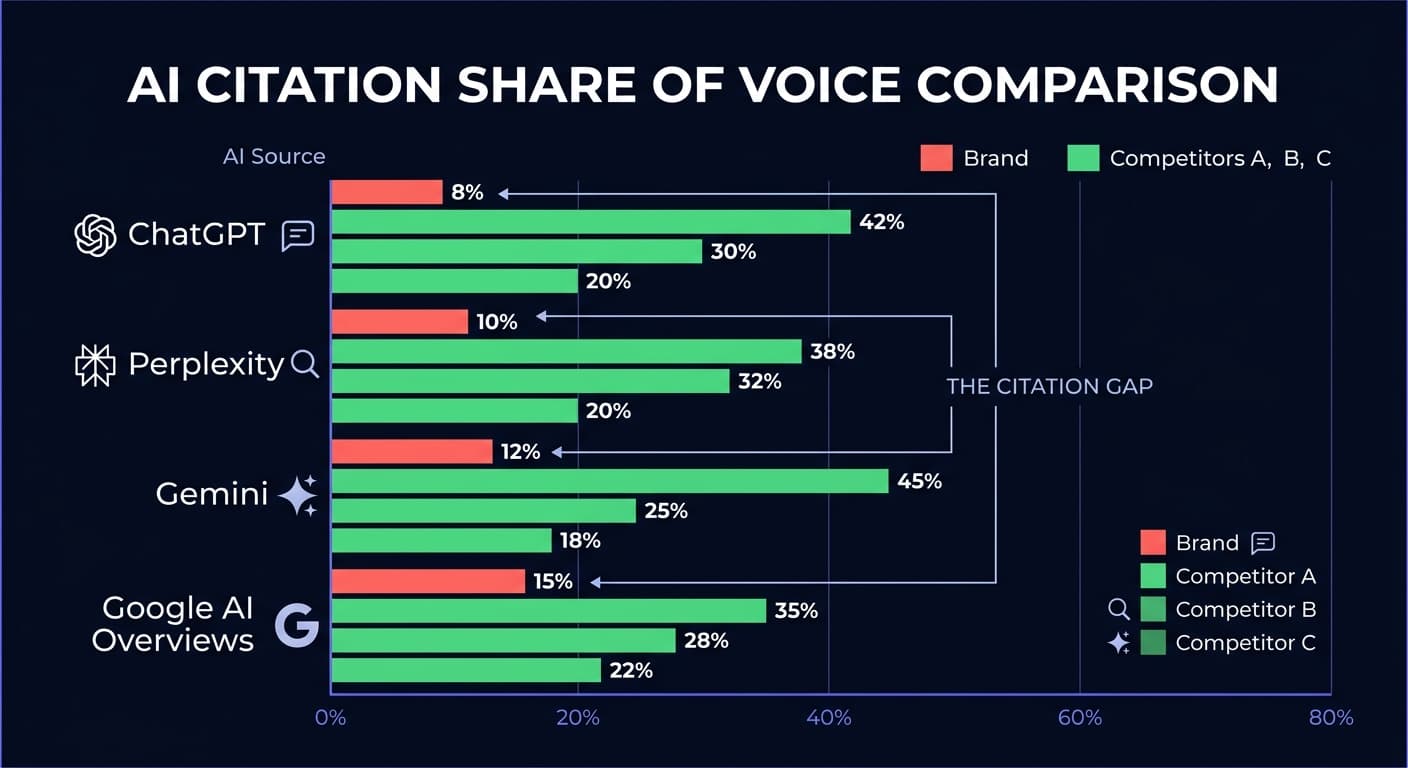
When ChatGPT cites Competitor A alongside industry leader B in 78% of responses, but only cites your brand with leader B in 23% of responses, you've identified a citation gap requiring targeted content and outreach strategies.
For every prompt where a competitor is cited and you are not, note:
Which URLs they're getting cited for
What type of content those pages are (guides, comparison pages, data studies, product pages)
How those pages are structured — do they use tables, bullet points, FAQ sections, answer-first formats?
What third-party sources link to or mention those pages
This competitive mapping gives you the raw material for your action plan.
Step 3: Calculate Your AI Share of Voice
To calculate share of voice, use this formula: AI SOV = (Your brand's citations or mentions / Total citations or mentions for all tracked brands) x 100. For example, if you track 200 prompts across ChatGPT, Gemini, and Perplexity, and your brand appears in 60 of those answers while a competitor appears in 90, your AI SOV is 30% and theirs is 45%.
AI answer engines like ChatGPT, Perplexity, Gemini, Claude, and Google AI Mode each have different retrieval behaviors and source preferences. Your SOV will vary by platform, so measure each engine separately in addition to tracking an aggregate score.
This metric is your north star. Track it monthly and watch how it shifts as you execute content improvements.
Step 4: Categorize and Prioritize Your Gaps
Not all gaps are equal. Use a 2×2 categorization framework:
"They Own It" — Competitors get cited and you do not. These are your gaps. Analyze what they have that you lack and build content to compete. "Nobody Owns It" — Neither you nor competitors get cited consistently. These are the easiest opportunities. First-mover advantage applies. Create the definitive resource for this topic. Map all your target topics across these four categories. The result is a prioritized list of optimization targets: protect owned topics, improve shared topics, attack competitor-owned topics, and claim unowned topics.
Attack "nobody owns it" topics first for quick wins, then build a medium-term plan to compete on competitor-owned topics.
Step 5: Diagnose WHY the Gap Exists
This is the step most teams skip — and it's the most important.
Content that simply restates what already exists has near-zero information gain and gives AI no reason to cite you over existing sources. The content gap that matters most in 2026 isn't a missing keyword; it's a missing perspective. To close citation gaps, your content needs to contribute something genuinely new: proprietary data, original research, expert analysis, or a unique framework that doesn't exist elsewhere.
Additionally, consider the technical dimension. A page first has to be selected as a plausible source. Then its evidence has to be easy for the model to absorb into the generated answer. Research on LLM citation behavior shows those are not identical steps, which is why a page with generic prose often underperforms a page with cleaner, more quotable structure.
How to Close Citation Gaps: Content and Technical Strategies
Content Strategies That Drive AI Citations
1. Publish proprietary data and original research
Forrester's 2026 research found that content providing unique "information gain" ranks three times higher in AI responses than content that rehashes existing consensus. Original benchmarks, surveys, and case studies give AI models something they can't get anywhere else.
2. Structure pages for extractability
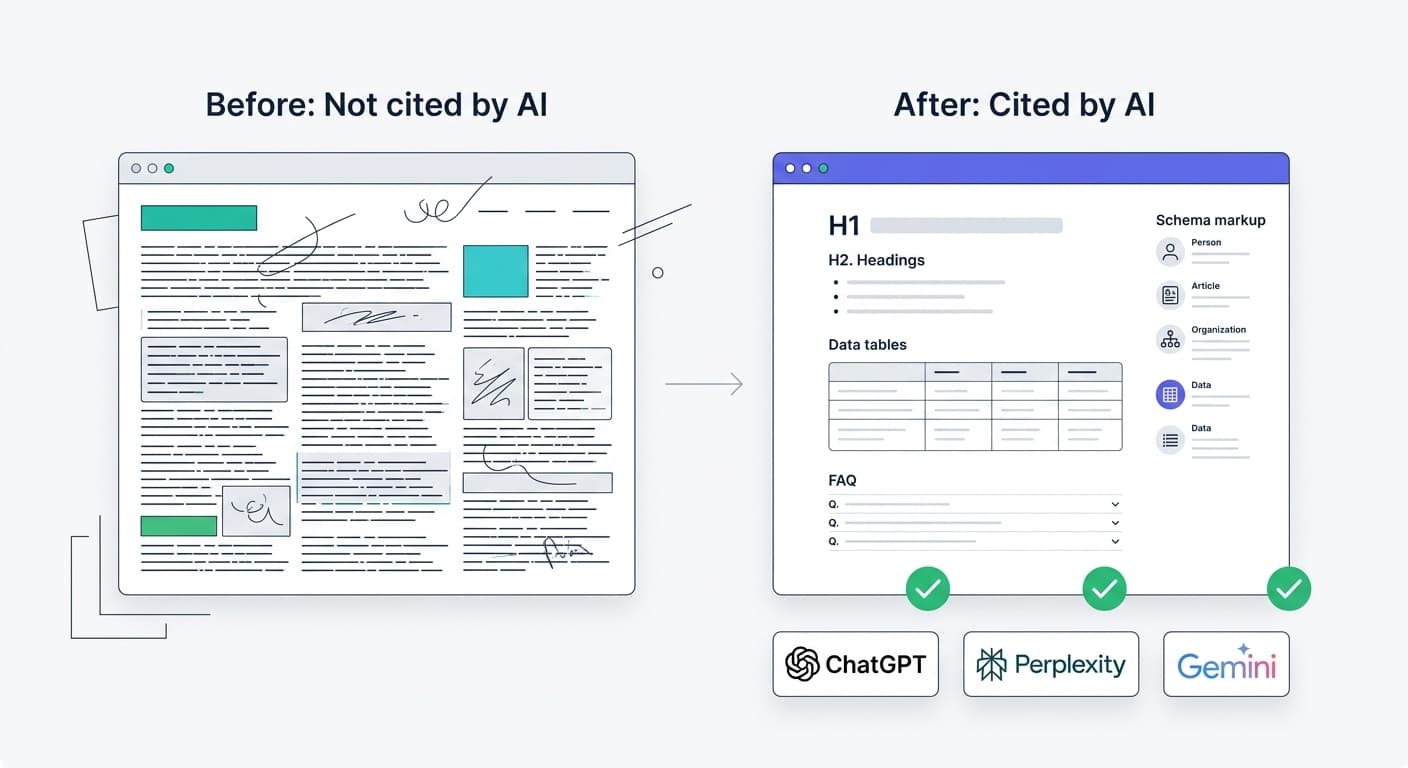
Answer-first structure, explicit claims, and clean tables matter more than broad narrative. Put your most citable statement in the first 150 words of every article. Use H2s framed as questions. Break complex information into bullet lists and comparison tables.
3. Build third-party consensus
ChatGPT in particular builds answers from cross-source patterns. If your brand appears on industry review sites, niche publications, and expert roundups, it is far more likely to be included in synthesized AI responses. Digital PR and earned media directly support AI citation rates.
4. Keep content fresh
Perplexity and ChatGPT's search layer both favour recently updated pages. Set a quarterly refresh schedule for your highest-value content. Update statistics, add current examples, and adjust publication dates to signal freshness.
Technical Strategies to Remove Citation Blockers
Implement structured data — Implement FAQ schema, organization schema, and product schema to help Gemini and Google AI Overviews identify and surface your content accurately. Our free AI Schema Markup Generator makes it easy to build the right schema for any page type.
Fix indexation issues — AI platforms can only cite what they can crawl. Use the robots.txt validator and sitemap validator to ensure your most important pages are fully accessible to AI crawlers.
Understand platform-specific preferences — Gemini demonstrates a strong preference for brand-owned content, with roughly 52% of its citations originating from brand websites, and rewards structured, factual information. ChatGPT operates on the logic of consensus, with nearly 49% of its citations coming from third-party directories and aggregators. Tailor your strategy to each platform's citation mechanics.
Consider domain authority context — Domain authority is one factor among many. AI engines also weight content quality, structure, recency, and technical implementation. A smaller brand with superior content structure and fresher data can outperform a high-authority domain with stale, poorly structured content.
How to Monitor for New Citation Gaps Ongoing
Citation gaps aren't static — they shift with every model update, competitor content publish, and algorithm change.
AI citations are not permanent. A competitor who published the best guide in 2024 can be displaced by a better guide in 2026. Content quality, recency, and technical optimization drive citations, not just historical authority.
Build a sustainable monitoring cadence:
Weekly: Run your top 20 buyer-intent prompts across ChatGPT, Perplexity, and Gemini. Log any new gaps that appear.
Monthly: Recalculate your AI share of voice. Review which new competitors appear in answers.
Quarterly: Conduct a full competitive citation gap audit. Update or retire content based on performance data.
The metrics that matter most are citation frequency, share of voice, source domain coverage, mention rate, and competitor citation overlap.
The biggest mistake teams make is tracking visibility without a workflow for turning citation gaps into content refreshes and new pages. Monitoring without action is just reporting. The brands winning in AI search are the ones closing gaps at speed.
Citation Gap Analysis vs. Traditional Keyword Gap Analysis
It's worth clarifying how this differs from the keyword gap analysis you may already be running.
Traditional Keyword Gap | AI Citation Gap | |
|---|---|---|
Focus | Keywords you don't rank for | Topics/prompts where you're not cited |
Platforms | Google SERP | ChatGPT, Perplexity, Gemini, AI Overviews |
Metric | Ranking position | Citation frequency, share of voice |
Content fix | Target the keyword | Add information gain, structure for extraction |
Update cycle | Monthly–quarterly | Weekly–monthly |
Content gap analysis in 2026 means more than finding keywords you're missing. It means understanding what information you're not providing that causes AI models to cite your competitors instead of you.
Both analyses are complementary — but if you're only running the traditional version, you're missing half the picture. Our keyword gap analyzer is a great starting point for the traditional side; your citation gap analysis covers the AI side.
Turning Citation Gaps Into a Content Execution Machine
The most effective approach is to treat citation gap analysis not as a one-off audit but as a continuous content intelligence feed.
Here's a production-ready workflow:
Identify gap → A competitor is cited in Perplexity for "best [your category] for [use case]" and you are not.
Diagnose → Their cited page has original data, an answer-first intro, and FAQ schema. Yours doesn't.
Brief → Create a new article or update the existing one with proprietary data, structured headings, and FAQ schema.
Publish → Get it indexed fast with a properly configured XML sitemap.
Validate → Re-run the prompt 2 weeks later to check if you've entered the citation pool.
Track → Monitor citation frequency monthly and protect the position.
The good news is that AI search visibility isn't random. It's the result of deliberate, repeatable actions: auditing where you currently stand, identifying the content gaps keeping you out of AI responses, creating content structured for AI citation, and tracking your progress systematically.
For more on understanding how each AI platform decides what to cite, see our deep-dive on how ChatGPT, Claude, Gemini, and Perplexity choose their citation sources.
The Long Game: Why Citation Authority Compounds
Organizations building systematic citation monitoring infrastructure now will compound advantages as AI search scales from 1 billion to 5+ billion daily queries by 2028.
Every citation your brand earns in an AI response signals to the model that your domain is a trusted authority on that topic. That trust compounds across model updates in the same way backlink authority compounds across algorithm updates in traditional SEO.
The brands doing this now are building AI authority that compounds. The ones that aren't are letting competitors claim it by default.
The brands that start running systematic citation gap analysis today — and publishing the content to close those gaps consistently — will be dramatically harder to displace in 12 months.
Conclusion
Citation gap analysis is the most under-utilized competitive intelligence practice in SEO right now — and the brands running it consistently are pulling ahead in AI search visibility while most of their competitors don't even know the gap exists.
The process is clear:
Establish a multi-platform baseline across ChatGPT, Perplexity, Gemini, and Google AI Overviews
Map exactly where competitors are cited and you aren't
Calculate your AI share of voice per platform
Categorize gaps by priority (unowned > competitor-owned)
Diagnose the root cause — information gap, structural gap, or technical gap
Execute targeted content and technical fixes
Monitor and iterate on a consistent schedule
The window to build compounding AI citation authority is open right now. Don't leave it for your competitors.
🚀 Ready to close your citation gaps automatically? QuickSEO finds where you're invisible in Google and AI chatbots, writes on-brand articles built to rank and get cited, and publishes them to your site — every day. No copy-paste. No manual work. Just organic traffic that grows. Start growing your AI visibility →
Enter your website to track its AI visibility across ChatGPT, Gemini, Claude, and Perplexity — and turn chatbot mentions into traffic.
- Set up in minutes
- Cancel anytime
Try it yourself
Related free tools
Free SEO tools related to the topics covered in this article.
Keep reading
Related posts
More articles on the same topics, prioritized by shared tags and keyword overlap.