If your content marketing feels like shouting into the void — publishing post after post without seeing meaningful ranking gains — the problem probably isn't your writing. It's your architecture.
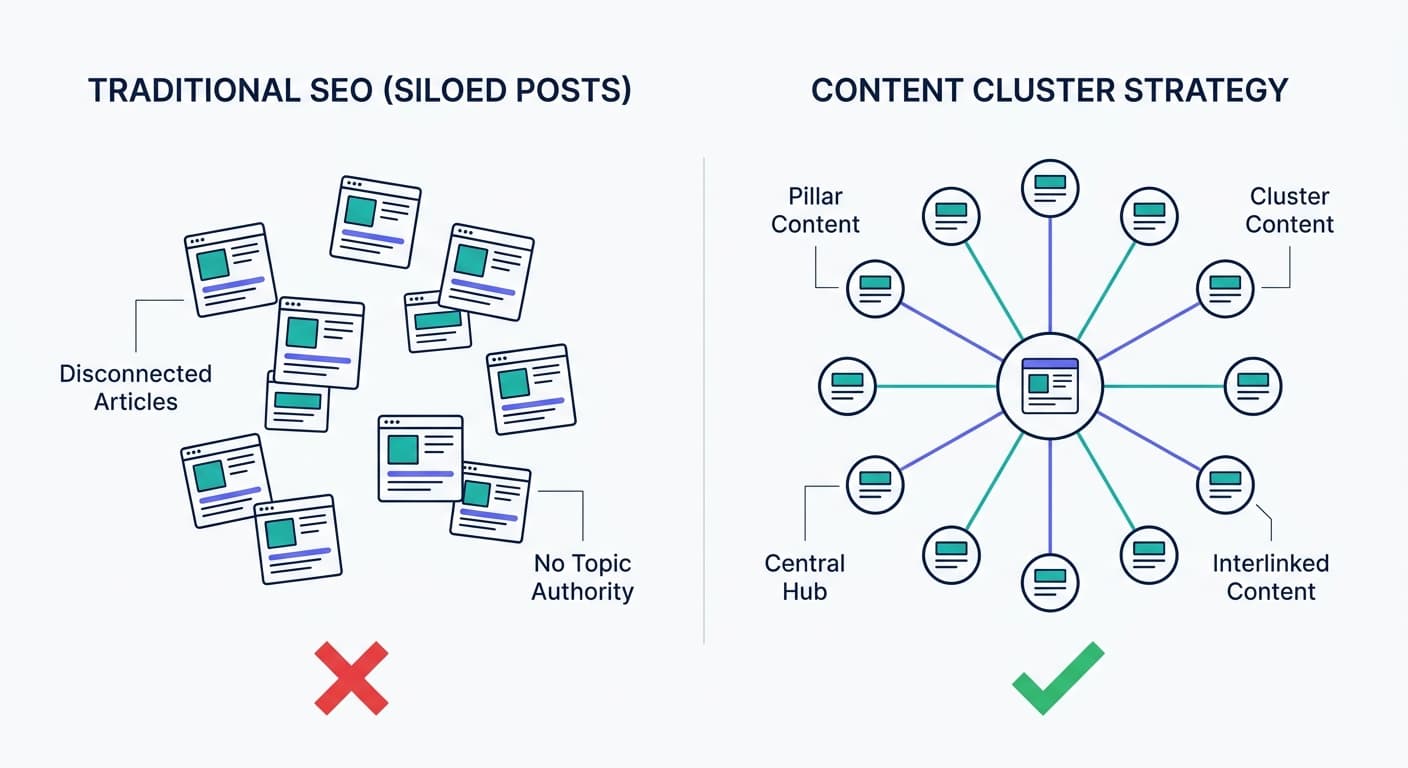
Content clustering has become the most powerful SEO strategy for businesses aiming to dominate search rankings in 2026. Rather than writing isolated blog posts scattered across your site, content clustering organizes your content into interconnected topic groups that signal deep expertise to Google and AI search engines.
In this guide, we'll walk you through exactly what content cluster planning is, why it works better than ever in 2026, and how to build a cluster strategy that drives measurable organic growth — on Google and in AI chatbots like ChatGPT, Gemini, and Perplexity.
What Is a Content Cluster?
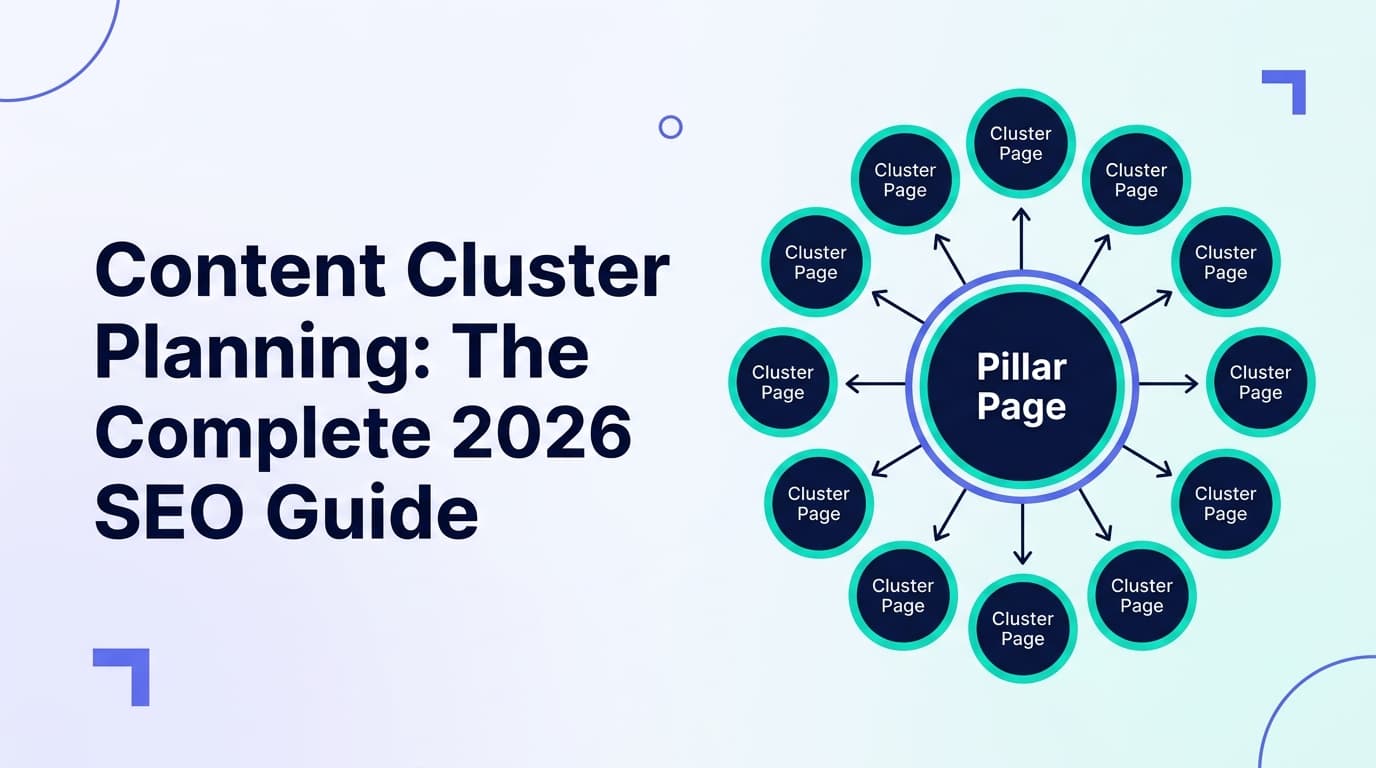
A content cluster is an SEO strategy that organizes content into a central pillar page supported by related cluster pages. This approach improves site structure, internal linking, and topic optimization.
Think of it like a solar system: the pillar page is the sun, and the cluster pages are planets orbiting around it — each one connected, each one adding gravitational pull to the entire system.
A topic cluster content strategy is a structured way to organize and interlink content so search engines can better understand the depth of expertise on a topic. The main pillar page acts as the central source of truth and covers a broad subject. Cluster pages expand on specific subtopics or questions that relate to that pillar. Each piece connects through internal linking, building a strong and interconnected content hub.
The Three Core Components
Pillar Page — A comprehensive, long-form resource (typically 3,000–5,000 words) that covers a broad topic at a high level and links out to all relevant cluster pages.
Cluster Pages — Focused articles (typically 1,500–2,500 words) that go narrow and deep on a specific subtopic, long-tail keyword, or search intent, all linking back to the pillar.
Internal Links — The connective tissue that ties it all together. Contextual links flow in three directions — hub-to-spoke, spoke-to-hub, and spoke-to-spoke — spreading authority and improving discovery.
Grow your organic traffic from chat-bots
Track your AI visibility across ChatGPT, Gemini, Claude, and Perplexity — and turn chat-bot mentions into traffic.
Free to start
No credit card required
Setup in 60 seconds
Keep reading
Related posts
More articles on the same topics, prioritized by shared tags and keyword overlap.
Why Content Cluster Planning Is More Important Than Ever in 2026
Google Has Shifted to Topical Authority
Google's ranking algorithm has fundamentally shifted from page-level authority to site-level topical authority. According to research from industry experts in 2026, topical authority and entity-driven coverage now rank higher than technical SEO and AI Overview optimization. This means Google rewards entire topic domains, not just individual pages.
SEO in 2026 is not about chasing keywords — it's about building authority. Google's latest ranking systems reward websites that demonstrate expertise, depth, and connection across their content.
AI Chatbots Cite Clustered Content Far More Often
Here's the stat that should make every content team sit up and pay attention: research shows clustered content drives 30% more organic traffic and receives 3.2× more AI citations than standalone posts — making topic clusters essential for both traditional SEO and AI search visibility in 2026.
AI search engines like ChatGPT and Perplexity rely on comprehensive, interconnected content to generate answers. When your content is siloed, these platforms struggle to extract your expertise. When your content is clustered, you become the go-to source for entire topic categories.
This has concrete implications for content planning: a tightly focused content cluster on one topic outperforms scattered coverage across many topics for AI citation purposes.
The Compounding Effect Is Real
Topic cluster content strategies help marketers build authority, strengthen SEO and create a better experience for users. The structure makes content easier to find, understand and act on. It creates a scalable foundation that grows stronger with every piece added.
Unlike isolated blog posts, which succeed or fail on their own merits, every new cluster page you publish strengthens every other page in the group. Each new article strengthens the visibility of your entire cluster.
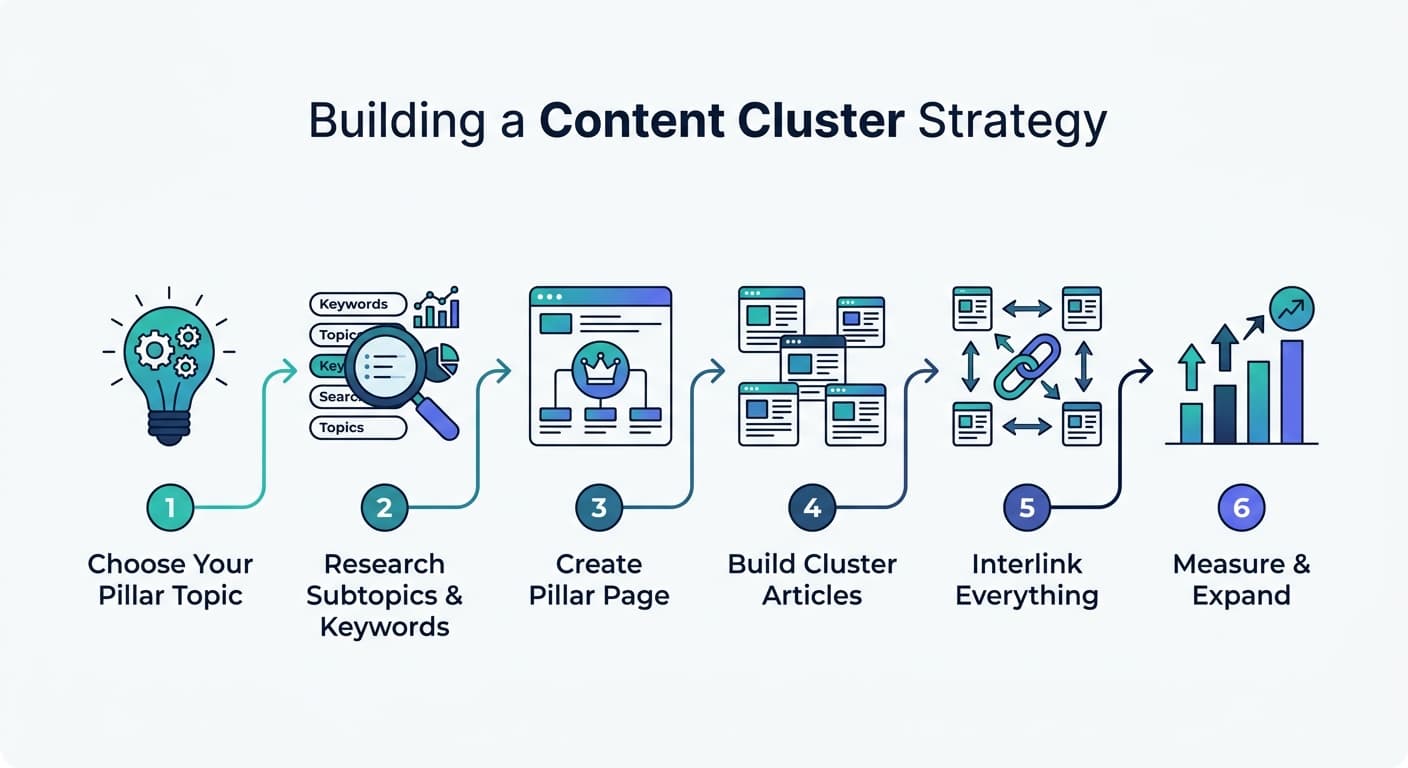
How to Plan a Content Cluster: A Step-by-Step Framework
Step 1: Choose Your Pillar Topics Strategically
Start by identifying the 3–5 broad topics your business genuinely has authority to speak on. These should be:
Commercially relevant — tied directly to your product, service, or audience
Broad enough to branch into 8–15 supporting subtopics
Searched consistently — with strong monthly search volume at the pillar level
Before creating a single post, a successful SEO content strategy starts by defining clear goals. Blog content for SEO should support real outcomes — not just traffic, but visibility at the right funnel stage, qualified leads, and long-term authority. When goals are clear, content planning for SEO becomes focused: each topic, keyword, and format is chosen because it serves a purpose.
Use our free Topical Map Generator to rapidly map out the full scope of topics your brand should own, or the Keyword Gap Analyzer to find the subject areas where competitors are outranking you.
Step 2: Audit Your Existing Content First
Before you create anything new, audit what you already have. Many sites have valuable content scattered in silos that could be reorganized into a cluster — saving months of production time.
Look for:
Orphan pages — content with no inbound internal links (use our Orphan URL Detector to find them)
Keyword cannibalization — multiple pages competing for the same query
Thin content — pages that cover a topic superficially and could be merged or expanded
Missing subtopics — gaps in your coverage that competitors are exploiting
Content decays. A post that ranked well in 2022 may have lost half its traffic by now because the information is outdated, competitors have published better versions, or the search landscape shifted after a core update.
Step 3: Build Your Pillar Page
The pillar page is the cornerstone of your content cluster. It covers a broad, high-volume topic comprehensively at a strategic level — meaning it addresses the full scope of the subject without going so deep on any subtopic that it eliminates the need for cluster pages. Think of it as an authoritative overview that explicitly invites readers to explore each component in more depth through supporting articles.
A strong pillar page should:
Be comprehensive but not exhaustive on any single subtopic
Include a clear table of contents for UX and crawlability
Link out to every cluster page it spawns
Target a broad, competitive head keyword
Incorporate structured data (Article, FAQ, HowTo schema where relevant)
Step 4: Map and Create Your Cluster Pages
Cluster pages are the supporting articles that surround the pillar and collectively build the topical authority the pillar page benefits from. Each cluster page targets a specific subtopic, long-tail keyword, or search intent related to the pillar topic. Where the pillar covers a broad topic at 3,000–5,000 words, cluster pages go narrow and deep: 1,500–2,500 words that comprehensively answer one specific question or cover one specific aspect of the broader topic.
Instead of writing a single post on "content marketing strategy," you build a pillar page on that topic, then cluster pages on content audits, content calendars, distribution, repurposing, and measurement. Every cluster page links back to the pillar.
Step 5: Execute Your Internal Linking Architecture
Internal linking is where most teams drop the ball. Getting it right is the difference between a collection of posts and a genuine content cluster.
Research confirms that content built with bidirectional linking — where the pillar links to cluster pages and each cluster page links back to the pillar with specific anchor text — earns AI citation at meaningfully higher rates than standalone articles. The link structure is not just a navigational aid. It is a signal to retrieval systems about the relationships between content units.
Key internal linking best practices:
Pillar → Cluster: Link from the pillar page to every cluster page using descriptive anchor text
Cluster → Pillar: Every cluster page links back to the pillar
Cluster → Cluster: Cross-link sibling pages where topics overlap or compare
Use descriptive anchor text — never "click here" or "read more"
Place links to your most important content within the first 30% of each page, where 44.2% of all AI citations originate.
Use the Internal Linking Audit tool to check that your link architecture is working as intended and surface any gaps.
Step 6: Launch Strategically
Ship the pillar and first 6–8 spokes together when possible. Add all internal links on day one — don't wait for future sprints.
Launching your cluster in a coordinated batch signals topical momentum to crawlers and helps the entire cluster gain traction together, rather than each piece gaining authority in isolation.
Step 7: Measure, Refresh, and Expand
AI citations drop sharply when content ages past 90 days, especially on ChatGPT and Perplexity where LLMrefs's 2026 tracking noted a visible decline in citations for content older than three months.
To stay in the citation set, review every pillar and high-value cluster page quarterly by updating statistics, adding recent developments, and refreshing the dateModified schema value.
Key metrics to track for each cluster:
Organic traffic growth across all cluster pages (not just the pillar)
Keyword rankings — both head terms on the pillar and long-tails on cluster pages
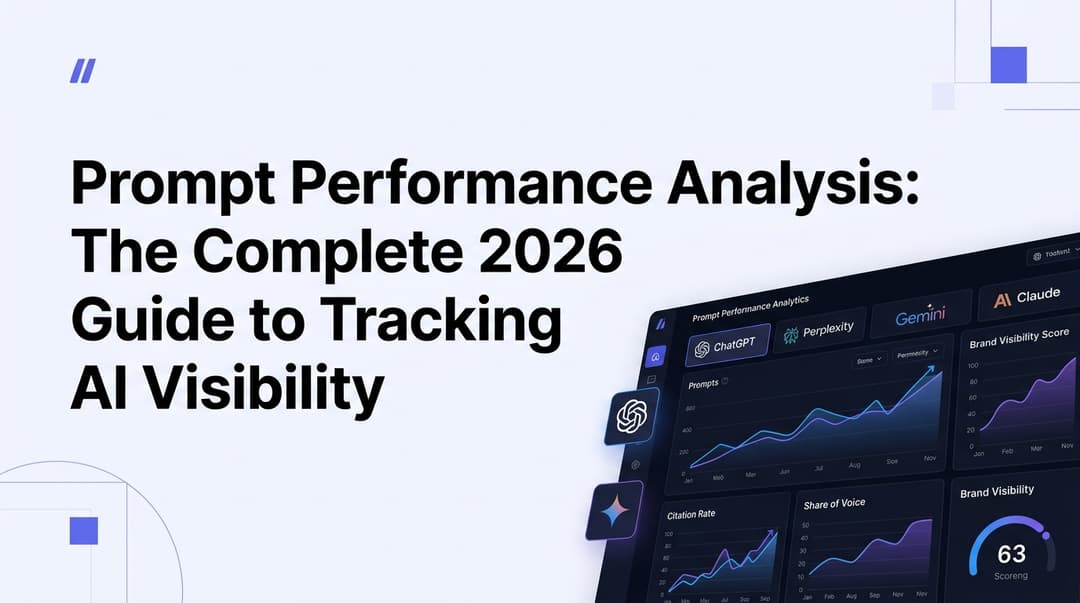
AI citation share of voice — are you showing up in ChatGPT, Gemini, and Perplexity answers?
Bounce rate and time on page — signals of content quality and relevance
Internal link click-throughs — are users navigating between cluster pages?
Content Cluster Planning for AI Search: What's Different in 2026
The pillar-cluster model was built for Google. But in 2026, it's now the primary architecture for winning AI search citations as well — and a few things are worth planning for specifically.
AI Engines Reward Depth Over Breadth
LLMs and generative search resolve over 60% of informational queries directly on the SERP, making keyword matching a legacy tactic. AI search engines process the structural relationship between ideas, meaning websites must pivot from isolated posts into interconnected, semantic knowledge graphs.
Answer-First Formatting Matters
Map clusters around a question hierarchy — start with core questions, branch into subtopics, then specific implementation details. Use AI query analysis to find frequently asked but poorly addressed questions in your category — these are your citation gaps.
Structure your cluster pages with a direct answer in the opening paragraph (before any preamble), followed by the detailed explanation. This "answer-first" format gives AI retrieval systems a clean chunk to extract and cite.
Schema Markup Amplifies Citation Rates
In one documented test, adding FAQ content with FAQPage schema increased AI citations from 529 to 2,379 — a 350% increase. Use the AI Schema Markup Generator to create the right structured data for each content type in your cluster.
Orphan Pages Are a Silent Killer
Audit for orphan pages regularly — pages with no inbound internal links are frequently missed by AI crawlers entirely. If a cluster page has no internal links pointing to it, it's essentially invisible to both search engines and AI systems.
Common Content Cluster Planning Mistakes to Avoid
Even experienced SEO teams make these errors when building out their clusters:
Making the pillar too narrow. If your pillar topic can't spawn at least 8 legitimate cluster pages, it's a cluster page itself, not a pillar.
Making the cluster pages too broad. Each cluster page should answer one specific question or cover one specific subtopic — not try to cover everything at once.
Forgetting bidirectional links. A cluster page that doesn't link back to the pillar breaks the authority flow.
Launching one piece at a time. A lone pillar page with no cluster pages looks thin to search engines. Launch at least 5–6 cluster pages alongside or shortly after the pillar.
Never refreshing. The benefits extend beyond rankings. A well-structured content marketing workflow guide becomes easier to maintain when organized as clusters. You can update individual pieces without overhauling everything, and new content fits naturally into existing frameworks.
Ignoring keyword cannibalization. If two cluster pages target nearly identical queries, they'll undercut each other. Use the Keyword Cannibalization Checker to catch this before it hurts rankings.
How QuickSEO Automates Content Cluster Execution
Planning a content cluster is one thing. Executing it — consistently, at scale, on-brand — is where most teams stall.
QuickSEO identifies the content gaps in your niche, writes fully researched, internally linked cluster articles, and publishes them directly to your site — every day, on autopilot. It finds where you're invisible in Google and AI chatbots, writes on-brand articles built to rank and get cited, and handles everything from keyword research to publication without any copy-paste.
💡 Ready to stop planning and start ranking?QuickSEO finds your content gaps, builds out your topic clusters with research-backed articles, and publishes them live to your site — automatically. No manual work, no copy-paste, no wasted effort. Join the sites already climbing in Google, ChatGPT, Claude, Gemini, and Perplexity. Start growing your organic traffic →
Conclusion
Content cluster planning isn't a trend — it's the architecture of modern search visibility. In 2026, a strong content cluster strategy is no longer optional — it's essential.
A modern topic cluster content strategy allows teams to adapt to evolving algorithms, shifting user expectations and new search behavior signals. It connects content meaningfully across multiple platforms and supports long-term ranking opportunities.
The sites winning in both Google and AI search in 2026 aren't the ones publishing the most content — they're the ones publishing the most connected content. Every pillar page, every cluster article, every internal link is a vote of confidence that compounds over time.
Start with one cluster. Pick your most important topic, map 8–10 subtopics, write the pillar, write the spokes, link everything together — and then watch the whole structure rise together. That's the power of content cluster planning done right.

 Summarize in ChatGPT