Internal Linking Strategy: The Complete 2026 SEO Guide

 Summarize in ChatGPT
If there's one SEO lever that consistently delivers results without requiring a new backlink campaign, a site redesign, or a content blitz — it's internal linking. Yet most websites, even well-funded ones, treat it as an afterthought.
In 2026, that mistake is increasingly costly. Google's entity-based algorithms, AI Overviews, and LLM-powered chatbots like ChatGPT, Claude, Gemini, and Perplexity all depend on clear, structured content relationships to understand your site. A strong internal linking strategy is no longer a "nice to have" — it's a technical requirement.
This guide covers everything: why internal linking matters more than ever, how to architect your site for maximum link equity flow, and the step-by-step tactics you need to turn your existing content into a ranking machine.
Why Internal Linking Is a Foundational SEO Signal in 2026
Internal links are hyperlinks that connect pages within the same domain. They're the road network your site runs on — guiding users from one piece of content to the next, and telling crawlers which pages matter most.
Internal linking connects pages within the same domain. It guides users and crawlers, concentrates authority on priority pages, clarifies topic relationships, and improves crawlability, indexation, and conversions.
The numbers back this up. Internal linking can boost search rankings by up to 40%, improve crawl efficiency by 40% to 70%, and drive traffic increases of 31% or more in just a few months.
But beyond raw rankings, the SEO landscape of 2026 makes internal linking even more critical. In 2026, SEVO (Search Everywhere Optimization) and AEO (Answer Engine Optimization) reward sites that make relationships between topics obvious: clear hubs, descriptive anchors, and predictable click paths. The upside isn't just Google — social and AI/LLM summaries favor pages that are easy to traverse, cite, and understand, which is exactly what a strong internal link system provides.
Internal linking has always been part of SEO, but today it is a precision-led discipline that impacts crawl efficiency, topic authority, engagement, and rankings, far more than most teams realise. Google's evolving systems increasingly depend on structured internal pathways to interpret context, assign authority, and understand which pages matter most.
The Three Core Functions of Internal Links
Understanding what internal links actually do for your site is the first step to using them strategically.
The three core SEO functions of internal links are: distributing PageRank across pages to pass authority from high-equity pages to those needing a rankings boost; establishing topical authority through semantic connections that signal topic depth to Google; and creating a navigational structure that helps search engines understand content importance.
Let's break each one down:
1. PageRank and Link Equity Distribution
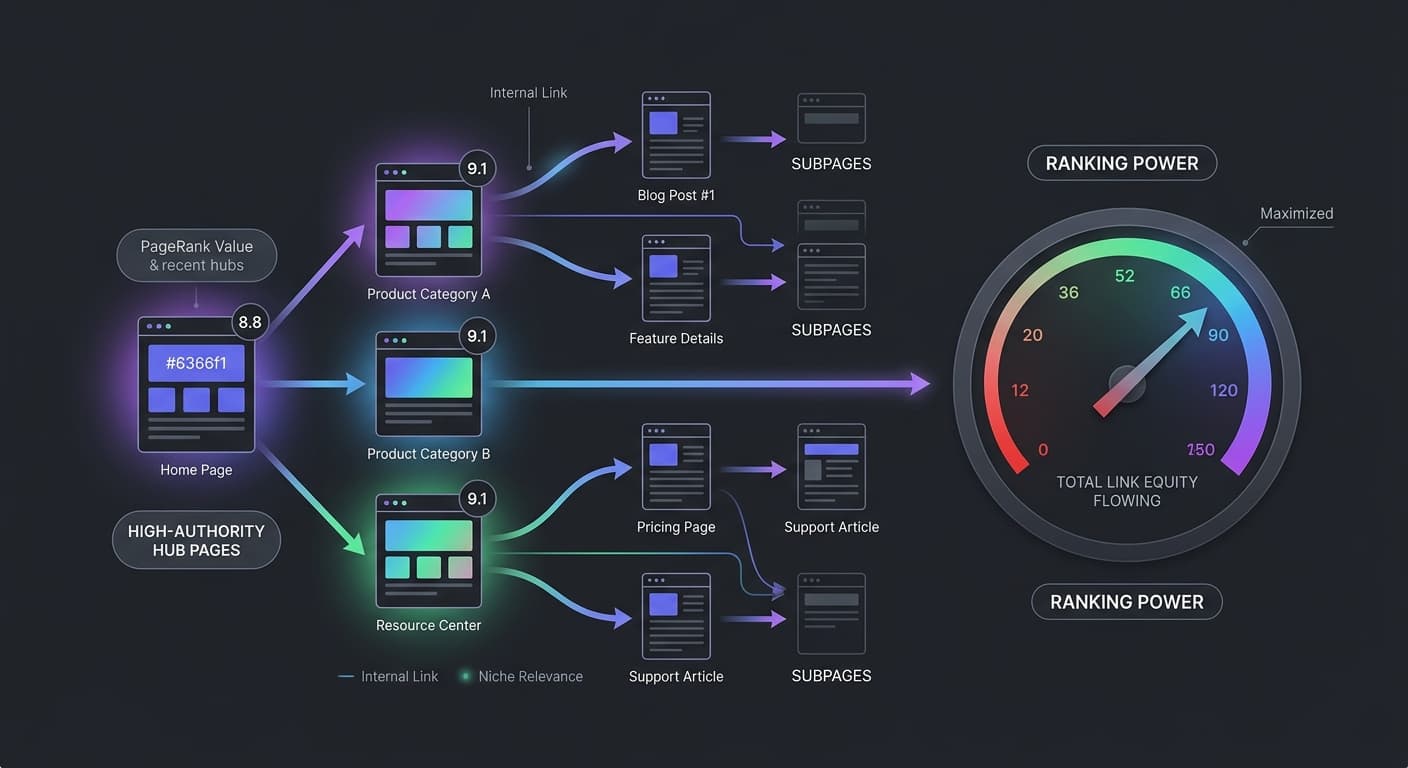
Internal links are the "plumbing" that moves PageRank from strong pages (home, linked assets) to priority URLs. Every time you publish a high-traffic blog post and link from it to a commercial service page, you're passing real ranking power to that service page.
Internal links move authority from strong pages to pages that need it. A link from a high-traffic blog post to a commercial service page passes measurable ranking power to that service page.
2. Crawlability and Indexation
The frequency of internal links to a page signals its importance to search engines. Pages receiving links from many other pages appear more significant, prompting prioritized crawling and faster indexing.
This is critical at scale. Pages four or more clicks deep see approximately 70% less crawl frequency than pages within two clicks. Strategic internal linking flattens your architecture so important content stays within crawling range.
3. Topical Authority and Semantic Context
Google's entity-based algorithms use link relationships to understand topical authority clusters. When your pages link to semantically related content, you're not just passing authority — you're telling Google what your site is about as a whole. Google now uses internal link graphs to map topical authority clusters. Random linking confuses entity relationships; strategic linking strengthens them.
Site Architecture: Build Your Pyramid First
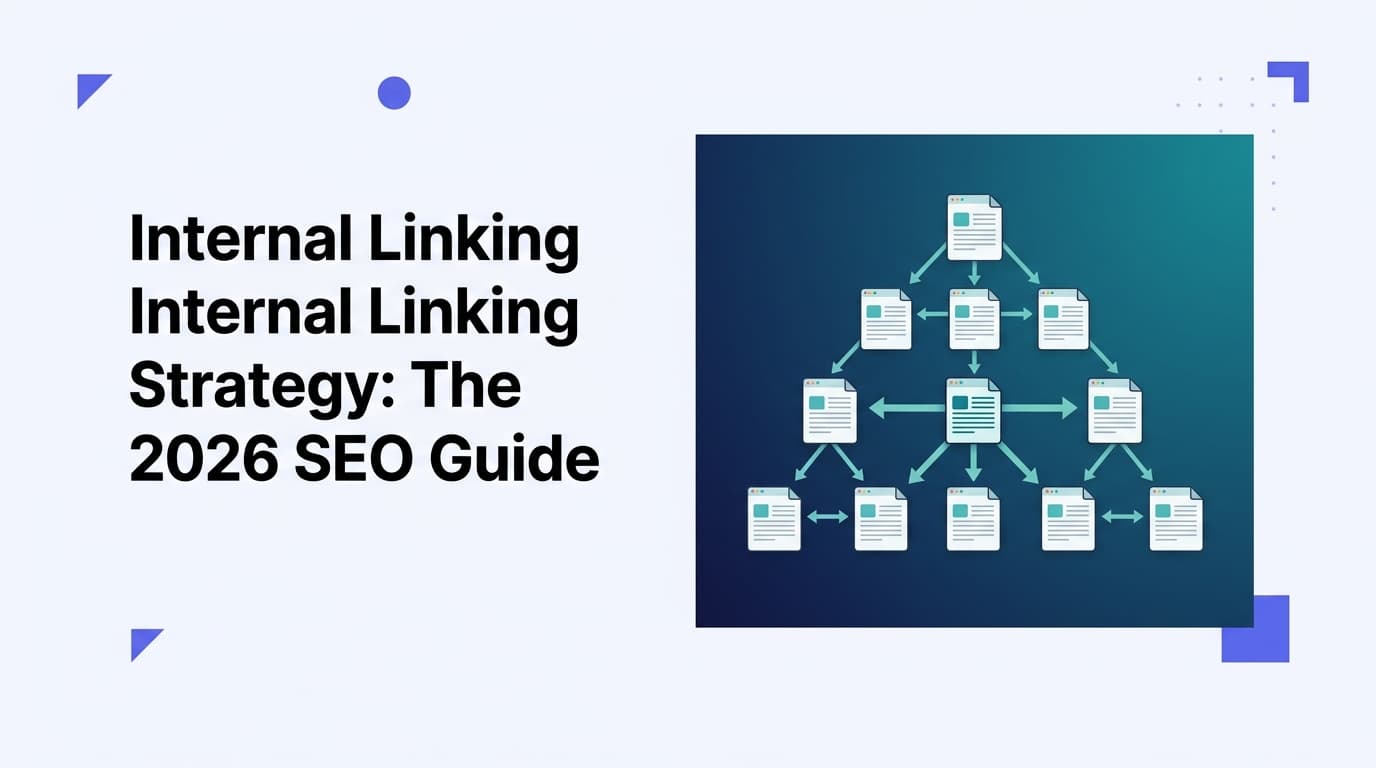
Before you place a single link, you need a solid architecture. A solid internal linking strategy can boost rankings by up to 40% and improve organic traffic significantly. A well-organized architecture ensures that authority flows naturally to your most important pages and helps search engines understand your content better. Imagine your site as a pyramid: broad, overarching pillar pages sit at the top, with detailed cluster content branching out below.
The rules are simple:
Keep critical pages within 3 clicks of the homepage. Every critical page should be no more than three clicks away from the homepage. Pages buried deep in your site often miss out on link equity and struggle to rank.
Eliminate orphan pages. Studies reveal that about 40% of internal link value is wasted on poorly structured websites with orphaned pages. You can quickly surface these issues with the Orphan URL Detector to find pages that aren't receiving any internal links.
Limit navigation complexity. For navigation, simplicity is key. Research suggests limiting main menu options to 7±2 items to minimize cognitive load.
Topic Clusters: The Engine of Topical Authority
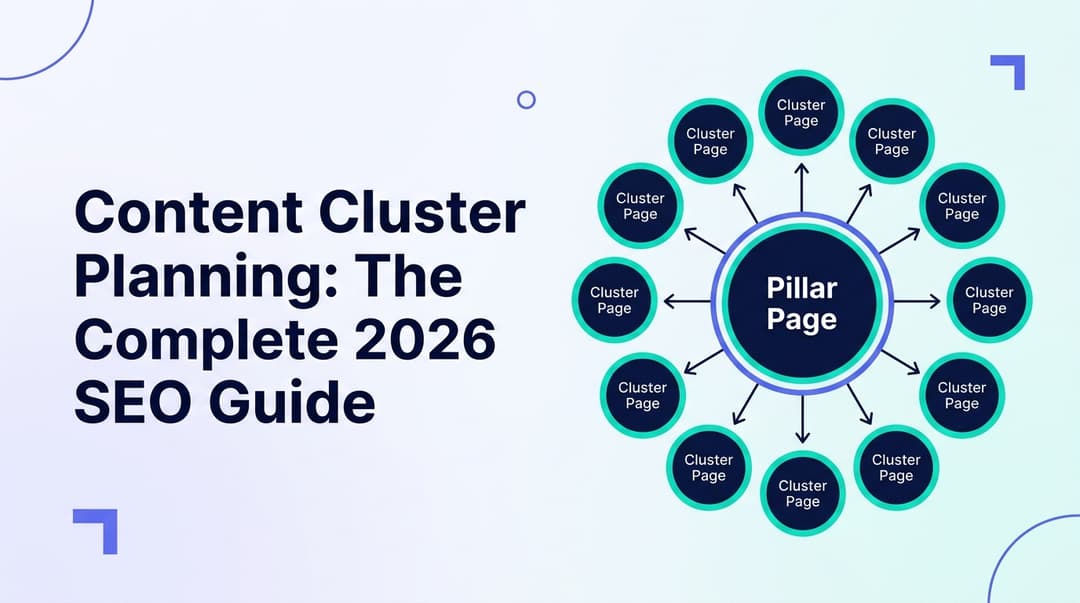
The most effective internal linking strategy in 2026 is built around topic clusters — a model where a central pillar page covers a broad topic and links to multiple cluster pages that go deep on specific subtopics, all of which link back to the pillar.
Internal links should form content hubs where related articles connect to each other and to a central pillar page. This signals to Google: "We have comprehensive coverage of this topic."
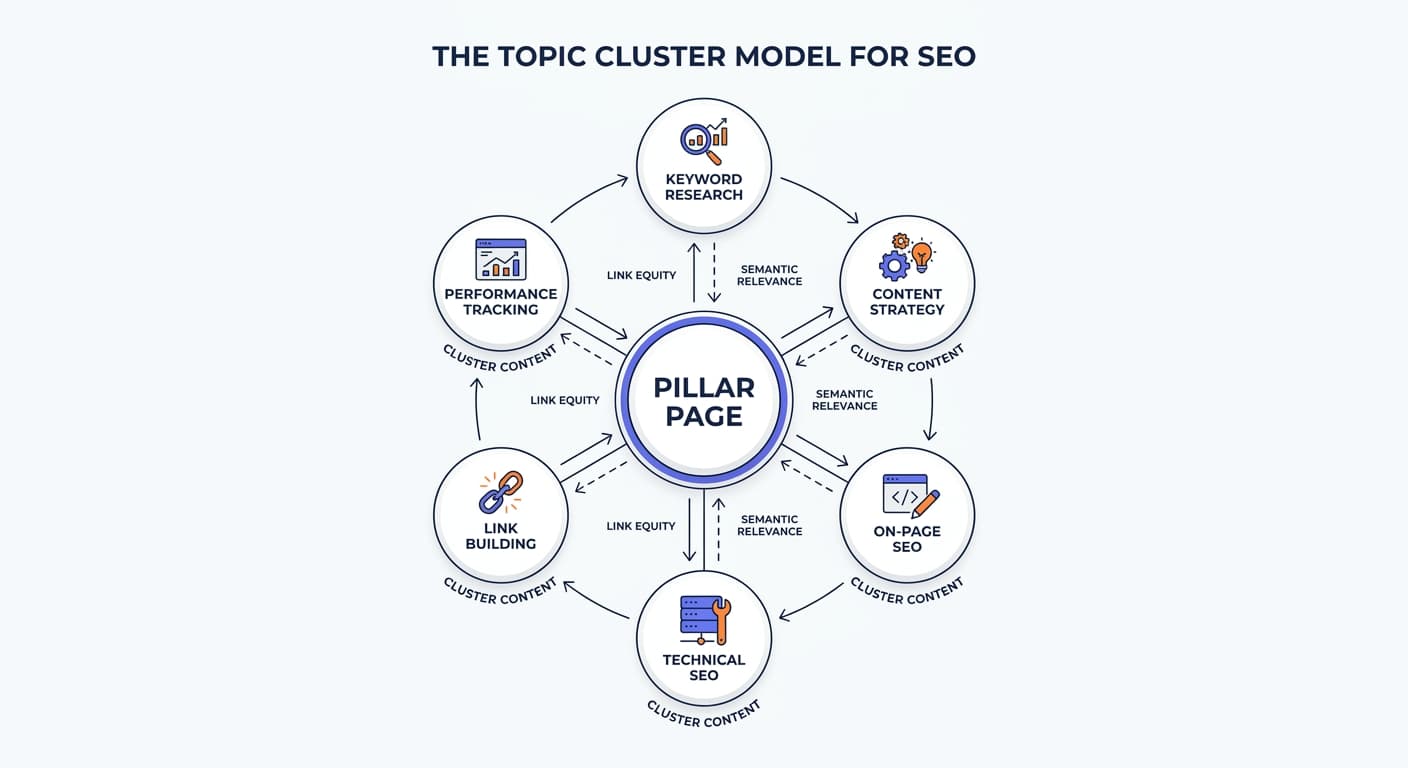
Here's what a well-structured cluster looks like in practice:
Identify your pillar topic — a broad, competitive keyword your business wants to own (e.g., "email marketing").
Map cluster content — supporting articles that cover specific subtopics (e.g., "email subject line best practices," "email automation workflows," "email list segmentation").
Create bidirectional links — every cluster page links back to the pillar; the pillar links out to all cluster pages.
Connect clusters to clusters — where topics naturally overlap, link between cluster pages across different hubs.
The most powerful internal linking strategies in 2026 focus on contextual relevance rather than arbitrary connections. Each internal link should provide genuine value to users while supporting your overall content strategy.
Anchor Text: The Most Underrated Internal Linking Signal
Anchor text carries more SEO weight than most internal linking guides acknowledge. Google's documentation on crawlable links confirms that anchor text helps both users and search engines understand the context of the destination page before they visit it.
Anchor text is one of the strongest on-page signals Google uses to determine the topic of a linked page. Descriptive, keyword-rich anchors tell crawlers exactly what the destination page covers. Generic phrases like "click here" or "read more" waste that signal entirely, offering no topical context to either users or search engines.
Anchor text best practices for 2026:
Use descriptive, natural language. Use descriptive, varied anchor text that flows naturally. Avoid overusing exact-match keywords.
Prefer partial-match and long-tail anchors. These consistently outperform exact-match anchors for contextual relevance signals.
Never nofollow internal links unnecessarily. Internal links should be followed so PageRank and context flow through your site. For low-value or non-public destinations (login, account, cart), consider removing the link from crawlable areas. Reserve nofollow for cases where you truly don't want association or equity to pass, which is rare for internal navigation.
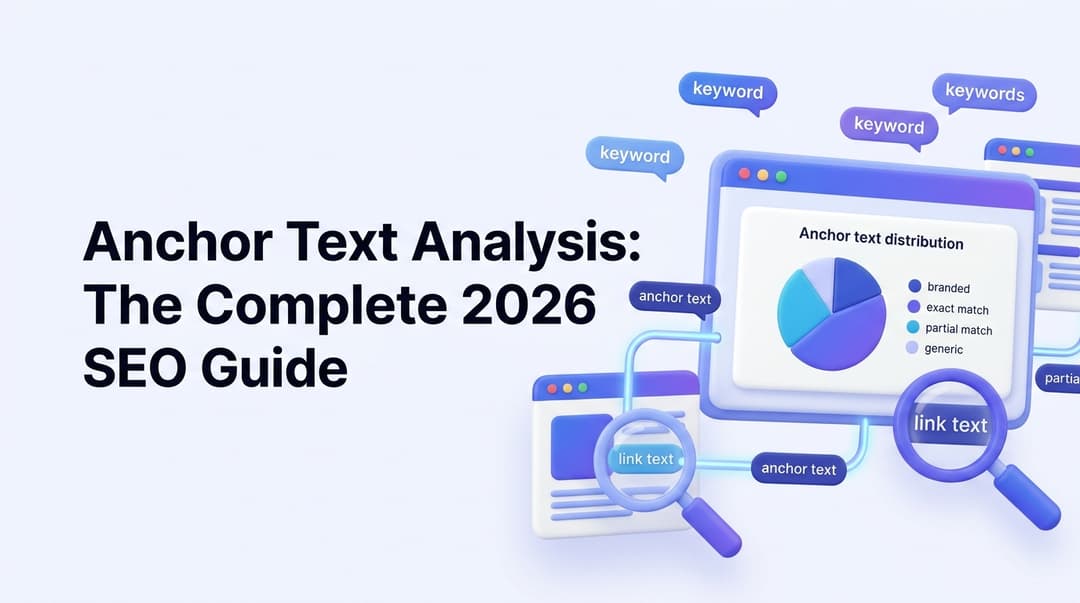
Use the Anchor Text Distribution Analyzer to get a clear picture of how your anchor text is currently distributed across your site, and where you're leaving context signals on the table.
Link Placement: Context Is Everything
Not all link placements are created equal. Not all link placements carry equal weight. Google's patents describe a distinction between "specialized content" and "boilerplate content." Links placed within your main content area are treated as editorial endorsements. Links in footers and sidebars are treated as navigational infrastructure. The difference in ranking impact is significant.
The three types of internal links — ranked by SEO value:
Link Type | Placement | SEO Weight | Best Use |
|---|---|---|---|
Contextual links | Main body content | Highest | Topic cluster connections, related guides |
Navigational links | Header, menu, breadcrumbs | Medium | Site hierarchy, key category pages |
Footer links | Page footer | Lower | Utility pages, trust signals |
The number and placement of links on a page can make or break your internal linking strategy. Aim for 2–5 contextual links per 1,000 words, and increase to 5–10 links for longer content around 2,000 words. These links should flow naturally within your main content, rather than being crammed into sidebars or footers.
Internal Linking for AI Search Visibility
Here's what most SEO guides in 2026 still miss: internal linking isn't just for Google anymore.
Strategic internal linking creates meaningful content relationships that AI search engines use to understand how deeply you covered the topic and how your website is organized. In simple terms, it tells the machine learning ranking algorithm which content is most important and how concepts relate to each other.
A well-linked site is crawled more completely by AI indexers; orphaned pages with few internal links are less likely to be discovered and cited.
This is a direct connection between your internal linking strategy and your ability to get cited in ChatGPT, Claude, Gemini, and Perplexity. Technical foundations like strong internal linking affect how reliably AI models crawl and interpret your content.
As AI-driven search engines and answer engines increasingly rely on clear topical relationships, internal linking will play an even bigger role in establishing authority and boosting discoverability across platforms.
For a deeper dive into how AI models decide what to cite, check out our guide on LLM citation sources and how AI chatbots choose what to reference.
Common Internal Linking Mistakes to Avoid
Even experienced SEOs fall into these traps:
Orphan pages — Orphan pages are pages with no internal links pointing to them. Google struggles to find and rank them.
Keyword cannibalization via linking — Link stuffing confuses Google and weakens authority. Pages compete instead of supporting each other, leading to keyword cannibalization. Use the Keyword Cannibalization Checker to spot this early.
Generic anchor text — Using "click here," "read more," or "learn more" instead of descriptive, keyword-rich anchors.
Burying important pages — Pages buried deep in your site often miss out on link equity and struggle to rank.
Neglecting cluster page interlinks — Linking only to the pillar but not between related cluster pages weakens the topical authority signal.
Ad-hoc, inconsistent linking — Most websites, even enterprise websites, use internal links inconsistently or incorrectly. Teams still rely on ad-hoc linking or outdated "link everything everywhere" methods. This weakens topic structure, scatters authority, and prevents key pages from ranking.
How to Audit Your Internal Linking Structure
A great internal linking strategy needs regular maintenance. Here's a practical audit workflow:
Step 1: Crawl Your Site
Run a full site crawl to map every internal link, identify broken links, surface orphan pages, and measure click depth. The Internal Linking Audit tool is a fast way to get a consolidated view of your site's link health.
Step 2: Identify High-Authority Pages
Find your pages with the most external backlinks and organic traffic — these are your PageRank sources. Make sure they link to your priority conversion pages.
Step 3: Map Orphan Pages
Do regular audits to identify broken links, orphaned pages, redirect issues, and optimize anchor texts. Every orphan page is a wasted opportunity.
Step 4: Audit Anchor Text Distribution
Review whether your anchor text is descriptive and varied. Look for over-reliance on exact-match anchors or generic phrases.
Step 5: Check Crawl Depth
Map how many clicks it takes to reach each important page. Any priority page beyond 3 clicks should be moved closer to the surface.
Step 6: Identify Linking Gaps
Find topically related pages that aren't linked to each other. These are your fastest wins — add contextual links and you'll see ranking movement within weeks.
Internal Linking at Scale: Tools and Automation
For sites with hundreds or thousands of pages, manual linking simply doesn't scale. Effective management at scale requires tools that can analyze your site structure, identify opportunities and problems, and track the impact of your internal linking structure strategies. While manual linking works for small sites, larger sites with hundreds or thousands of pages need automated analysis.
Key tools to incorporate into your workflow:
Internal Link Graph Mapper — Visualize your site's internal link structure as a graph to spot connection gaps and authority silos.
Site Depth Visualizer — See exactly how deep your pages are buried and which ones need elevation.
Click Depth Estimator — Estimate the number of clicks required to reach any page from the homepage.
Broken Link Checker — Catch dead internal links before they leak PageRank.
Quick-Win Internal Linking Tactics for 2026
If you want results fast, start with these high-impact moves:
Link new content from existing high-authority pages — Every time you publish, find 2–3 existing pages to link from. This immediately gives new content a ranking boost.
Update old posts with new internal links — Go back to your 20 highest-traffic posts and add links to pages you want to rank.
Fix your top orphan pages first — Prioritize orphan pages that already have some external backlinks. One internal link from a related hub page can dramatically improve their rankings.
Build "related posts" sections contextually — Not in a generic sidebar widget, but within the content body where thematic relevance is clear.
Use breadcrumb navigation — Navigational links in header, mega menu, sidebar, and breadcrumb links outline your hierarchy and keep key pages within a few clicks.
Ready to Turn Your Content Into an Organic Traffic Machine?
At QuickSEO, we automatically find the keyword gaps where you're invisible in Google and AI chatbots, write on-brand articles built to rank and get cited, and publish them directly to your site — every day. Every article is internally linked from day one, building the exact kind of topic cluster architecture described in this guide. **Stop leaving rankings on the table. ****Start growing your organic traffic with QuickSEO →**
Conclusion
Internal linking is one of the highest-ROI activities in SEO — and in 2026, its importance has only grown. With Google relying on entity relationships and topical authority signals, and AI systems like ChatGPT and Perplexity depending on well-structured site architectures to decide what to cite, the cost of a weak internal linking strategy has never been higher.
The good news: unlike backlink building or major site redesigns, internal linking is entirely within your control. You can start improving it today.
Build your pillar-cluster architecture. Use descriptive anchor text. Keep priority pages shallow. Eliminate orphan pages. And audit regularly. Do these things consistently, and your site will compound its authority month after month — in both Google search results and AI-generated answers.
For more on the broader SEO strategies that complement your internal linking work, explore the QuickSEO blog — packed with data-driven guides for every stage of your organic growth journey.
Enter your website to track its AI visibility across ChatGPT, Gemini, Claude, and Perplexity — and turn chatbot mentions into traffic.
- Set up in minutes
- Cancel anytime
Keep reading
Related posts
More articles on the same topics, prioritized by shared tags and keyword overlap.