Summarize in ChatGPT
If you've ever published a technically flawless page — optimised title tags, solid backlinks, clean schema — and watched it refuse to rank, search intent mismatch is almost certainly the culprit. In 2026, getting search intent right is no longer a "nice to have" SEO tactic. It is the single most decisive factor separating pages that rank from pages that languish on page four.
This guide will walk you through everything you need to know about search intent mapping: what it is, why it matters more than ever in the age of AI search, the four (and now five) core intent types, and a repeatable step-by-step process you can apply to your entire content library today.
What Is Search Intent Mapping?
Search intent mapping is a modern SEO strategy that focuses on understanding what users actually want when they type a query into a search engine. Instead of only targeting keywords, it organises content based on user goals and needs.
More precisely, search intent mapping is the process of categorising and aligning keywords or search queries with the underlying purpose behind them. Every search has an intent; users may want information, a product, a website, or a comparison. Mapping helps SEO professionals connect these intents with the right content type.
The practical upshot is powerful: by aligning content with user intent, websites can increase visibility, reduce bounce rates, and improve engagement across all types of search queries effectively and consistently.
Why Search Intent Mapping Is Critical in 2026
Search intent mapping is extremely important in 2026 because search engines are now powered by advanced AI systems that understand user behaviour deeply. Google no longer relies only on keywords but analyses context, engagement, and satisfaction signals. If the content does not match the intent, it will not rank well, even with strong keywords.
Algorithms now use NLP, entity recognition, and behavioural data — dwell time, bounce rates, return searches — to understand what a user actually wants. Keyword stuffing doesn't fool it. Thin content doesn't hold rankings. If your page doesn't satisfy the intent behind a query, it won't rank — no matter how well it's technically optimised.
The consequences of getting this wrong are stark. Hundreds of technically optimised pages with strong backlinks fail to rank for one reason: they are the wrong content type for the query. A service page targeting 'how to' keywords, or a blog post targeting 'buy' keywords, are both intent mismatches that no amount of technical SEO can fix.
For a deeper look at how search behaviour is shifting, see our search intent research guide and our breakdown of search visibility trends in 2026.
The 4 Core Search Intent Types (Plus the New Fifth)
The four intent types are: informational (learn something), navigational (find a specific site), commercial (compare options), and transactional (take action). Here's how each one works in practice:
1. Informational Intent
Informational intent mapping focuses on users who are looking for knowledge or answers. These searches often start with words like "how," "what," or "why." Content for this intent usually includes blog posts, guides, tutorials, and FAQs.
In 2026 SEO, informational intent is very important for building authority and trust. Search engines reward websites that provide clear and helpful answers.
Example queries: "how does SEO work," "what is a canonical tag," "why is my site not indexing"
Best content formats: Long-form guides, how-to articles, explainer videos, FAQ pages
2. Navigational Intent
Navigational searches occur when users want to find a specific website or page. These queries often include brand names or specific product names. Navigational intent indicates high brand awareness and often represents users who are already familiar with your company or seeking a specific destination online.
Example queries: "Ahrefs login," "Google Search Console dashboard," "QuickSEO pricing"
Best content formats: Well-structured homepage, branded landing pages, login/account pages
3. Commercial Investigation Intent
Commercial investigation represents users who are researching products or services before making a purchase decision. These queries often include terms like "best," "review," "comparison," or "vs." This intent type is crucial for businesses as it represents users in the consideration phase of the buying journey.
Commercial search intent appears when the user has identified a need and is comparing options. In B2B, it is often where qualified leads are generated: the prospect is looking for criteria, limitations, real-world feedback, and quantified proof.
Example queries: "best SEO tools 2026," "Semrush vs Ahrefs," "QuickSEO review"
Best content formats: Comparison articles, "best of" listicles, review pages, side-by-side tables
4. Transactional Intent
Transactional queries indicate users ready to take action, whether making a purchase, signing up for a service, or completing a specific task.
Example queries: "buy SEO software," "sign up for keyword tracker," "download SEO template"
Best content formats: Product pages, pricing pages, sign-up flows, landing pages with strong CTAs
5. Generative AI Intent (The New Fifth Type)
The fifth type — Generative AI Intent — is growing fast. Users are asking AI tools to do things, not just answer questions. For some queries, being cited in an AI-generated answer now matters more than ranking first organically.
If you want to rank in traditional Google results, you still need to optimise for informational, navigational, commercial, and transactional intent. But if you want visibility in ChatGPT, Perplexity, or Claude, you need to optimise for exploratory, comparative research, and synthesis intent. The smartest strategy: optimise for both.
How to Map Search Intent: A Step-by-Step Process
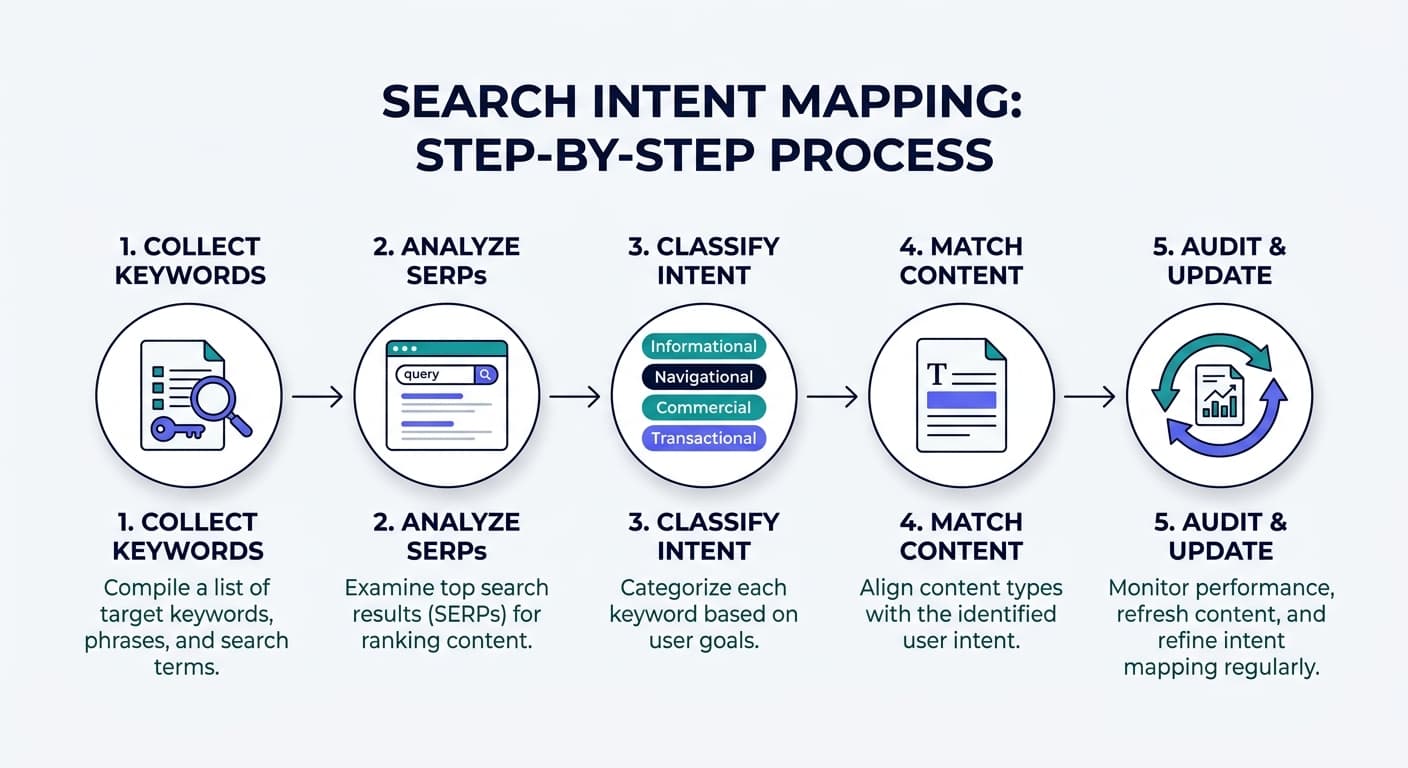
Creating a search intent map involves several steps: conduct keyword research using SEO tools, analyse search results to understand the intent behind queries, and group keywords based on intent categories, like informational or transactional.
Here's the full, actionable framework:
Step 1: Build Your Keyword List
Start with a comprehensive keyword pull using tools like Google Search Console, your own site data, or QuickSEO's keyword gap analyser. Prioritise keywords that are relevant to your product or service across all funnel stages.
Effective implementation of search intent classification begins with comprehensive keyword research that goes beyond search volume and competition metrics. Modern keyword research must include intent classification as a primary factor in keyword selection and content planning.
Step 2: Analyse the SERPs
Search intent optimisation is the practice of matching your page's content format, depth, and angle to what Google's top-ranking results reveal about what users actually want for a given query. In 2026, intent alignment is the most common reason technically sound pages fail to rank and the fastest fix available.
For each keyword, examine the top 5–10 results:
Content type: Is Google surfacing blog posts, product pages, or videos?
Content format: Are results listicles, step-by-step guides, or comparison tables?
Content angle: Do titles emphasise recency ("2026"), comprehensiveness ("complete list"), or specificity ("for agencies," "for enterprises")?
SERP features: Featured snippets and PAA boxes indicate informational dominance.
Step 3: Classify Each Keyword by Intent
Once you've analysed the SERPs, assign each keyword to one of the five intent types. Use a spreadsheet or a dedicated tool. Pick one "primary job to be done" per cluster. If the query is mixed, decide what your page will satisfy first. Classify the dominant intent.
Pro tip: Context has become crucial for accurate intent classification in 2026. The same query can have different meanings depending on user location, device, time, and previous search behaviour. Advanced classification systems now incorporate contextual signals to provide more accurate intent determination.
Step 4: Segment Keywords into Intent Clusters
Don't work keyword-by-keyword. Group semantically related queries together. Start by segmenting your keyword cluster into intent intensity levels: low-intent exploratory, medium-intent evaluative, and high-intent decisive.
Intent mapping without clustering produces page-level analysis that misses the relational dynamics between topics. Each cluster should have a single dedicated page — not multiple pages competing for the same intent, which causes keyword cannibalisation. Use our keyword cannibalisation checker to surface any existing conflicts before you start building.
Step 5: Match Content to Intent
The goal is not to label keywords. The goal is to assign each meaningful query cluster to the right page type, internal links, and next step.
Use this quick-reference matching table:
Intent Type | Content Format | CTA |
|---|---|---|
Informational | Guides, how-tos, FAQs | Learn more, explore related topics |
Navigational | Brand pages, login pages | Go to dashboard, contact us |
Commercial | Comparisons, reviews, listicles | See demo, compare plans |
Transactional | Product/pricing pages, sign-up | Buy now, start free trial |
AI/Generative | Comprehensive, structured, cited | Referenced answers, entity coverage |
Step 6: Build Intent-Driven Internal Links
A few practical rules to build a clear journey between intent types: from informational, link to comparisons and case studies (natural progression to evaluation). From commercial, provide proof (customer story) and action (demo, quote) without multiplying CTAs on the same page. From transactional, reassure with links to FAQs, documentation, and use cases to remove final objections.
Intent mapping fails without structural linking. Make sure your internal link architecture guides users naturally from awareness to conversion.
Step 7: Audit and Refresh Regularly
Search intent can evolve as user behaviour and trends shift, so it's important to reassess intent periodically and update your content strategy to stay aligned.
Quarterly intent audits are standard practice for any serious topical authority build. Use your heading structure analyser and on-page tools to verify that updated content still aligns with what the SERPs are rewarding.
Common Search Intent Mapping Mistakes to Avoid
Even experienced SEOs fall into predictable traps. Here are the most damaging ones:
1. Mixing Intents on a Single Page
Trying to serve both "what is" and "buy now" on the same page weakens ranking. Choose one dominant intent per URL.
2. Assuming Intent Without SERP Analysis
SERP analysis (reading the top 5 results) is the only reliable method for identifying true search intent; never assume. Your intuition about a keyword's intent is often wrong.
3. Over-Indexing on One Intent Type
Most sites over-index on top-of-funnel informational content (because it's easier to write) and bottom-of-funnel transactional pages (because they convert). The commercial investigation and navigational gaps are where many brands leave significant traffic on the table.
4. Ignoring AI Search Intent
Most sites are only optimised for traditional intent. If you optimise for the new intent types, you win in AI search while competitors are still fighting over Google keywords.
5. Treating Intent as Static
Search intent shifts over time, especially in fast-moving niches. As new protocols emerge and user familiarity with the technology increases, the intent behind the same keywords can drift.
Search Intent Mapping and the AI Search Revolution
The rise of ChatGPT, Perplexity, Claude, and Gemini has fundamentally changed the intent landscape. Understanding how to analyse search intent has become one of the most critical skills for SEO professionals and content marketers in 2026. As search engines continue to evolve with advanced AI capabilities, the ability to decode what users truly want when they type a query determines the success or failure of your content strategy.
AI search engines look for specific formatting patterns that signal comprehensive, authoritative content. This means your intent-matched content needs to go beyond keyword alignment and into genuine topical depth — covering entities, answering follow-up questions, and structuring data in ways that AI models can extract and cite.
For brands who want to move beyond just ranking on Google and start being cited in AI responses, our complete guide to AI citation tracking walks through exactly how to make that happen.
How Intent Mapping Connects to Business Outcomes
Getting search intent right is not just an SEO exercise — it's a revenue lever. Consider this real-world example: a medium-sized SaaS firm used structured intent modelling to reshape its content plan — mapping 400 keywords by buyer phase, making awareness guides and comparative resources, and developing decision-oriented product content. The result: organic traffic rose 68% and qualified leads increased by 32%.
When you connect intent to the buying or conversion journey, your content stops being random. It becomes a structured path from research to action.
The framework is straightforward:
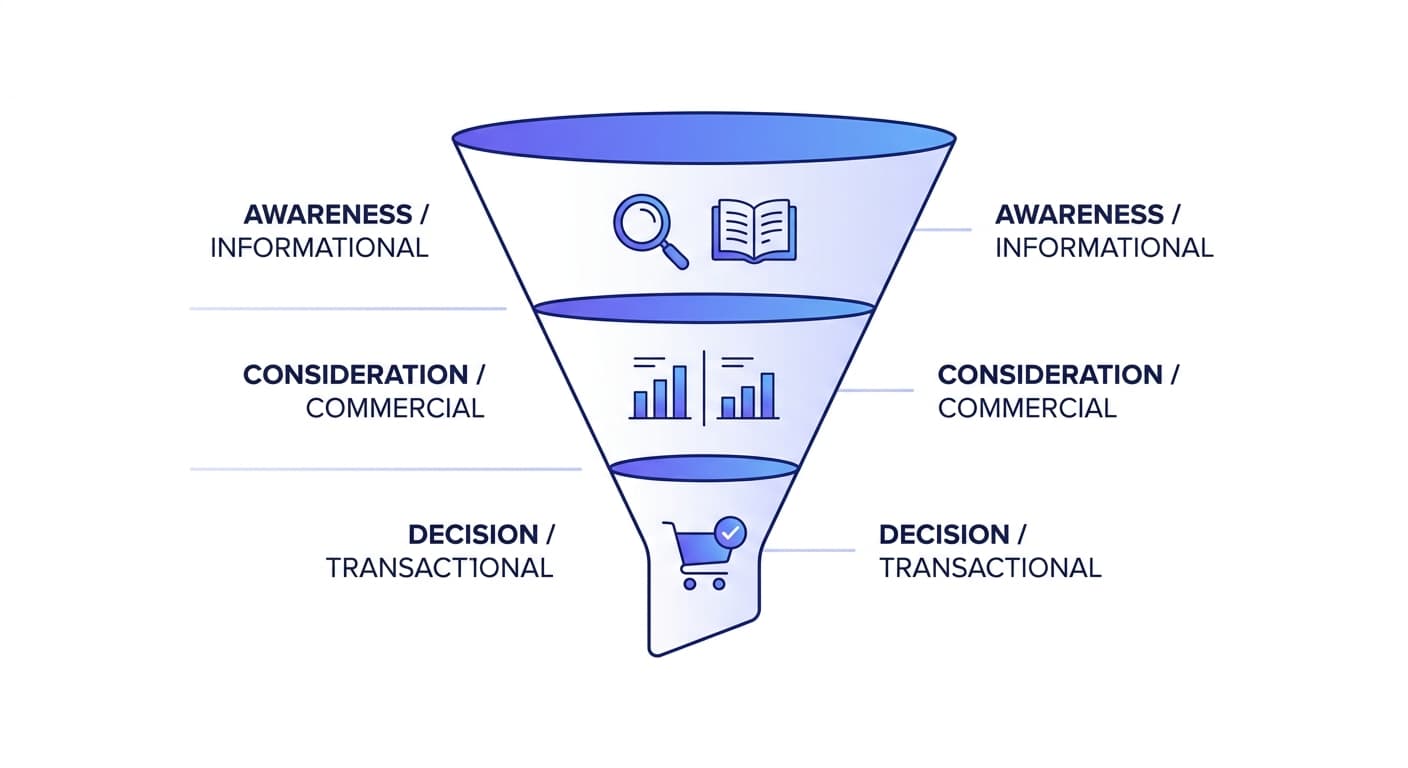
Awareness content (informational) builds trust and authority
Evaluation content (commercial) captures users comparing solutions
Decision content (transactional) converts intent into action
For short-term ROI, secure pages closest to action first — pricing, demo and quote pages (transactional), then comparisons and solution pages (commercial). Next, produce informational guides and resources to capture broader acquisition and feed conversion pages via internal linking planned upfront.
🚀 Stop Guessing. Start Winning.
QuickSEO finds the exact keyword gaps where you're invisible on Google and in AI chatbots like ChatGPT, Claude, Perplexity, and Gemini — then writes and publishes on-brand, intent-matched articles automatically, every day. No more intent mapping spreadsheets. No more copy-pasting. Just organic traffic, growing on autopilot. Try QuickSEO free at quickseo.ai →
Conclusion
Search intent mapping is the foundation of every effective content strategy in 2026. Search intent analysis goes beyond simple keyword research. It's about understanding the underlying motivations, needs, and expectations of your target audience. When you master this skill, you can create content that not only ranks well but also satisfies user needs and drives meaningful conversions.
The core process is repeatable: collect keywords, analyse SERPs, classify intent, cluster related queries, match content formats, build intentional internal links, and audit on a quarterly cadence. Do this consistently and you'll build a content portfolio that earns traffic not just from Google, but from every AI platform that's reshaping how people search.
The SEOs who win in 2026 won't be the ones with the best keyword research. They'll be the ones who understand how people actually search now and create content that serves those new search behaviours. Search intent mapping is how you get there.
Enter your website to track its AI visibility across ChatGPT, Gemini, Claude, and Perplexity — and turn chatbot mentions into traffic.
- Set up in minutes
- Cancel anytime
Try it yourself
Related free tools
Free SEO tools related to the topics covered in this article.
Keep reading
Related posts
More articles on the same topics, prioritized by shared tags and keyword overlap.