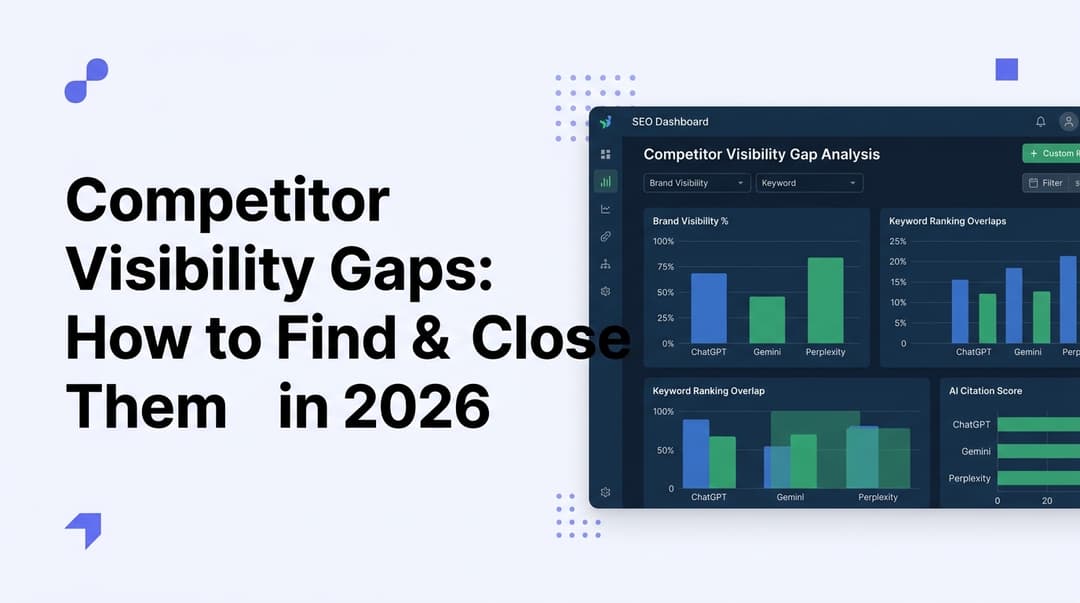
How to Find & Fix Competitor SEO Gaps in 2026: The Complete Playbook

 Summarize in ChatGPT
Your competitors have already done years of SEO testing on your behalf. Every keyword they rank for tells you something about what your target audience is searching for. Every backlink they've earned points to websites open to linking to content like yours. Every content gap in their portfolio is an opportunity for you to rank where they do not.
But in 2026, the competitive SEO landscape has added a critical new dimension: AI visibility. SEO competitor analysis now covers AI surfaces — like Google AI Overviews, ChatGPT Search, and Perplexity — where competitors may be winning citations. It covers both traditional Google rankings and AI surfaces, where citation share is an entirely separate metric from organic rank.
This guide gives you a complete, modern framework for finding and closing every type of competitor SEO gap — keyword, content, backlink, technical, and AI visibility — so you can build a data-driven strategy that compounds over time.
What Is a Competitor SEO Gap Analysis?
An SEO competitor analysis is the process of studying the websites that rank above you in search results to understand what they are doing differently. It looks at their keywords, content, backlinks, technical performance, and authority signals to find gaps you can close and opportunities you can take.
Think of it this way: your competitors have already done years of testing. They know what Google rewards. Instead of starting from scratch, you can learn from their wins and weaknesses and build a smarter strategy around them.
Most teams treat SEO gap analysis as a simple keyword comparison. But a real gap analysis goes deeper. It shows where competitors cover topics more thoroughly, where their websites are easier for search engines to crawl, and where they earn stronger authority through better links.
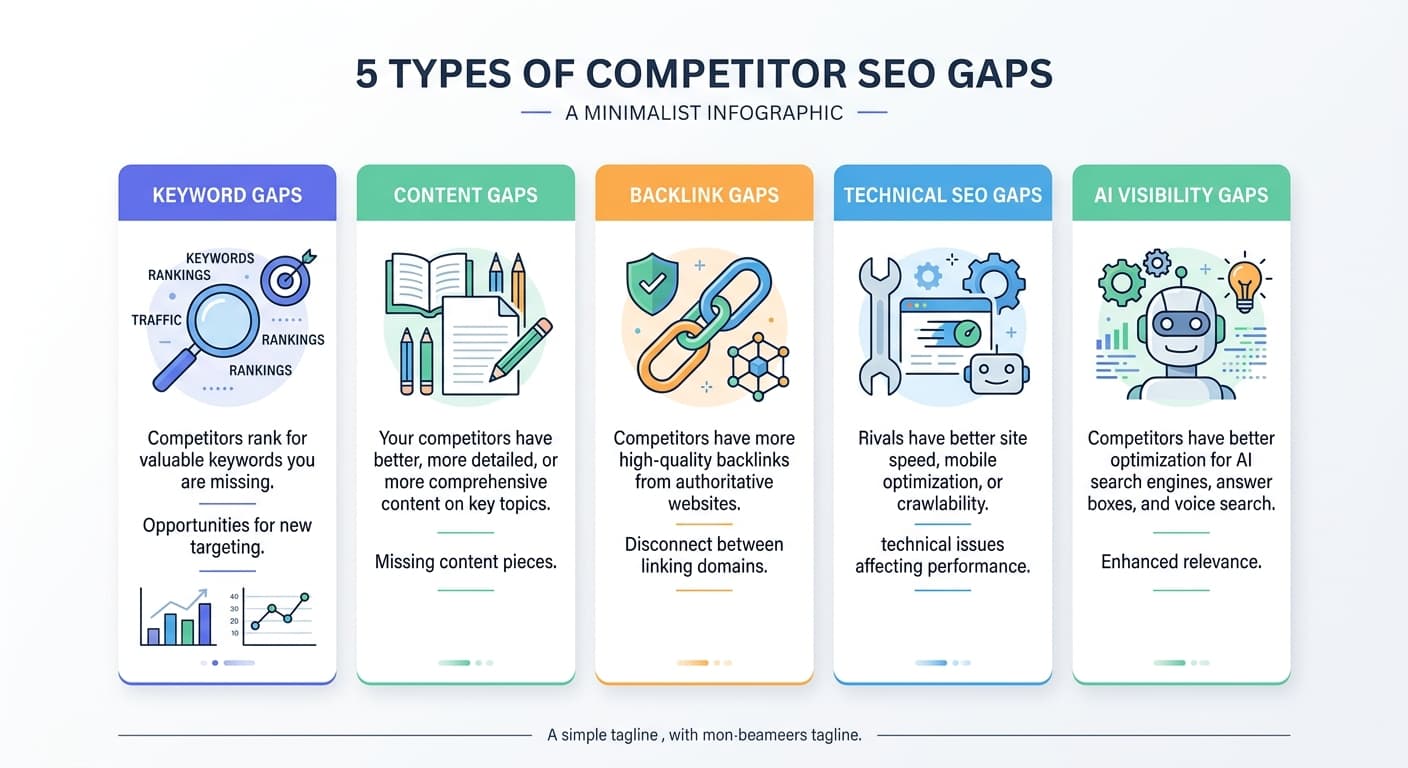
A thorough competitor SEO gap analysis in 2026 covers five interconnected dimensions:
Keyword Gaps — Terms competitors rank for that you don't
Content Gaps — Topics and formats competitors cover that you haven't
Backlink Gaps — Referring domains pointing to competitors but not you
Technical SEO Gaps — Site health and structured data advantages they hold
AI Visibility Gaps — Citations in ChatGPT, Gemini, Claude, and AI Overviews
Step 1: Identify Your True SEO Competitors
Before you can close gaps, you need to know who you're up against — and your SEO competitors are not always your business competitors.
Business competitors sell similar products or services to the same customers. SEO competitors are any websites ranking for your target keywords, including blogs, publishers, and aggregators that may have no commercial overlap with your business at all.
Your true SEO rivals are whoever ranks in the top five for your core keywords — regardless of industry or business model — so always identify them through SERP research, not assumption.
How to find your real SEO competitors:
Manual SERP search: Type your main keywords into Google in an incognito window and list the domains consistently appearing in the top 10 results.
Organic research tools: Use tools like Ahrefs or Semrush to pull a list of domains that share the most keyword overlap with your site.
People Also Ask boxes: If your competitors are appearing in these boxes for questions you haven't answered, it indicates a clear gap in your content.
Focusing on three to five true rivals delivers the most actionable results. More than five creates analysis paralysis without generating meaningfully better insights.
Step 2: Run a Keyword Gap Analysis
Performing a keyword gap analysis helps you find terms competitors rank for in organic search that you don't, so you can spot topic gaps your site hasn't covered yet.
Competitor SEO analysis compares your keyword profile, content, and backlinks against competing websites to find gaps and opportunities you are missing. It typically reveals 50–200+ untapped keyword opportunities.
What to look for:
You're looking for three categories: keywords competitors rank for that you miss entirely, keywords where competitors rank in the top results while you fall outside the top 10, and keywords where you both rank on page one but competitors consistently appear higher and capture more visibility.
Prioritization tips:
Focus on keywords that have low difficulty and where competitors already rank in the top 20 results.
Prioritize keywords based on a balance of high search volume, low difficulty, and relevance to your services. Focus on terms where multiple competitors rank well, as this confirms the keyword's importance in your niche.
High-intent keywords — terms like "best project management software for remote teams" or "affordable CRM for startups" — signal searchers who are closer to making a purchase decision. When competitors rank for these but hold positions outside the top three, you have a chance to capture that conversion-ready traffic.
Once you've compiled your keyword gap list, use QuickSEO's Keyword Gap Analyzer to surface clusters of untapped opportunities and organize them by topic theme, not just individual terms.
Step 3: Perform a Content Gap Analysis
Keyword gaps tell you what to target. Content gap analysis tells you how to win.
A content gap analysis is the practice of finding relevant topics you haven't covered or could cover better to improve your online visibility.
Content gap analysis looks at the depth and coverage of your content. It helps you identify missing content types, thin pages, outdated explanations, and angles competitors cover more thoroughly. It also reveals intent gaps — for example, when you only cover informational content, but competitors cover comparisons, buying guides, or troubleshooting queries.
How to find content gaps manually:
Pull each competitor's top 50 pages by organic traffic. Classify each one by page type: editorial blog post, comparison page, product page, glossary, or programmatic. Look for clusters where they have 5 or more pages on a topic and you have zero. That's a content gap worth filling.
Use the operator
site:competitor.com "keyword". If your competitor has 50 pages about a topic and you only have 2, you have a depth gap.Review the competitor's sitemap at
competitor.com/sitemap.xml. Skim through their list of URLs — it's a literal roadmap of their content strategy. If you see a category they have that you don't, mark it as a gap.
Not every gap is worth filling. Prioritize content opportunities that meet at least one of these criteria:
Pages they have backlinks to that you don't have equivalents for (the links prove the page is link-worthy), pages ranking positions 4–15 where a better version can take the spot, pages winning featured snippets with thin content under 800 words, and featured snippets they own where you also rank in the top 10.
The 2026 Content Gap Shift: Information Gain Over Volume
Today, the most valuable gap often isn't a missing keyword; it's a missing perspective. To stay visible, the focus should shift from simple coverage to "Information Gain" — providing the unique expertise and data that answer engines rely on to build their responses.
The era of "content for content's sake" is over. The "Content Gap" of 2026 is not a void to be filled with more words; it is a strategic deficit in Trust, Experience, and Utility.
Use QuickSEO's E-E-A-T Checker to audit how your existing content stacks up against competitors on trust and authority signals.
Step 4: Analyze Backlink Gaps
Backlink gap analysis is an SEO strategy that compares your site's backlinks with those of competitors. It identifies websites linking to them but not to you, revealing precise link-building opportunities. This approach focuses on high-value domains, helping to improve authority, rankings, and traffic.
Why backlink gaps matter:
Backlinks remain a core ranking signal. The sites that rank above you have usually earned more links from more authoritative and relevant sources. Your job is to understand where those links come from and build a path to earning similar ones.
How to find backlink gaps:
Use a Link Intersect or Backlink Gap tool to find domains that link to your competitors but not to you. These are warm prospects — they've already demonstrated willingness to link to your niche. Sort your prospect list by domain authority or domain trust. Focus outreach efforts on the highest-authority, most relevant domains first.
Pay attention to links that point to multiple competitors, as these are typically easier to acquire and highly valuable. Prioritize gaps based on authority, relevance, and potential traffic.
Three backlink gap opportunity types:
Opportunity Type | Description | Priority |
|---|---|---|
Shared competitor links | Domains linking to 2+ competitors but not you | High |
Broken competitor links | Dead pages with strong referring domains you can replace | High |
Unique competitor links | Domains linking to only one competitor | Medium |
Gap analysis also helps identify broken link opportunities, where competitors link to outdated content that you can replace with updated, superior resources.
Step 5: Audit Technical SEO Gaps
Technical SEO gaps are often the "invisible barrier" that prevents high-quality content from performing — and competitors who get the technical fundamentals right gain a compounding ranking advantage.
The "Technical Gap" is often the invisible barrier preventing high-quality content from performing. While basic schema (Organization, Website) is standard, closing the technical gap requires advanced, nested implementation. Rich Result Gaps — if competitors appear in carousels or FAQ snippets and you do not — means you are losing valuable real estate.
Key technical areas to compare against competitors:
Core Web Vitals — Page speed and user experience scores
Schema markup — Are competitors earning FAQ, HowTo, or review rich results that you're not?
Crawlability & indexation — Are key pages indexed, and is the site architecture efficient?
Internal linking — Are competitors building stronger topical authority through internal link structures?
Mobile experience — Rendering and usability on mobile devices
Use QuickSEO's Structured Data Validator to check whether competitors are leveraging schema types you're missing, and the Internal Linking Audit tool to benchmark your internal link architecture.
Step 6: Identify AI Visibility Gaps — The New Competitive Frontier
This is where most competitor SEO analyses in 2026 fall dangerously short. Most articles on SEO competitor analysis focus almost entirely on keyword gaps and backlink profiles. These are still important, but they tell you nothing about the AI citation landscape that now shapes how a large portion of your audience finds information. For informational queries, Google's AI Overviews now reduce organic CTR for position one by up to 58%, according to Ahrefs research. That is a fundamental change to how search traffic works, and any competitor analysis that does not account for it is incomplete.
AI visibility is now a separate metric: In 2026, winning Google AI Overview or ChatGPT Search citations does not always correlate with classic organic rank, meaning you can capture AI traffic even on queries where you cannot dethrone a dominant competitor.
According to a Semrush study on SEO and AI traffic, nearly 90% of the webpages ChatGPT cited were outside Google's top 20 organic results for related queries. That also means a page can perform well in organic search and still be missing from AI-generated answers.
How AI visibility gaps manifest:
Competitors are cited by ChatGPT, Claude, or Gemini for your target topics while you aren't
Competitors appear in Google AI Overviews for high-intent queries where you rank organically
Competitors' brand names are mentioned as recommendations in AI answers to purchase-intent questions
How to audit AI visibility gaps:
When Google's AI Overview answers a query, it doesn't pull from the page with the most backlinks. It pulls from the source that most completely and clearly answers the question, covers the relevant entities, and demonstrates genuine expertise. If your content is missing key data points, comparisons, or structured context that a competitor's page includes, the AI cites them. You get nothing.
The AI visibility layer is the new edge. Most of your competitors haven't started auditing it yet. The brands that do this work in 2026 will compound years of distribution before the rest catch up.
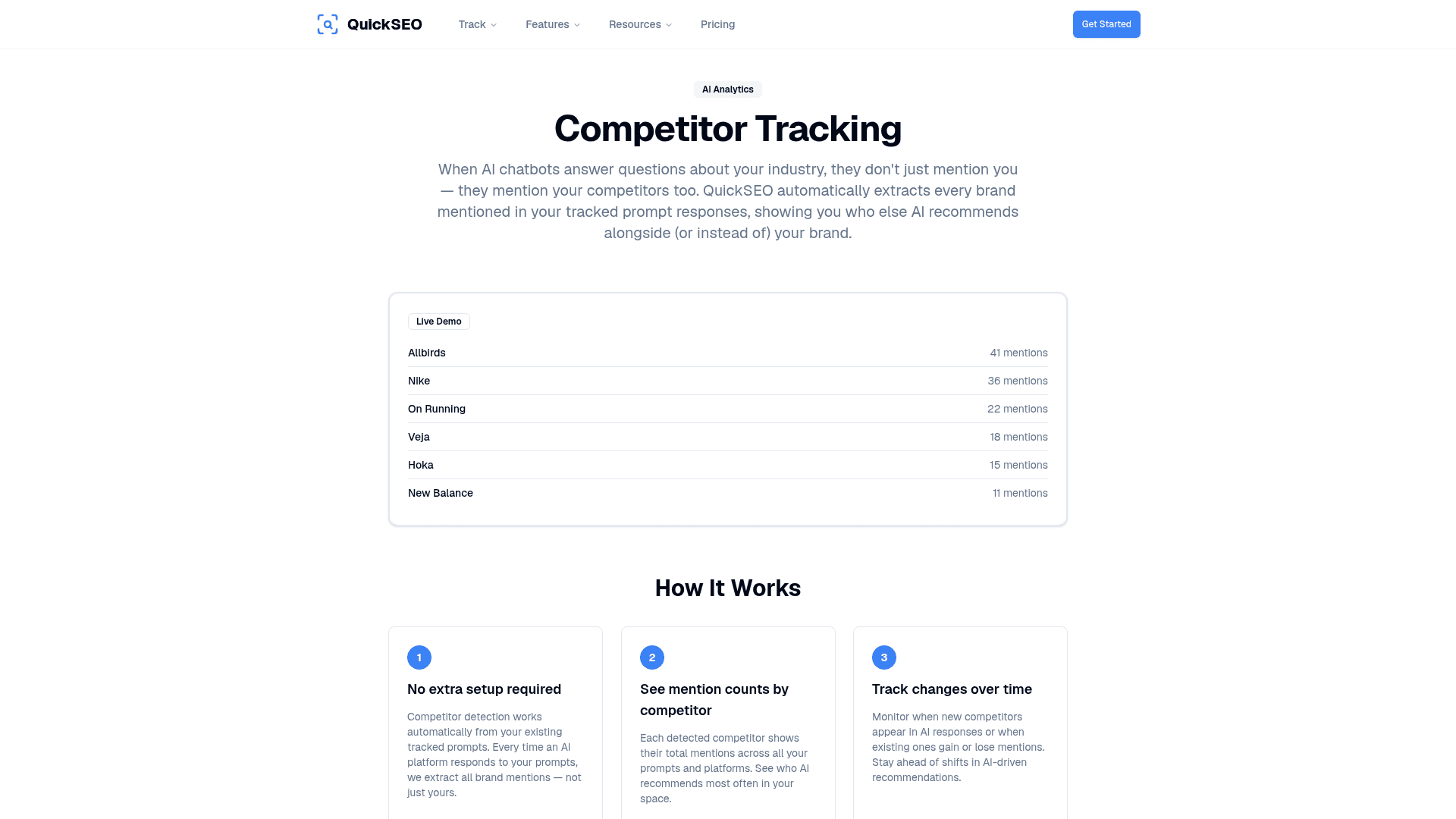
QuickSEO's competitor tracking feature lets you monitor how your brand and competitors are cited across ChatGPT, Claude, Gemini, and Perplexity — all in one dashboard.
Step 7: Turn Your Gap Analysis Into a 90-Day Action Plan
Synthesize all findings from your analysis into a structured report with three sections: Gaps (where competitors are stronger), Opportunities (specific, actionable actions to close gaps), and Wins (areas where you are already stronger that should be protected and leveraged). Prioritize the opportunities list by: potential traffic impact, speed to rank, and investment required.
Here's a practical 90-day sprint framework:
Days 1–30: Quick Wins
Write 3–5 keyword-gap articles targeting terms where competitors rank positions 4–15 with thin pages
Update 2 existing pages to outrank weak competitor content
Claim any competitor broken backlinks with high referring domain counts
Run an AI visibility audit across your 20 most important queries
Days 31–60: Content Authority
Build out topic clusters where competitors have 5+ pages and you have zero
Add FAQ schema and HowTo schema to top informational pages to compete for rich results
Close intent gaps by adding comparison guides, buying guides, or troubleshooting content alongside existing informational articles
Days 61–90: Link Building & AI Optimization
Launch targeted outreach to domains linking to multiple competitors
Enrich your most authoritative pages with original data, expert quotes, and structured context that AI models prefer to cite
Track your progress across both Google rankings and AI visibility scores
How Often Should You Run a Competitor Gap Analysis?
A full competitive analysis should be conducted quarterly, with lighter weekly monitoring of keyword position changes and competitor content activity. Search rankings shift frequently, and timely data lets you respond to competitor moves before they affect your traffic.
You should monitor your "competitor gaps" monthly to see if rivals are moving into your territory or if new search trends are emerging.
Common Mistakes to Avoid
The goal is not to replicate a competitor's strategy — it is to identify opportunities they have found and do it better. A competitor ranking well might have advantages (brand recognition, domain age, massive link profile) that you cannot quickly replicate. Understanding why they rank helps you assess which opportunities are realistic.
Watch out for these frequent pitfalls:
Analyzing too many competitors: Five is the practical maximum. More than that creates analysis paralysis without better insights.
Chasing volume, not revenue: In 2026, volume is often a vanity metric. A sophisticated gap analysis focuses on revenue-generating gaps, accepting that AI will take the low-value traffic.
Ignoring the AI layer: Running a gap analysis without checking AI visibility leaves out one of the fastest-growing competitive battlegrounds of 2026.
One-and-done audits: A competitor content gap analysis is not a one-time project. It is a vital part of a recurring competitive intelligence routine. In the fast-moving world of 2026, the businesses that stay on top are the ones that are constantly looking for the next underserved opportunity.
The AI Visibility Gap Is Your Biggest Opportunity Right Now
The biggest untapped competitive SEO opportunity in 2026 isn't a keyword your competitors rank for. It's the AI citations they're earning that you're not. The AI visibility layer is the new edge. Most of your competitors haven't started auditing it yet. The brands that do this work in 2026 will compound years of distribution before the rest catch up.
Tracking both your traditional search performance and your AI visibility in a single workflow — rather than juggling multiple disconnected tools — is what separates reactive SEO from a proactive, compounding strategy. Our guide on hybrid SEO and AI strategy goes deep on how to win on both fronts simultaneously.
🚀 Stop Guessing. Start Tracking.
QuickSEO** gives you Google Search analytics AND AI visibility tracking — ChatGPT, Claude, Gemini, and Perplexity — in one dashboard.** See exactly which competitor SEO gaps you need to close, track your AI citation scores, and monitor your share of voice across every search surface that matters in 2026. Start for free at quickseo.ai →
Conclusion
Competitor SEO gap analysis in 2026 is no longer just a keyword comparison exercise. The brands that will dominate search — both on Google and inside AI chatbots — are those who systematically identify and close all five types of gaps: keyword, content, backlink, technical, and AI visibility.
The framework is clear:
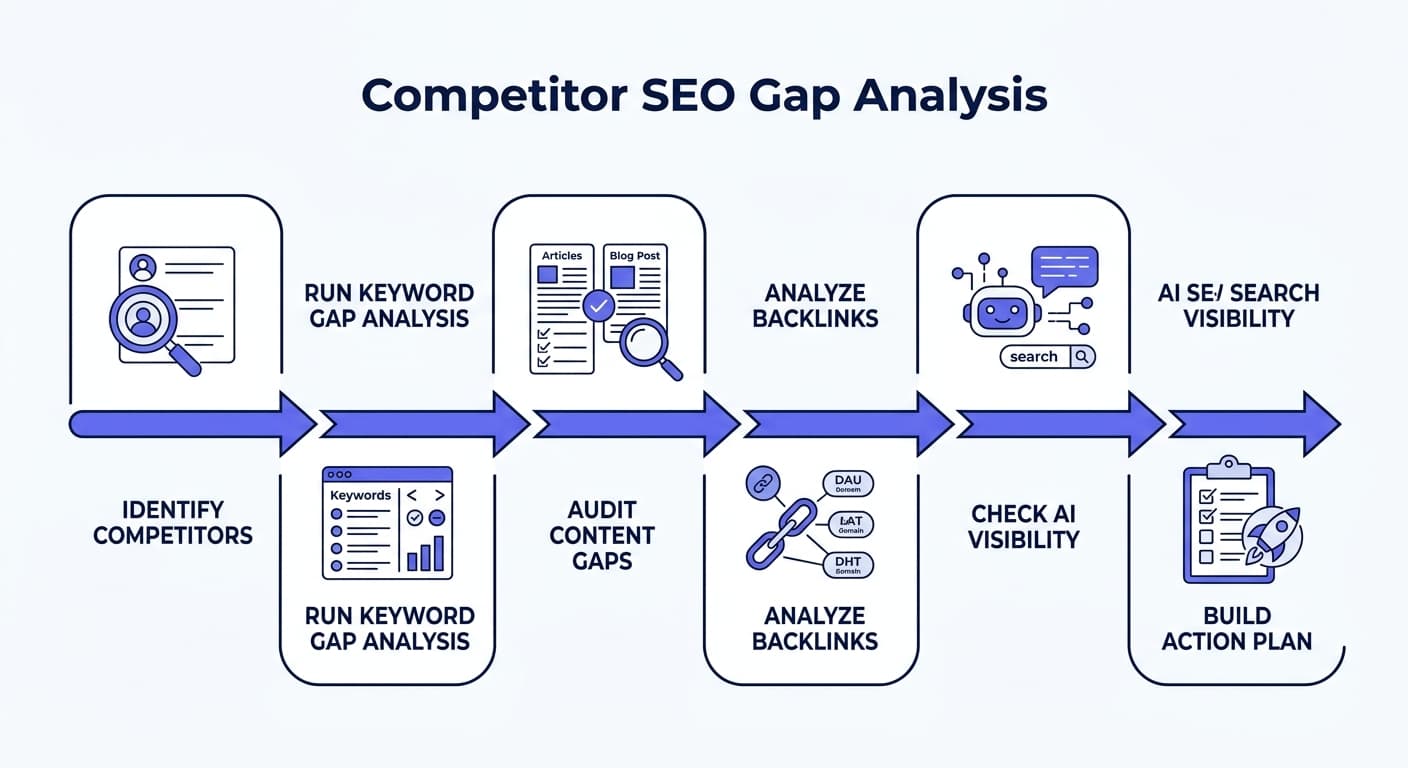
Identify your true SEO competitors (not just your business rivals)
Run a keyword gap analysis to find untapped ranking opportunities
Audit content gaps at the topic, format, and intent level
Identify backlink gaps and prioritize warm outreach targets
Fix technical SEO gaps, especially schema and crawlability
Map your AI visibility gaps — the most overlooked dimension in 2026
Then turn all of that into a focused, time-bound action plan and repeat the process quarterly.
Competitor analysis isn't a one-time project. SEO is multidimensional; traffic alone or backlinks alone tells an incomplete story. Learn what your competitors do well, find where they fall short, and combine those insights with your own strengths. That's how you build sustainable search visibility — on every surface where your audience is searching.
Enter your website to track its AI visibility across ChatGPT, Gemini, Claude, and Perplexity — and turn chatbot mentions into traffic.
- Set up in minutes
- Cancel anytime
Keep reading
Related posts
More articles on the same topics, prioritized by shared tags and keyword overlap.