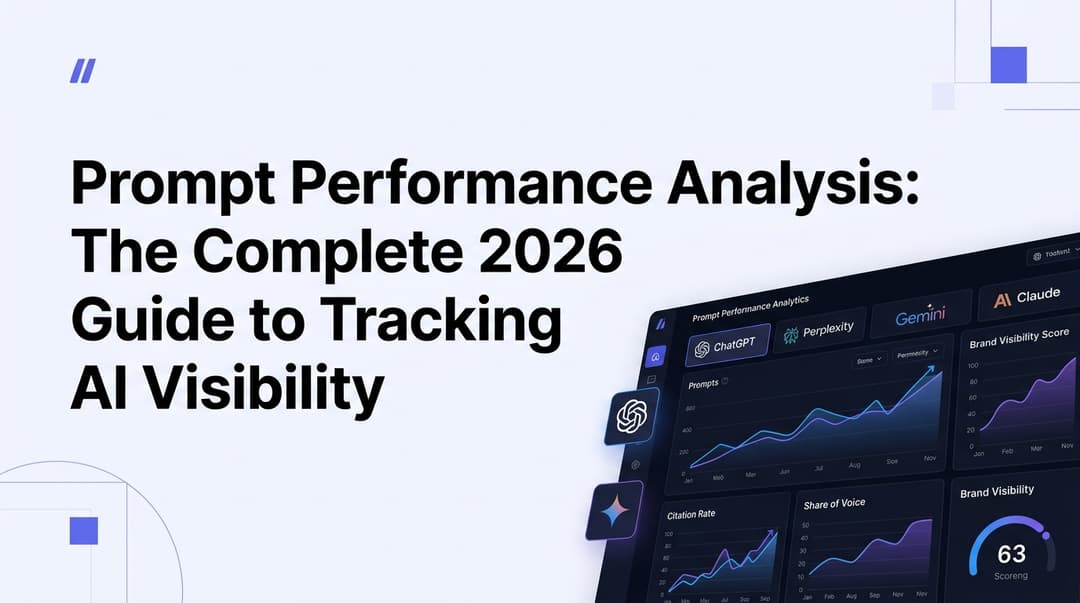
Competitor Visibility Gaps: How to Find & Close Them in 2026

 Summarize in ChatGPT
Every keyword your competitor ranks for that you don't is lost traffic. Every AI answer that cites them and not you is a lost customer. In 2026, competitor visibility gaps aren't just an SEO problem — they're a revenue problem that lives across two very different search surfaces: Google and AI chatbots.
The good news is that these gaps are entirely findable, entirely fixable, and — for most brands — still largely ignored by the competition. This guide walks you through exactly what competitor visibility gaps look like in 2026, how to surface them, and how to close them systematically before your rivals do.
What Are Competitor Visibility Gaps?
A competitor visibility gap is any situation where a rival brand appears in search results — whether traditional Google results or AI-generated answers — and your brand does not.
Content gap analysis is the systematic process of identifying topics, keywords, and formats where your competitors are winning and you're not. But in 2026, this definition has expanded significantly.
There are now four distinct types of visibility gaps you need to track:
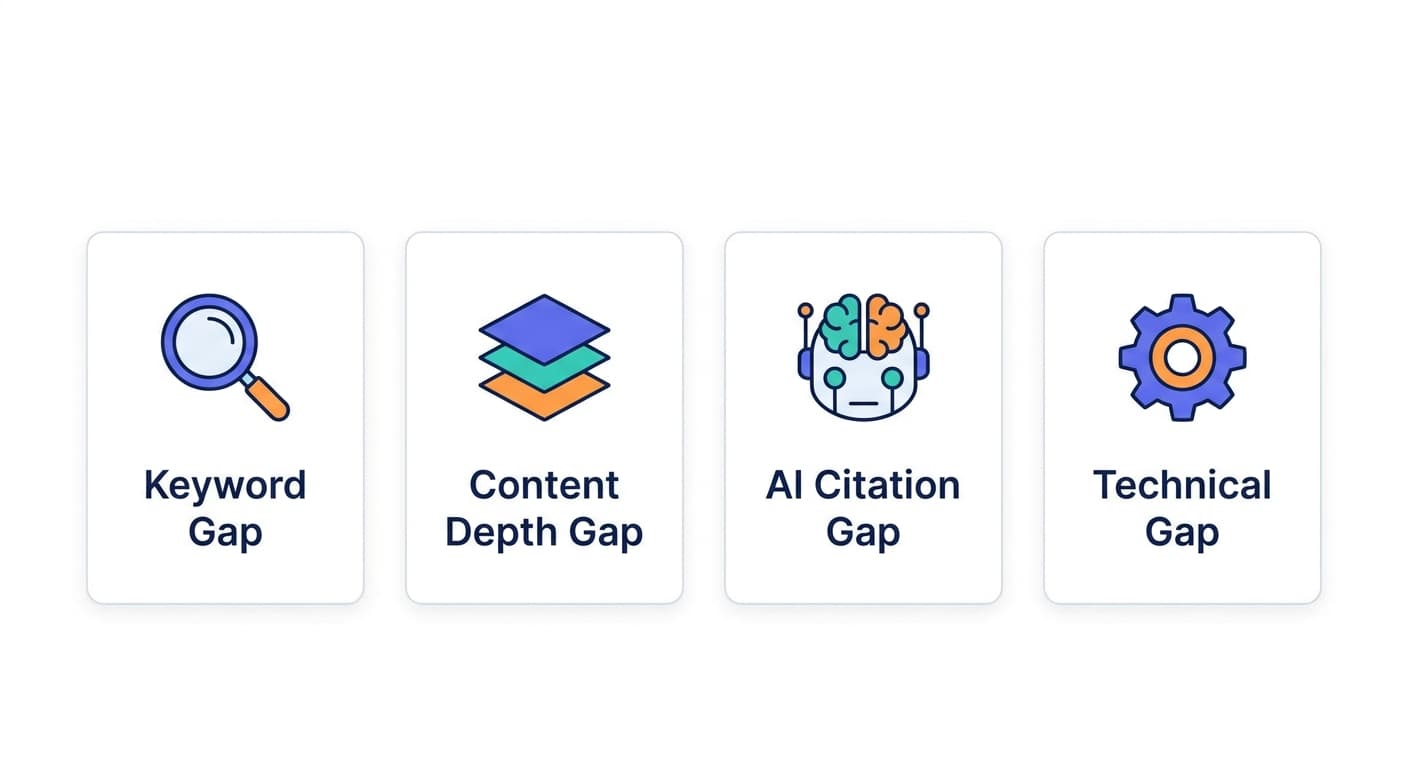
1. Keyword Gaps
The classic. Keyword gap analysis compares your website's rankings against competitors to identify keywords they rank for that you currently do not. These gaps often reveal some of the most practical opportunities for growth because competitors have already demonstrated that the keywords can generate traffic and visibility.
2. Content Depth Gaps
Topic depth gaps happen when you've covered a subject but not comprehensively enough. Your competitor may rank for the same keyword, but their page answers five follow-up questions yours doesn't — earning them the featured snippet and the AI citation.
3. AI Citation Gaps
The new battlefield is the "Mention Gap." A Mention Gap occurs when an AI assistant responds to a high-value prompt by citing your competitors while completely ignoring your brand. This is the fastest-growing category of visibility gap in 2026.
4. Technical Gaps
The "Technical Gap" is often the invisible barrier preventing high-quality content from performing. If competitors implement structured data you haven't — like FAQ schema, product schema, or breadcrumb markup — they win rich results and AI-eligible formatting that you don't.
Why Competitor Visibility Gaps Matter More Than Ever in 2026
The search landscape has fractured. In 2026, Google AI Overviews, ChatGPT search, and Perplexity now answer a significant chunk of the queries your audience types. That means a competitor gap isn't just about organic clicks anymore.
If a competitor gets cited in those AI answers and you do not, they are capturing traffic you never even see in your rank tracker.
The numbers are stark. The click-through rate for position 1 on search results is 39.8%, followed by 18.7% for position 2, and 10.2% for position 3, meaning the top three organic results receive over 68% of all clicks. The gap between first and invisible is enormous — and it's growing as AI answers absorb even more of the attention above the fold.
Perhaps the most surprising data point: according to a Semrush study on SEO and AI traffic, nearly 90% of the webpages ChatGPT cited were outside Google's top 20 organic results for related queries. That also means a page can perform well in organic search and still be missing from AI-generated answers.
This creates a dual-surface problem. Content strategy in 2026 is harder because traffic and visibility have decoupled. A piece can lose Google clicks and gain LLM citations in the same quarter. A page that never ranked in Google might be cited regularly by ChatGPT.
Step 1: Identify Your True SEO Competitors
Before you can find gaps, you need to know who you're actually competing against — and this is where most brands make their first mistake.
Your SEO competitors are not always your business competitors. A SaaS company might think its rivals are three other startups. But on Google, a media site or niche blog could rank higher for half its target keywords. That blog is an SEO competitor even if it sells nothing in your category.
How to identify your real competitors:
Search your 10 most important keywords on Google. List every domain in the top 10.
Cross-reference these with an SEO tool's competitor discovery feature.
Focus on three to five true rivals — this delivers the most actionable results.
Repeat for AI search: run those same keywords in ChatGPT, Perplexity, and Google AI Mode and note which brands appear in the answers.
Step 2: Run a Keyword Gap Analysis
Performing a keyword gap analysis helps you find terms competitors rank for in organic search that you don't, so you can spot topic gaps your site hasn't covered yet.
Use QuickSEO's keyword gap analyzer to run this comparison quickly across multiple competing domains. Export the results and then apply the right filters — not all gaps are created equal.
Prioritize gaps that have:
Clusters where competitors have 5 or more pages on a topic and you have zero — that's a content gap worth filling.
Pages winning featured snippets with thin content: anything under 800 words is easy to beat.
Keywords where competitors rank with outdated content (e.g., articles from 2023) or forum content (Reddit threads). These represent high-opportunity gaps where a structured, updated article can win.
Filter out gaps that don't fit your strategy:
A high-volume keyword with low business relevance is often worse than a low-volume keyword that directly targets your ideal customer.
You can also use QuickSEO's keyword grouping tool to cluster your gap opportunities by topic, so you're building content that covers entire subject areas rather than chasing isolated keywords.
Step 3: Audit the AI Citation Gap
This is the layer most brands are still missing entirely. The AI visibility layer is the new edge. Most of your competitors haven't started auditing it yet.
Traditional rank tracking tells you where you appear in Google's blue-link results. It tells you nothing about whether your brand surfaces in a ChatGPT answer, a Perplexity summary, or a Gemini overview.
How to run an AI citation gap audit:
Search your 10 to 15 target keywords directly in ChatGPT, Perplexity, and Google with AI Overviews turned on. Note which sources get cited in each answer. Do this across all your keywords and track which domains appear most frequently.
Look for AI mentions where the AI answer names your competitors but not you, or mentions your competitors more prominently. And AI citations where the AI answer links to competing sources but not you, or shows them higher in the list of sources.
Reverse-engineer which sources give competitors their AI visibility. If a competitor consistently gets cited from a particular review platform or industry publication, that source becomes a priority for your own citation-building efforts.
Share of voice measures how much of the AI conversation your brand owns versus competitors in your category. A tool showing you have 12% share of voice while your top competitor has 34% gives you a concrete gap to close.
Step 4: Identify Content Depth and E-E-A-T Gaps
Once you know which topics to target, the next question is why competitors are winning on those topics — and whether word count alone is the issue.
E-E-A-T gaps are often the real ranking barrier: If a competitor consistently outranks you despite comparable backlinks and content length, audit their trust signals — author credentials, original data, expert quotes, and last-updated dates — as these are frequently the deciding factor in 2026.
The reality in 2026 is that "more content" isn't always the answer when AI tools can generate summaries in milliseconds. Today, the most valuable gap often isn't a missing keyword; it's a missing perspective. To stay visible, we suggest shifting focus from simple coverage to "Information Gain" — providing the unique expertise and data that Answer Engines rely on to build their responses.
What fills an Information Gain gap:
Proprietary data — internal metrics, survey results, or original research your competitors can't copy
Expert quotes — named subject matter experts whose authority Google and AI platforms can recognize
First-hand experience — showing what happened when you actually tested the thing, not just describing it
Counter-narratives — well-supported arguments that challenge the prevailing wisdom in your niche
Temporal gain — being the first to report on a new trend or update. Freshness is a key component of gain.
Use QuickSEO's E-E-A-T checker to benchmark your key pages against these signals and identify where your content is falling short relative to competitors.
Step 5: Close the Technical Visibility Gap
Rich Result Gaps exist when competitors appear in carousels or FAQ snippets and you do not — you are losing valuable real estate. Implementing FAQPage schema on all informational pillars helps reclaim it.
Technical gaps extend further than schema alone. Check your site for:
Crawlability issues — are AI crawlers able to access your key pages?
Canonical conflicts — duplicate content diluting your authority signals
Internal linking gaps — orphaned pages that earn no link equity from the rest of your site
Structured data completeness — missing properties that prevent rich results
Internal linking opportunities are a key benefit of gap analysis: new content created from gap analysis creates natural internal linking targets, strengthening your site architecture.
Step 6: Build and Execute a Prioritized Content Plan
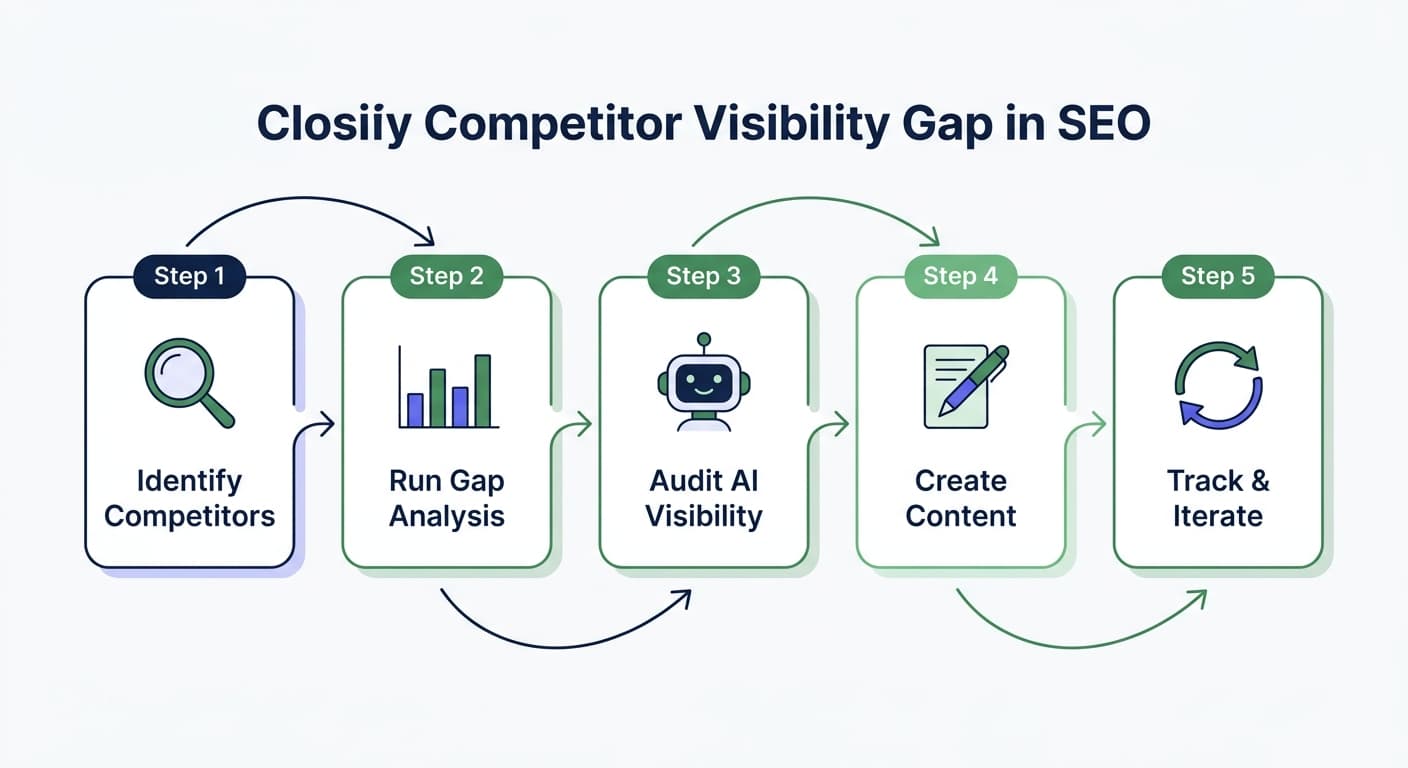
Finding gaps is the easy part. Executing against them is where most teams stall. Most teams run a gap report, export a list of 200 keywords, and then freeze. That's the most common failure mode.
Instead, convert every gap into an actionable task:
Map each gap to a content format — guide, comparison page, FAQ, landing page, or product page
Assign ownership and a deadline — gaps without owners stay gaps forever
Sequence by impact — fix technical issues first (they affect every page), then fill the highest-traffic content gaps, then build out AI citation coverage
Track both surfaces — your content scorecard needs two tracks: traditional organic performance (clicks, rankings, conversions) and LLM visibility (citation frequency, mention consistency, platform coverage).
The teams that treat gap analysis as a quarterly strategic exercise — rather than a keyword dump — will build the kind of content libraries that earn citations from both traditional search engines and AI platforms. And those citations compound. Every page with genuine original insight strengthens the domain's authority for everything else in the cluster.
How Often Should You Audit Competitor Visibility Gaps?
At minimum, run a full content gap analysis every quarter. For competitive industries or fast-moving niches, monthly monitoring is more appropriate.
Between full audits, keep a light ongoing watch on your top three to five competitors: track their new content, check for keyword position changes on your most important terms, and spot-check AI answer citations for your highest-value queries.
Every week you wait to track AI visibility, competitors extend their lead in a channel that's growing rapidly.
Common Mistakes to Avoid
Chasing every gap equally. Not every gap is worth filling. Prioritize gaps where search intent aligns with your product, the keyword difficulty is manageable, and the traffic potential justifies the production cost.
Ignoring search intent. Ranking for a keyword means nothing if the content format doesn't match what the searcher wants. A blog post can't satisfy a transactional query, and a product page can't answer an informational one.
Assuming Google rank equals AI visibility. AI search engines cite sources based on answer quality, directness, and topical authority. That means a page can rank well in Google and still be invisible in AI search results.
Scaling AI-generated content without differentiation. Sites using AI tools to scale content without differentiation saw 54% lose 30%+ of their peak organic traffic. The pattern: rapid page count growth, traffic peak within 3–6 months, then a steep drop triggered by a Google update.
The Compounding Advantage of Acting Now
The brands that do this work in 2026 will compound years of distribution before the rest catch up.
Gap analysis isn't a one-time project — it's an ongoing competitive intelligence system. Each gap you close makes your domain more authoritative, making the next piece of content easier to rank and more likely to earn AI citations. The brands winning in AI search right now didn't get there by accident. They systematically identified where competitors were visible and they were not, then filled those gaps with genuinely better content.
The window to build that compounding advantage is open. But it won't be forever.
Whatever share of search AI answers end up taking, Google Search Console is still where you see the clicks Google actually sends you. QuickSEO puts Search Console for every website you run on one free dashboard. See all your sites in one place →
QuickSEO shows clicks, impressions, keywords and pages for every website you manage, compared with the period before.
- Unlimited websites on the free plan
- No credit card needed
Try it yourself
Related free tools
Free SEO tools related to the topics covered in this article.
Keep reading
Related posts
More articles on the same topics, prioritized by shared tags and keyword overlap.