Summarize in ChatGPT
Most SEO teams are still looking backward. They pull last month's traffic report, notice the numbers, and call it strategy. Organic traffic forecasting flips that entirely — it turns historical data and search trends into a forward-looking roadmap that helps you plan content, justify budgets, and communicate SEO's real value to leadership.
But in 2026, forecasting is harder and more consequential than ever. AI-powered search results and zero-click searches have changed the way rankings are converted into actual visits — the number one ranked site today may get fewer clicks than it did two years ago, because Google often shows the answer directly on the results page. A forecast built on outdated assumptions will miss the mark badly — and lose the trust of every stakeholder it's designed to serve.
This guide walks you through everything you need to build an organic traffic forecast that's accurate, actionable, and built for the search landscape of today.
What Is Organic Traffic Forecasting?
SEO forecasting is the practice of projecting future organic search performance — traffic, rankings, conversions, or revenue — using a combination of historical data, keyword-level search volumes, click-through rate (CTR) modelling, and assumed ranking trajectories. It is not a guarantee. It is a structured estimate with defined inputs and testable assumptions.
There's an important distinction worth making early: a forecast is not the same as a target. A target is what you want to achieve. A forecast is what the data suggests is plausible given a set of inputs. Good SEO strategy needs both: targets to drive effort, and forecasts to calibrate whether those targets are realistic. When the two are conflated — when an SEO team simply declares a traffic number without a model behind it — credibility erodes the first time the number is missed.
Why Forecasting Matters More Than Ever
When you cannot show a credible projection of what organic search will deliver — in traffic, leads, or revenue — you are asking decision-makers to fund something on faith. SEO forecasting replaces that faith with structured, evidence-based projections that can be stress-tested, revised, and held accountable to real outcomes.
Forecasting organic traffic enables businesses to strategically plan content by understanding potential traffic levels, allocate resources effectively by knowing future traffic trends, and measure campaign success by setting clear benchmarks and tracking the impact of SEO efforts over time.
The Data Inputs Every Organic Forecast Needs
A forecast is only as reliable as the data feeding it. There are four core inputs that every meaningful organic forecast requires.
1. Your Google Search Console Data
Your own Google Search Console data is the most accurate record of how your site performs in search — clicks, impressions, average position, and CTR by query. This is your baseline. Any credible forecast starts here, not with third-party traffic estimates, which are directionally useful but carry significant margin of error for individual domains.
2. Keyword Rankings and Search Volume
Your SERP position determines how much visibility and how many predicted organic clicks are even possible. A page at position 3 behaves very differently from one at position 10. Search volume is your ceiling — you cannot receive more clicks than the number of people searching for a term each month. Use Google Keyword Planner, Ahrefs, or Semrush to gather volume estimates. Average across multiple tools when numbers differ significantly.
3. Position-Based CTR Benchmarks
This is where most forecasts fail in 2026. The single most common SEO forecasting mistake is assuming a position-1 ranking gets 30–40% of search volume in clicks. That number was true a decade ago. Today, with AI Overviews, ads, featured snippets, People Also Ask boxes, and zero-click results, position-1 organic CTR is closer to 28% on a clean SERP and as low as 10–15% when AI Overviews appear.
4. At Least 12 Months of Historical Traffic
You need keyword rankings, monthly search volumes, position-based CTR benchmarks, and at least 12 months of historical organic traffic from Google Search Console or Google Analytics 4. This window is essential for capturing seasonal patterns and real growth rates.
The Three Core Forecasting Methods
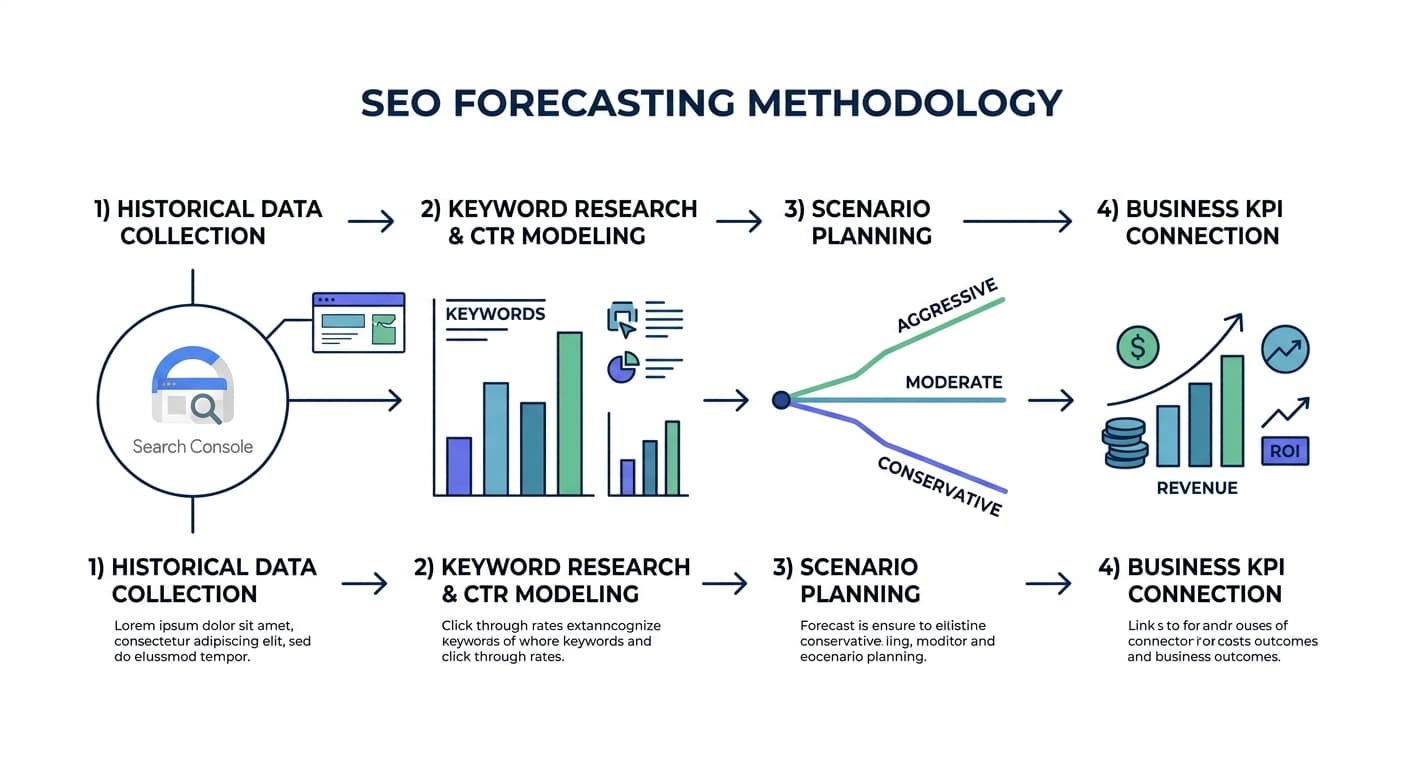
SEO forecasting is the process of using keyword data, historical traffic, and click-through rate benchmarks to estimate how much organic traffic a website will receive in the future. The two methods that work best are keyword-based forecasting and historical traffic modeling — used together, they give SEO teams a realistic picture of what growth is possible and when. A third, goal-based approach ties everything to business outcomes.
Method 1: Keyword-Based Forecasting
One of the most common methods for SEO forecasting is keyword-based traffic estimation. By analyzing the search volume for target keywords and expected CTR for specific SERP positions, you can estimate the potential traffic and conversions.
The formula is straightforward:
Estimated Traffic = Monthly Search Volume × Expected CTR at Target Position
For example, a keyword with 2,000 monthly searches that you rank in position three for might carry a 7–10% CTR. That gives you 140–200 visits per month from that one keyword. Multiply this across a content plan of 20 target keywords and you have a data-backed forecast to share with any stakeholder.
This method is especially powerful for justifying new content investments — it turns a content plan into a business case before a single word is written.
Method 2: Historical Traffic Modeling
Historical traffic forecasting uses past organic traffic data to project what is likely to happen next. Pull 12–18 months of non-branded organic traffic from Google Analytics and Google Search Console.
This method captures real seasonality patterns, reflects the impact of past SEO efforts, and gives you a baseline — what happens if the team keeps doing exactly what it is doing now. Strip out branded keyword traffic to isolate what's genuinely driven by SEO, then apply a trend model (linear regression, moving averages) to project the next 3–6 months.
Statistical forecasting involves analyzing historical data and applying mathematical models such as linear regression or moving averages to predict future traffic trends.
Method 3: Goal-Based Modeling
This approach is the most business-centric of the three, and it's also the one that most SEO plans skip. You start with a specific revenue or business goal and work backwards to figure out how much traffic you need.
The best forecasts combine all three methods — use trend analysis for your baseline, use keyword research to find growth opportunities, and use goal-based modeling to tie everything back to real business numbers.
Forecasting in the Age of AI Overviews and Zero-Click Search
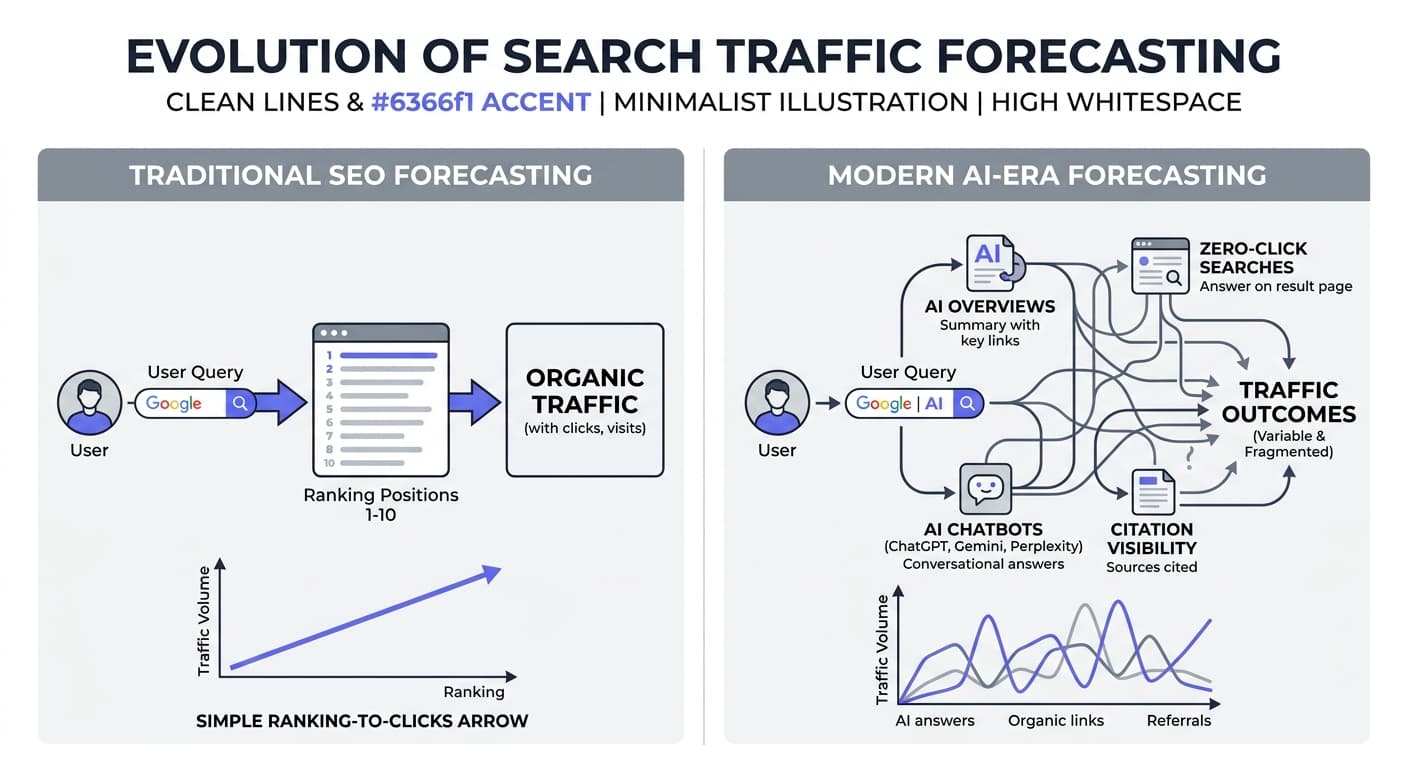
This is the most critical section of any 2026 forecasting guide. The search landscape has changed structurally, and any model that ignores this will be wrong from the moment it's built.
The Zero-Click Reality
Here is the number that should reframe how you think about search. In the United States, 58.5% of Google searches now end without a single click to another website. People get what they need right on the results page, then move on. That is a zero-click search, and it is no longer the exception. It is the majority.
When AI Overviews are present, the situation is more severe: about 83% of searches end without a click when an AI Overview is present, compared to roughly 60% when one is not. AI Overviews answer the query directly at the top of the page, so far fewer searchers click anything.
In a 21.9-million-search study, 25.11% of Google searches triggered an AI Overview in Q1 2026. That is a quarter of all searches where your organic listing is competing against an AI-generated answer sitting above it.
How to Adjust Your CTR Assumptions
Rather than applying a single industry CTR curve, segment your keyword universe by SERP type. Run each target keyword through a live search and categorise it: clean organic SERP, AI Overview present, featured snippet present, or heavily monetised (ads above fold). Apply different CTR curves to each category.
Studies using aggregated 2024 and 2025 performance data show CTR reductions of 40 to 50 percent on informational queries when an AI Overview is present. If your SEO traffic prediction treats all keywords the same way, you will consistently overestimate traffic from informational content.
Predictive SEO analytics should include a "zero-click adjustment factor" for affected keywords. This ensures your forecast to predict organic traffic reflects actual behavior patterns rather than outdated averages.
Content Type Matters for Your Forecast
AI Overviews are reshaping organic traffic, but the 2026 data shows a split outcome rather than a collapse. Most informational queries now lose clicks to AI summaries, yet referral traffic from AI engines is growing fast and converts at higher rates. The net effect depends on what kind of content a site publishes and how it measures success.
Traffic loss is uneven. Pages targeting simple, factual queries lose the most, because AI summaries can answer those questions completely. Pages that earn citations inside AI answers, or that serve high-intent comparison and decision queries, often hold steady or grow.
The strategic implication: build your forecast with content-type segmentation, not a flat average across your entire site.
Building Your Forecast: A Step-by-Step Framework
Step 1: Establish Your Historical Baseline
The first step in any SEO forecast is reviewing what has already happened. Historical trend analysis typically reviews 12 to 16 months of data to identify seasonal patterns, traffic fluctuations, and ranking movements. This baseline shows how your site currently performs and what a realistic growth rate is.
Run a technical SEO audit at this stage to surface any issues that may be suppressing your historical performance data — crawl errors, indexing problems, and broken links can all skew your baseline numbers downward.
Step 2: Segment Your Keyword Universe
Use your keyword gap analyzer to identify which queries you're missing, then segment your full keyword list by:
SERP type — clean organic, AI Overview present, featured snippet, or ad-heavy
Search intent — informational, commercial, transactional, navigational
Current position — tracking how each position tier converts in your niche
The mistake is treating "organic traffic" as one bucket with one expected CTR. A branded navigational query, a "best software" query, and an informational query with an AI Overview behave very differently.
Step 3: Apply Position-Specific CTR Curves
The core formula is: multiply monthly keyword search volume by the expected CTR for your target ranking position. CTR varies by position and industry. Industry-average CTR curves show that position one typically captures 25–35% of clicks for informational queries, while positions two through five see significantly lower rates.
A forecast that assumes flat traffic across all 12 months will miss the mark every single month. Pull seasonal data from Search Console or Google Trends. Apply monthly index values to your projections.
Step 4: Build Three Scenarios
Always include optimistic, realistic, and pessimistic scenarios to reflect possible outcomes.
One number invites one question: "What if you are wrong?" Three scenarios (conservative, moderate, aggressive) show you have thought about uncertainty.
Conservative (high confidence): Assumes moderate ranking improvements, AI Overview headwinds on informational content, and stable competitor activity
Moderate (expected): Current growth trajectory continues; some new content wins keywords
Aggressive (upside): Significant content investment pays off, key rankings reach page one
Integrating content production velocity (e.g., 10 new pages/month increases organic growth rate by 8%) helps quantify the upside scenario. Building traffic ranges — not single numbers — communicates confidence intervals and uncertainty honestly. Connecting forecasts to business KPIs, not just traffic metrics, is equally critical.
Step 5: Connect Traffic to Business Outcomes
Many SEOs would stop at traffic projections, but you can take your forecast a few steps further and calculate how your traffic translates into leads, sales, and revenue. This would help you better understand the ROI of each keyword.
Use a formula like this:
Estimated Conversions = Estimated Page Traffic × Average Conversion Rate
Traffic projections alone won't win executive buy-in in 2026's ROI-obsessed environment. Decision-makers need to see the direct line between SEO efforts and business results. You can use our SEO ROI calculator to translate organic traffic projections into revenue estimates that resonate at the board level.
How Accurate Can an Organic Traffic Forecast Be?
A well-structured SEO forecast built on verified first-party data and realistic CTR assumptions can be directionally accurate within a range of 20–30% for 12-month projections. That level of accuracy is enough to make meaningful budget decisions, prioritise content investments, and set stakeholder expectations with credibility.
A 6-month forecast is useful. A 12-month forecast is reasonable. Anything beyond 12 months is speculation. Algorithm updates, competitor moves, and market shifts make long-range forecasts unreliable.
A well-built forecast typically falls within 15 to 25 percent accuracy when based on real data and realistic ranking assumptions. Accuracy improves significantly when you update the model each month using actual performance data.
The Most Common Forecasting Mistakes in 2026
Avoid these pitfalls that consistently derail organic traffic forecasts:
Using outdated CTR benchmarks. CTR data from studies published before 2024 does not account for AI Overviews. Modeling around AI Overviews is not optional in 2026. It is the difference between a forecast your team trusts and one that loses credibility after the first monthly review.
Treating all organic traffic the same. Successful forecasting requires understanding search intent alignment. Not all organic traffic is created equal. A local plumber receiving 1,000 monthly visits from "emergency plumbing repair" searches will generate significantly more revenue than a blog receiving 5,000 visits from general informational queries.
Building a forecast once and never updating it. Reforecast quarterly, incorporating fresh SERP and competitor data to stay aligned with market changes.
Ignoring seasonality. A forecast that assumes flat traffic across all 12 months will miss the mark every single month.
Conflating rankings with AI citation visibility. The overlap between top-10 Google rankings and AI Overview citations has collapsed from 75% in mid-2025 to between 17% and 38% by early 2026, meaning high rankings no longer guarantee AI visibility.
Setting single-point estimates. In 2026's unpredictable search landscape, single-point forecasts are a liability. Instead, build a range of outcomes based on clearly documented assumptions that you can revisit and adjust as conditions change.
The Best Tools for Organic Traffic Forecasting
The best organic traffic forecasting tools in 2026 are Ahrefs and Semrush for keyword-level projections, Google Search Console and Google Analytics 4 for first-party historical data, and Google Sheets or the Animalz free tool for forecasting without a paid subscription. The right choice depends entirely on your budget, team size, and what you need the forecast to prove.
For keyword-level projections:
Ahrefs — Stronger for page-level forecasting. Its Traffic Potential metric shows the total organic traffic a page could receive if it ranked number 1 for its main keyword, accounting for all the related keywords that same page would also rank for. This is more useful than single-keyword volume estimates because it reflects how search actually works.
Semrush — Has more granular data for US markets and tends to report higher search volume estimates for many keywords. Its Traffic Analytics feature estimates domain-level and page-level organic traffic in near real time, making it useful for competitive benchmarking inside your forecast model.
For first-party data:
Google Search Console — Your most accurate source for clicks, impressions, and position-level CTR data
Google Analytics 4 — Add conversion rate and revenue data to extend your traffic projections into business outcomes
For free forecasting:
Google Trends — Apply seasonality multipliers to your monthly keyword projections
Google Sheets — Build and maintain your full forecast model using FORECAST functions
Additionally, use QuickSEO's SERP preview tool to check how your target pages appear in search results, and the keyword density checker to make sure your content is optimised for the keywords you're targeting in your forecast.
Forecasting Beyond Clicks: AI Visibility as a New Metric
The 2026 forecast must account for a channel that doesn't send traditional clicks at all: AI chatbots. AI engines are routing growing, high-value traffic to the sites they cite. Content teams that shift from chasing rankings to earning citations capture the channel as it scales.
AI search visitors are 4.4x as valuable as the average traditional organic visitor, according to Semrush, and AI referral traffic is 3x as likely to convert as other channels. This means that even a modest stream of AI-referred visitors can outperform a large volume of traditional organic traffic.
Forward-thinking SEOs are now building a second layer into their forecasts: AI visibility projections. This means tracking which prompts your brand appears in across ChatGPT, Claude, Gemini, and Perplexity, and projecting how content investments will improve citation rates over time. You can explore AI visibility benchmarks for your industry to understand where your brand stands today.
The takeaway for 2026 is simple: measure visibility, not just clicks, and build to be cited. Zero-click is the symptom. The fix is being present in AI answers.
Keeping Your Forecast Current
Algorithm updates can significantly shift traffic trends, so it's smart to build flexibility into your model. Always include optimistic, realistic, and pessimistic scenarios to reflect possible outcomes. Revisit and adjust your forecast quarterly or after major updates to stay aligned with search dynamics.
Regularly update models using fresh Search Console data to improve SEO forecast accuracy methods. Forecasting in AI search requires flexibility, constant recalibration, and realistic CTR modeling SEO adjustments.
The SEO teams pulling ahead in 2026 treat forecasting as a continuous practice, not a quarterly report. They track AI citation rates alongside rankings, update CTR assumptions when SERP features change, and connect every traffic projection back to the revenue metrics that leadership actually cares about.
QuickSEO is a free Google Search Console dashboard for all your websites. Connect Search Console, pick the properties you want, and see clicks, impressions, CTR and average position for every site on one screen, each compared with the previous period, with the keywords and pages behind the numbers. Connect Search Console for free →
Conclusion
Organic traffic forecasting in 2026 is no longer a simple exercise in multiplying search volume by CTR. It requires a layered approach: historical trend analysis as your baseline, keyword-based modeling to quantify content opportunities, AI Overview adjustments to keep CTR assumptions honest, and scenario planning to communicate uncertainty without losing credibility.
The teams that do this well transform SEO from a cost line into a measurable business investment with projected returns. They walk into budget conversations with data, not faith. And in a search environment that's shifting faster than ever — with AI Overviews, zero-click behavior, and citation-based visibility all reshaping the traffic landscape — a well-built forecast is one of the most valuable tools an SEO team can have.
Start with your Google Search Console data. Segment your keywords by SERP type. Build three scenarios. And update your model every quarter — because the search landscape won't wait for your next annual review.
QuickSEO shows clicks, impressions, keywords and pages for every website you manage, compared with the period before.
- Unlimited websites on the free plan
- No credit card needed
Try it yourself
Related free tools
Free SEO tools related to the topics covered in this article.
Keep reading
Related posts
More articles on the same topics, prioritized by shared tags and keyword overlap.