Search Visibility Trends in 2026: The Complete Guide to Google & AI Search

 Summarize in ChatGPT
If you're still measuring search visibility by page-one rankings alone, you're already operating with an outdated map. The search landscape has fundamentally restructured in 2026, and the brands winning today are the ones who understand that visibility now means something entirely different than it did two or three years ago.
The digital search landscape is currently experiencing the biggest upheaval since the introduction of Google itself. AI Overviews answer questions before users ever reach your site. ChatGPT and Gemini are recommending brands in conversations that never touch a traditional search result. And zero-click behavior has become the default, not the exception.
This guide breaks down every major search visibility trend shaping 2026 — and what your brand needs to do to stay competitive across both Google and AI platforms.
The State of Search in 2026: A Dual Landscape
The biggest shift in 2026 isn't that Google is dying — it's that search has fractured into two distinct ecosystems that require two separate visibility strategies.
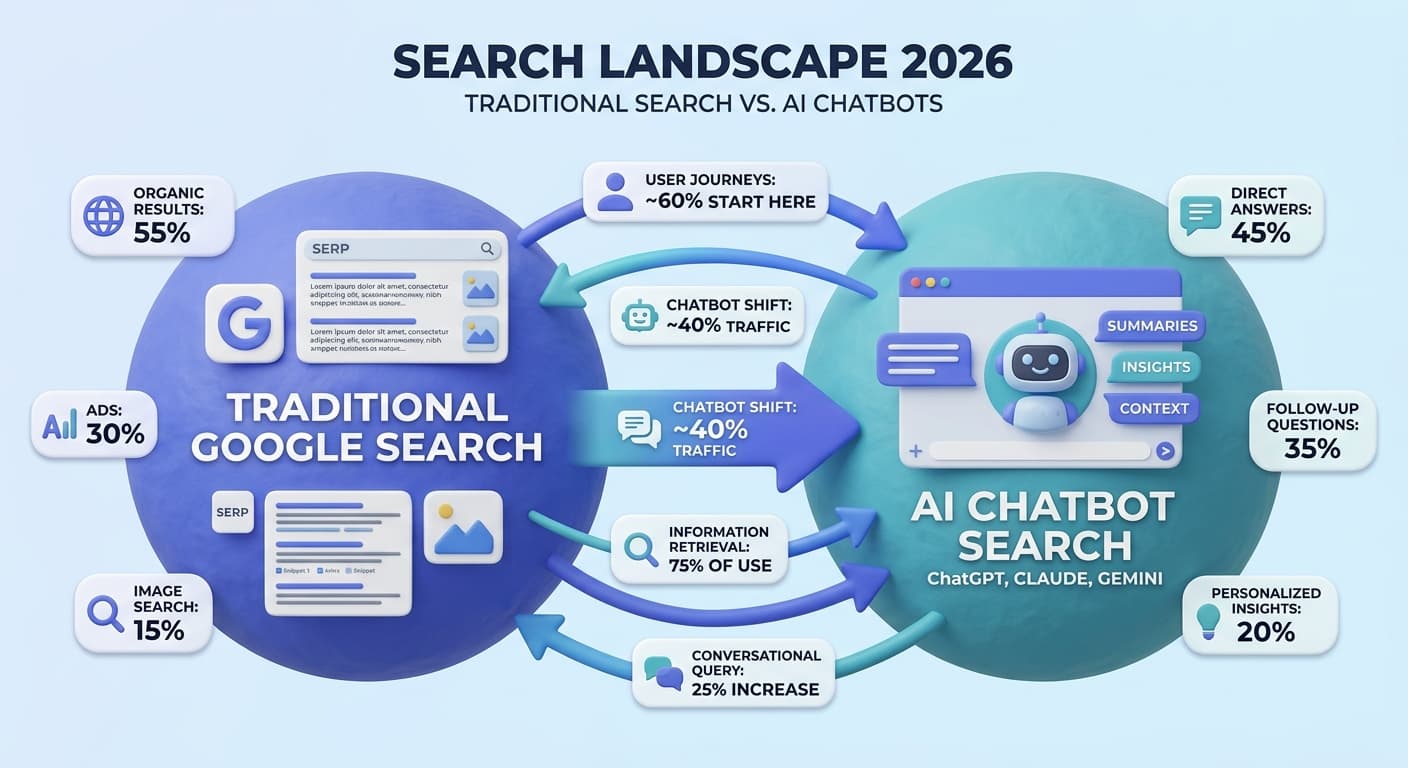
ChatGPT has 900 million weekly active users, processes 2.5 billion prompts per day, and has hit roughly 17% of all global digital queries — the first time in two decades that anyone has cracked Google's near-monopoly with double-digit share.
But Google isn't standing still. Google's AI Overview now reaches over 2 billion monthly users, with informational searches triggering AI Overviews at rates as high as 80–88% depending on the industry.
The crucial insight, however, is that the total search pie is getting bigger: total search usage (search engines + LLMs combined) has grown 26% globally and 16% in the US — the pie got bigger, and AI took the new slice.
For brands, this creates both opportunity and urgency. AI-powered search engines like ChatGPT, Google Gemini, Perplexity, and Claude are answering the questions your customers used to type into Google. They're recommending brands, comparing products, and shaping buying decisions — often without a single click to your website.
Trend #1: Zero-Click Search Is Now the Default
The most disruptive visibility trend of 2026 is the normalisation of zero-click search behaviour. Users are getting the answers they need directly on the results page — or inside an AI chat response — without ever landing on your website.
Zero-click searches now reach 60–70% of all queries, meaning the majority of people who find your content never visit your site at all.
The breakdown across Google surfaces is stark. Zero-click searches vary across Google: 34% in Google Search without an AI Overview, 43% in Google Search with an AI Overview, and 93% in Google's AI Mode.
What does this mean for your SEO strategy? AI Overviews and AI Mode now dominate SERPs, cutting organic click-through rates sharply and forcing digital marketing teams to rethink what visibility actually means. Ranking on page one is no longer enough if zero-click results absorb the majority of intent.
The new success metrics are:
Citations — does your brand appear inside AI-generated answers?
Brand mentions — are you being recommended by name, even without a link?
Conversion rate — is the traffic that does land on your site high-intent?
Share of voice — how often does your brand appear relative to competitors in AI responses?
Speaking of conversion rate — the headline stat for marketers isn't volume, it's conversion rate. AI search traffic converts at 14.2%, compared to Google's 2.8% — roughly 5x more valuable per session. This means that even a small volume of AI-referred traffic can have an outsized business impact.
Trend #2: AI Chatbots Are a Primary Search Surface
One of the biggest shifts in 2026 is the recognition that "search" no longer just means Google. Your potential clients and customers are discovering information across ChatGPT, YouTube, LinkedIn, Reddit, industry forums, podcasts, and social platforms — and AI systems are pulling from all of these sources to inform their answers.
51% of B2B software buyers now start their research with an AI chatbot more often than with Google. And across the AI chatbot landscape itself, the competitive dynamics are shifting fast.
If you only track ChatGPT, you're already missing the most aggressive shift of 2026. Within the AI chatbot category itself, ChatGPT's share of web traffic has dropped from 87.2% to 68% in twelve months — the steepest decline of any dominant tech platform in recent memory.
Copilot (25.2x growth) and Claude (12.8x growth) are the fastest-growing AI platforms, signalling AI discovery is moving into embedded workplace tools.
This platform diversification has enormous implications for how brands track and manage their visibility. Each AI platform cites from a completely different pool of sources — analysis of 118,000 AI-generated answers across ChatGPT, Perplexity, Google AI Mode, and Claude found that only 11% of cited domains appeared across multiple platforms.
You can track and compare your brand's presence across all the major AI platforms using QuickSEO's AI visibility tracking dashboard, which covers ChatGPT, Claude, Gemini, and Perplexity in one place.
Trend #3: Rankings No Longer Equal Visibility
This is the central paradox of 2026 SEO: you can rank #1 in Google and still be largely invisible.
AI and LLM platforms — whether Google's own generative features or external tools like ChatGPT, Perplexity, or Claude — don't crawl the SERP and pick from the top results. They build understanding from training data, citation patterns, entity relationships in knowledge graphs, and signals about who is genuinely considered authoritative on a given topic. A high-ranking page can be largely invisible to these systems if the brand behind it hasn't established recognition and preference.
The data confirms this disconnect. Across ChatGPT, Perplexity, Copilot, and AI Mode, around 80% of cited URLs do not rank in Google's top 100 results for the original query.
76% of practitioners describe the future of SEO in 2026, where visibility depends less on ranking position and more on presence across AI search, SERP features, and intent-driven surfaces.
The implication is clear: your SEO strategy needs to earn recognition — not just rankings. Brand visibility is crucial because AI search engines consult multiple trusted sources and look for consistent brand mentions across third-party websites, social media, and publications — similar to how consumers research products by checking various objective sources before making decisions.
Trend #4: Generative Engine Optimization (GEO) Is Now Essential
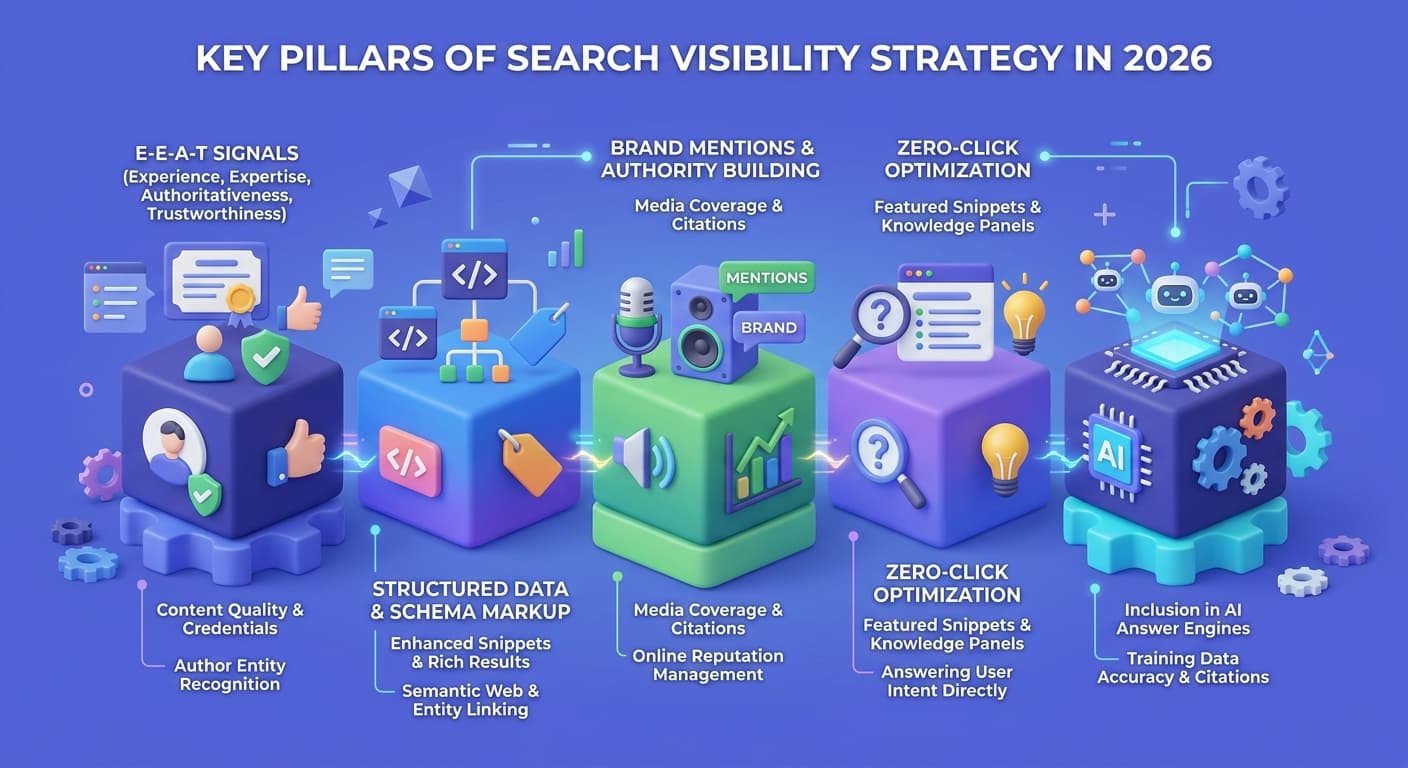
Generative Engine Optimization (GEO) is developing into the new standard in search engine optimization. This discipline focuses on designing content so it can be understood, extracted, and cited by AI systems.
Traditional SEO optimization is no longer sufficient to remain visible in an AI-dominated search landscape.
For a successful GEO strategy in 2026, the following elements are critical:
Structured content — AI systems prefer clearly structured information with logical headings and subheadings
Precise, context-rich answers — direct, concise answers to specific questions are preferentially cited
E-E-A-T signals — Experience, Expertise, Authoritativeness, and Trustworthiness remain foundational
Schema markup — source citation improves by 30% when schema markup is included.
Content freshness — pages updated within 60 days are 1.9x more likely to appear in AI answers.
Author authority — websites with author schema are 3x more likely to appear in AI answers.
Use QuickSEO's E-E-A-T Checker to audit how well your content demonstrates the trust signals AI systems rely on when selecting sources to cite.
Trend #5: AI Visibility Is Highly Volatile — and Requires Constant Monitoring
One of the most underappreciated facts about AI search visibility is how rapidly it can change. Unlike traditional Google rankings that tend to be relatively stable, AI citations are in constant flux.
AI Overview content changes roughly 70% of the time for the same query, and when the answer updates, almost half of the citations are replaced with new sources. Only about 30% of brands remain visible in back-to-back AI responses for the same query.
Real-world tracking data makes this concrete. Tracking weekly trends from January to February 2026, brand visibility declined from 1.92% to 1.23% (-35.9%), citation rate declined from 7.35% to 4.82% (-34.4%), and share of voice declined from 0.66% to 0.43% (-34.8%) — all three core metrics declined in lockstep over 5 weeks. This proves that AI visibility is not a "set it and forget it" metric. A brand can lose a third of its AI presence in just over a month.
Quarterly audits are insufficient; weekly monitoring is the minimum.
Additionally, each AI platform treats your brand very differently. Sentiment analysis across 6,447 brand mentions revealed that each AI platform has what amounts to an editorial personality. The sentiment gap between Perplexity (0.769 score) and ChatGPT (0.052 score) is 14.8x — same brand, radically different editorial treatment depending on the platform.
Trend #6: Search Everywhere Optimization
Consumers are searching on AI platforms, social media, YouTube, Instagram, forums, Reddit, and countless other spaces where information lives. AI assistants pull from this entire ecosystem, treating all public information as search data. For brands, SEO is evolving from traditional website optimization to managing a full organic presence across every platform where reputation, discovery, and authority signals exist.
Your content strategy must integrate more strongly with platforms like Reddit, LinkedIn, or industry-specific forums — where LLMs get their knowledge.
Brands are 6.5x more likely to be cited through third-party sources than their own domains — which is a powerful reason to invest in PR, guest content, review generation, and community participation as core components of your visibility strategy.
The real buying journey in 2026 is no longer linear. It might start with a conversational AI query, move through a Reddit thread, surface a YouTube comparison, hit a review platform, and only then arrive at a branded search. Your brand needs to be present and consistent across that entire arc.
Trend #7: Structured Data and Schema Are More Important Than Ever
As AI systems become the primary interface for search, technical signals that help machines understand your content have become critical differentiators.
The use of FAQPage schema is now an emerging trend as AI search heavily cites FAQ content in its outputs. The steady increase in FAQPage schema is a strong sign of AI search strategies changing the shape of the web.
Sites implementing structured data and FAQ blocks saw a 44% increase in AI search citations.
Content format also plays a significant role in citation rates. Listicles are the preferred format, sitting at a 25% citation rate compared to blogs and opinion pieces' 11% citation rate. And "best", "top", and "vs" content tends to drive the highest AI traffic.
Use QuickSEO's Structured Data Validator to ensure your schema markup is correctly implemented and helping AI systems understand your content.
Trend #8: Content Quality and Freshness Trump Quantity
The content arms race of the early 2020s — when publishing volume was the primary lever — is definitively over. AI content quality, not quantity, now determines ranking success.
The March 2026 core update confirmed that relevant, satisfying content is Google's top ranking signal, making quality the non-negotiable baseline.
Content with statistics, citations, and quotations achieves 30–40% higher visibility in AI responses, and pages updated within 2 months earn 28% more citations than older content.
Meanwhile, format matters enormously for AI citation. AI platforms tend to cite content that is 25.7% "fresher" (posted or updated within 1,064 days compared to 1,432 days for traditional search).
The winning content strategy in 2026 combines:
Original research and proprietary data that AI systems haven't seen before
Structured, scannable formatting with clear headers and direct answers
Regular updates to signal freshness to both Google and AI crawlers
Deep topical coverage that establishes genuine expertise in your niche
How to Adapt Your Search Visibility Strategy for 2026
Based on the trends above, here's a practical framework for brands looking to maintain and grow visibility across both Google and AI search:
1. Audit Your Current Visibility Across All Surfaces
Before you optimize, you need to know where you stand. Run a comprehensive audit that covers:
Traditional Google rankings and GSC data
AI chatbot mentions (ChatGPT, Claude, Gemini, Perplexity)
Share of voice versus competitors in AI answers
Brand sentiment across AI platforms
2. Implement Foundational Technical SEO
2025 saw increasingly higher SEO standards: near-universal adoption of HTTPS (now up to 91%+), increased use of title tags at nearly 99% adoption, and viewport meta tags at over 93% adoption. These are baseline requirements, not advantages. Ensure your technical foundation is solid before pursuing more advanced strategies.
3. Shift from Traffic to Citation Metrics
The teams winning right now are not optimizing for rankings or sessions. They are optimizing for citations, conversions, and cross-channel influence. Update your reporting dashboards to include AI citation rate, brand mention frequency, and AI-sourced conversion rate.
4. Build Cross-Platform Brand Authority
Invest in getting your brand mentioned in credible third-party sources — industry publications, forums, review platforms, and social media. These are the sources AI systems learn from. As AI systems are now aggregating everything the internet says about your brand and using that as a signal for whether to recommend you, brand reputation is no longer just a marketing concern — it's an SEO concern.
5. Track Your AI Visibility Weekly
Given how rapidly AI citations can change, monitoring needs to be continuous. Set up tracking for your target prompts across all major AI platforms and review trends weekly, not monthly or quarterly.
🚀 Ready to Track Your Search Visibility in 2026?
Most brands are flying blind — tracking Google rankings while their AI visibility is completely unmeasured. QuickSEO gives you one dashboard to monitor your presence across Google Search AND AI chatbots like ChatGPT, Claude, and Gemini. Track clicks, impressions, AI visibility scores, and competitor share of voice — all in one place. No guesswork. No switching between tools. 👉 Get started for free at quickseo.ai — join thousands of marketers already tracking their AI & SEO performance.
The Bottom Line
Search visibility in 2026 is not a single metric — it's a multi-surface, multi-platform discipline that requires a completely new measurement framework. The brands that will win are those that:
Understand that rankings and visibility are no longer the same thing
Track their presence across both Google and AI chatbots
Optimise content for citation, not just clicks
Build brand authority across the entire ecosystem where AI learns
Monitor AI visibility continuously, because it changes fast
The good news? The tools and strategies to do all of this exist right now. The question is which brands move fast enough to capitalise on this shift while the competitive landscape is still forming.
To get a deeper look at what's working across the two halves of search in 2026, check out our breakdown of AI Search vs Google Search: 40+ Stats — and our guide on how to rank #1 in ChatGPT.
Search has changed. Your visibility strategy needs to change with it.
Enter your website to track its AI visibility across ChatGPT, Gemini, Claude, and Perplexity — and turn chatbot mentions into traffic.
- Set up in minutes
- Cancel anytime
Try it yourself
Related free tools
Free SEO tools related to the topics covered in this article.
Keep reading
Related posts
More articles on the same topics, prioritized by shared tags and keyword overlap.