AI Search Market Share in 2026: The Complete Data Breakdown

 Summarize in ChatGPT
The search landscape in 2026 is more complex — and more consequential — than at any point in the past two decades. Google still commands the majority of query volume, but a growing constellation of AI platforms is absorbing a meaningful and fast-growing slice of how people find information, research products, and discover brands.
If you're still thinking about "SEO" as purely a Google game, you're already leaving share on the table. This post breaks down all the key AI search market share data for 2026, platform by platform, and explains what it actually means for your visibility strategy.
The Big Picture: Google vs. AI Search in 2026
Google still accounts for roughly 80% of global query volume across all device types, per StatCounter and Similarweb 2026 data. But that headline number obscures a deeper story.
Google holds 89.3% of global search but its lead is finally narrowing: Google's all-device share dropped roughly 1.5 percentage points year-over-year, the largest single-year erosion since 2009. Simultaneously, AI search referrals reached 0.9% of total visits in March 2026, up 5x year-over-year — ChatGPT, Perplexity, Gemini, and Claude-powered surfaces now collectively send 0.9% of all referral traffic measured by Similarweb, up from 0.18% twelve months earlier.
The disruption is concentrated on informational and research queries, where ChatGPT Search, Perplexity, and Google AI Mode now absorb a meaningful slice of volume that previously generated organic clicks to content sites.
Crucially, Google's absolute search volume has not fallen; total information discovery grew 26% between Q1 2023 and Q4 2025, but Google's share of that combined discovery landscape dropped from 89.3% to 57.6% between December 2022 and December 2025. This is the structural shift: the pie has grown, but Google's slice has shrunk as AI platforms have taken root.

AI Chatbot Market Share: Platform by Platform
ChatGPT
ChatGPT remains the dominant AI search platform by almost every metric — but its monopoly-era is over.
ChatGPT reached 1 billion monthly active users in May 2026, becoming the fastest app in history to reach that milestone. ChatGPT has 900 million weekly active users, processes 2.5 billion prompts per day, and just hit roughly 17% of all global digital queries — the first time in two decades that anyone has cracked Google's near-monopoly with double-digit share.
However, the trend lines tell a more complicated story. ChatGPT holds 76.85% of global AI chatbot referral traffic, down from 84.21% a year ago, as a four-platform market — ChatGPT, Gemini, Perplexity, and Claude — has permanently replaced a single-platform era.
In terms of actual referral traffic sent to B2B websites, the decline is even sharper. Eight months ago, ChatGPT held 89% of B2B AI referrals. Today, it holds 63%. Claude went from 1.4% to 18.5%.
Google Gemini
Gemini's growth is the single most significant trend in AI search right now.
Google Gemini has scaled rapidly to 750 million monthly active users, driven by native integration across Google Search, Android, and Workspace, positioning it as ChatGPT's most significant long-term competitor.
Gemini's app MAU grew over 1,100% between September 2024 and March 2026. StatCounter CEO Aodhan Cullen noted that "Google's ecosystem advantage is a key driver behind Gemini's growth," citing deep integration across Search, Android, Workspace, and Chrome that enables Gemini to "scale distribution rapidly and convert usage into website referral traffic."
At Google I/O 2026, Google said AI Mode had surpassed one billion monthly users, with queries more than doubling every quarter since launch.
Perplexity
Perplexity built its reputation as the citation-first AI search engine, but it's now feeling pressure from better-funded rivals.
Perplexity peaked at 12.07% of AI referral traffic in April 2025 and has since dropped to 7.07%, a decline of more than 40%. The core problem: Perplexity's core value proposition (precise question-answering with cited sources) has been replicated across ChatGPT, Gemini, and Claude.
That said, Perplexity still punches above its weight in traffic quality. Perplexity sends the highest-quality referral traffic because its citation-first design puts source links front and center. Its users are researchers and professionals who click through and engage. A Perplexity citation often converts better than a ChatGPT one.
Claude
Claude's rise in 2026 is arguably the most surprising market share story of the year.
Monthly worldwide visits for Claude ramped from about 101M in March 2025 to 952.6M by May 2026, with the steepest rise after February 2026. Ranked by quarterly web-visit growth, Claude is the fastest-growing AI chatbot, followed by DeepSeek, Gemini, and Copilot.
Claude's StatCounter share went from 1.37% in February to 2.91% in March, more than doubling in a single month. TechCrunch reported that Claude's paid subscriptions more than doubled in early 2026.
Anthropic crossed $14B in annualized revenue in February 2026, serving 70% of the Fortune 100 with more than 300,000 business customers. Enterprise adoption is the key driver — Claude is particularly important if you're selling to large businesses, even if its raw referral click volumes remain lower than ChatGPT or Gemini.
Microsoft Copilot
In 2026, Copilot handles roughly 80–120 million search-intent queries per week, with a heavier skew toward workplace usage than any other AI search platform. Enterprise adoption of Microsoft 365 Copilot pulls a meaningful slice of research queries into Bing's AI surface, particularly for users who never visit bing.com directly but query Copilot inside Word, Outlook, and Teams.
For B2B software, professional services, and enterprise content publishers, Copilot is a higher-value AI search channel than raw market share implies.
How AI Search Has Changed the Click Economy
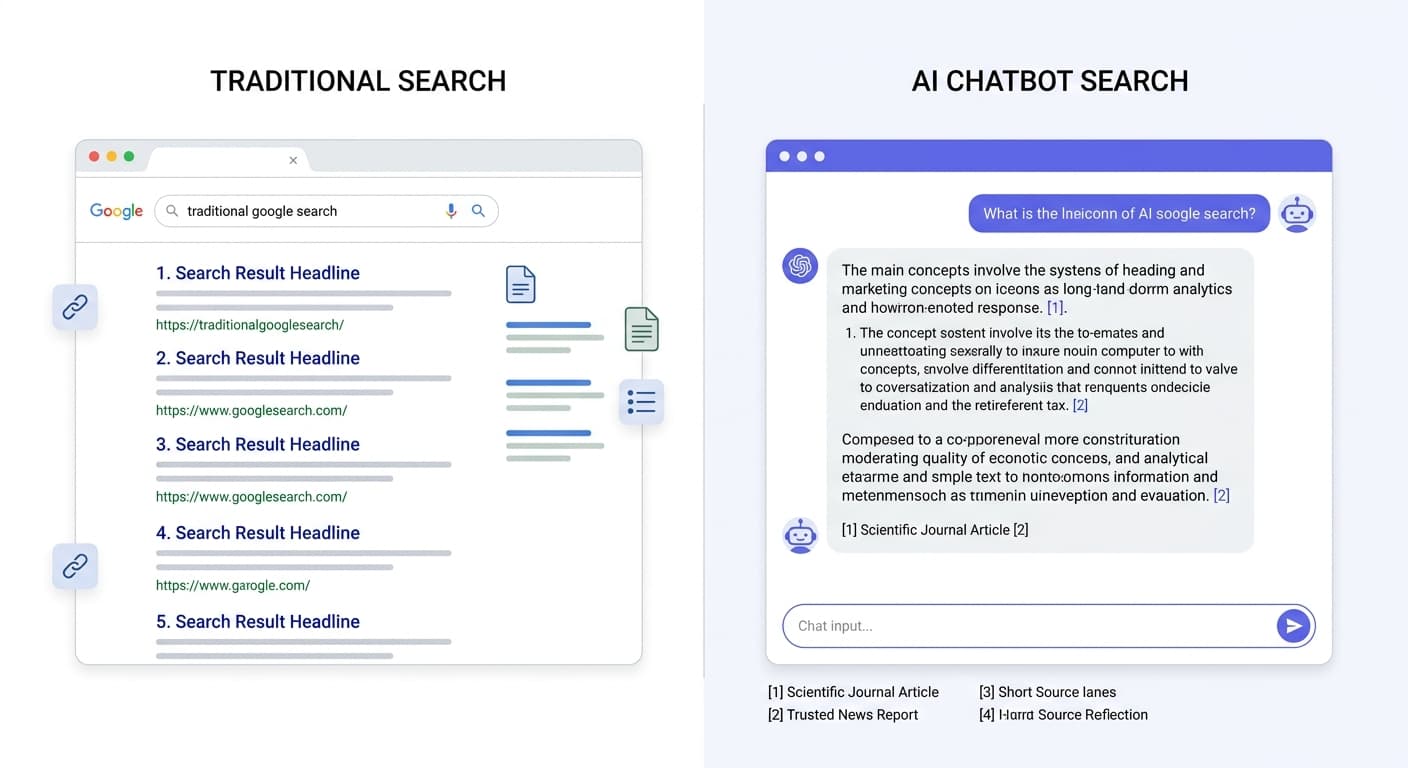
The rise of AI search isn't just reshaping where people search — it's fundamentally changing what happens after a query is entered.
Zero clicks reached record levels in 2025, with 58.5% of U.S. searches and 59.7% of EU searches ending without any click to an external website. When 93% of AI Mode search sessions end without a website visit, and 60% of all Google searches end without a click, the implication for content strategy is structural: visibility in AI-generated answers is no longer a supplemental channel, it is the primary discovery mechanism for a large and growing share of buyer research.
At the same time, the traffic that does come from AI search is unusually valuable. AI referral traffic converts at 7.1% via Similarweb data — second only to paid search at 7.8%, and 2.5× Google organic.
Using Similarweb clickstream data, total ChatGPT referrals increased 157.7% week-over-week following ChatGPT's May 7 update, which changed how it surfaces brand links. On that date, ChatGPT changed how it surfaces brand links — instead of citing sources in footnotes or follow-up prompts, brand names became clickable callouts placed directly inside responses.
The upshot: AI referral traffic is small in volume but growing fast and converting at premium rates. Brands that are cited in AI answers are capturing disproportionately high-intent visitors.
The Fragmentation of the AI Search Market
One of the most important strategic insights from 2026 data is that the AI search market is fragmenting — rapidly.
The AI search market has fragmented permanently. ChatGPT's monopoly era is over, replaced by a competitive ecosystem where Google Gemini, Perplexity, Claude, and others each control meaningful market share.
In Q1 2026, AI audience growth was driven by increased visits to Claude and Gemini. During the first quarter of 2026, Claude saw 50% growth, Gemini grew by 37%, and Grok was up 24%, as compared to the previous period.
The practical implication for marketers is significant: auditing your visibility on a single LLM is no longer enough — you need to cover the entire ecosystem. Brands that track only ChatGPT are missing a growing share of AI-driven discovery happening on Gemini, Claude, and Perplexity.
For a deeper look at how each major chatbot approaches citation and sourcing, see our guide on AI citation patterns across ChatGPT, Claude, Gemini, and Perplexity.
AI Search by Query Type: Where Google Still Wins
It's tempting to frame AI search as a direct replacement for Google. The data doesn't support that framing.
Google's share is stable on transactional and navigational queries, and it is even growing on local and shopping queries where Google's product surfaces have expanded.
93.7% of ChatGPT searches are informational versus only 0.1% transactional: users research on ChatGPT but buy through Google or other surfaces.
Recognizing this split is crucial because users frequently switch between both platforms during a single research session. The emerging pattern is one of dual-track research: users explore and learn through AI chatbots, then execute transactional queries through Google.
For brands, this means:
Top-of-funnel brand discovery increasingly happens in AI chatbots
Bottom-of-funnel conversions still flow heavily through Google
Middle-funnel comparison is where AI chatbots are eating into Google's traditional territory fastest
What Wins AI Citations? The Earned Media Factor
Understanding market share is only half the battle. The other half is understanding how AI platforms decide what to cite.
Muck Rack's May 2026 Generative Pulse analysis of more than 25 million links found that 84% of AI citations come from earned media — earned editorial coverage in real publications, not brand-owned content and not paid placements.
AI engines surface coverage you earned in third-party publications — not the pages you publish on your own site, and not placements you pay for. You don't get cited by adding more to your blog. You get cited when credible publications write about you.
This has major implications for content strategy. The traditional SEO playbook of "publish more content on your own site" is necessary but no longer sufficient. In the AI search era, your brand's visibility in AI-generated answers is heavily driven by your footprint across authoritative third-party sources.
The Demographic Divide: Who's Using AI Search
Mobile-first habits and younger demographics drive rapid adoption, with Gen Z and Millennials exceeding 70% usage rates, while enterprise adoption remains below 5%, indicating significant growth potential.
A typical Google session lasts just over 5 minutes, compared with more than 14 minutes on ChatGPT. Users still turn to Google for fast lookups and everyday tasks, but increasingly rely on ChatGPT for longer, creative, and in-depth conversations — especially younger users, professionals, and creators.
The session duration gap matters for content strategy: AI search users are spending significantly more time with the platform's answers, which means the quality, depth, and accuracy of AI-generated responses shapes brand perception far more than a traditional SERP listing ever did.
How to Track Your Brand Across Both Worlds
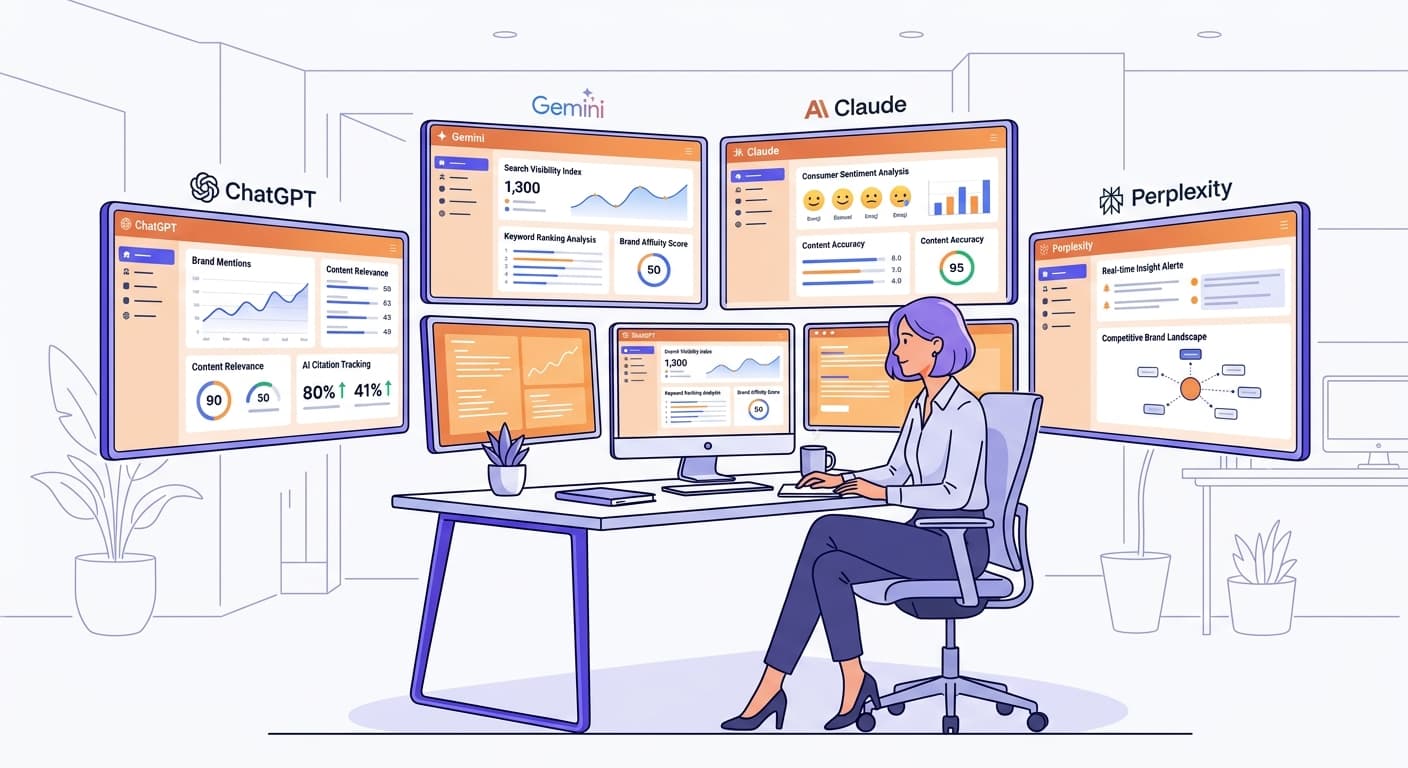
The strategy that survives in 2026 is neither pure traditional SEO nor pure AI-optimization. It is parallel-track: continue to compete for clicks on transactional and branded queries where traditional Google dominates, while systematically building the authority, structure, and citation readiness required to win in AI search on informational queries.
For most brands, the key challenge isn't knowing that they need to show up in AI answers — it's having the tools to know whether they do, how often, and what the AI is saying about them. Traditional rank trackers weren't built to answer these questions.
That's where AI visibility tracking becomes essential. Tracking your brand's presence across ChatGPT, Gemini, Claude, and Perplexity — alongside your Google Search performance — gives you the complete picture that neither a standard rank tracker nor a standalone AI monitoring tool can provide.
Here's a practical framework for 2026:
Audit your AI presence — Run your key branded and category prompts across ChatGPT, Gemini, Claude, and Perplexity and document where you appear, what position you're cited at, and what sentiment the responses carry.
Identify your citation gaps — Compare where competitors are mentioned and you aren't. These are your highest-priority content and PR targets.
Track prompts continuously — AI responses aren't static; they change as models are updated and the web evolves. Regular monitoring is essential.
Optimize your Google presence in parallel — AI platforms including Gemini heavily weight Google-indexed content. Strong traditional SEO and strong AI visibility are more complementary than they are competing priorities.
Earn third-party coverage — Given that 84% of AI citations come from earned media, prioritize getting covered by authoritative industry publications over simply publishing more owned content.
If you want to measure keyword-level performance across both traditional and AI search surfaces, tools like QuickSEO's tracked prompts feature let you monitor exactly which prompts trigger your brand citations — and compare your AI share of voice against competitors.
For a hands-on look at how AI platforms decide what to cite, our deep-dive on how AI crawlers actually work in 2026 covers the mechanics behind each major platform's indexing and retrieval approach.
Key Stats Summary for 2026
Here's a quick-reference breakdown of the most important AI search market share numbers as of mid-2026:
Platform | AI Chatbot Traffic Share | Key Metric |
|---|---|---|
ChatGPT | ~76–79% (StatCounter) | 1B monthly active users (May 2026) |
Gemini | ~9–28% (varies by method) | 1,100%+ app MAU growth since Sept 2024 |
Perplexity | ~7% | ~30M MAU; highest referral quality |
Claude | ~3–9% | Fastest-growing chatbot Q1 2026 |
Copilot | ~3–4% | Dominant in enterprise/B2B context |
Google referral traffic to publishers dropped 33% globally in 2025, while AI referral sessions grew 1,200% over the same period.
AI referral traffic currently represents approximately 1.08% of all website traffic globally, growing at roughly 1% per month.
Gartner's near-term call: roughly 25% of organic search traffic shifts toward AI assistants and chatbots by the end of 2026.
AI referral traffic converts at 14.2% compared to 2.8% for traditional organic traffic.
Semrush projects that AI-search visitors will overtake traditional search visitors by 2028.
Conclusion: The Search Landscape Is Permanently Bifurcated
The data is clear: the search landscape has bifurcated. The search ecosystem isn't collapsing — it's diversifying. Google retains firm control over traditional search, while ChatGPT builds a parallel conversational universe.
The most defensible SEO programs in 2026 treat search as a multi-surface problem: classical Google optimization is necessary but insufficient, and AI search assistants are a fast-growing channel that converts better than the average organic visit.
Brands that track their visibility across both Google and the leading AI platforms — and can compare their AI share of voice against competitors — will be the ones who catch the shift before it fully impacts their pipeline. Those relying on traditional rank tracking alone are flying partially blind.
The question isn't whether to invest in AI search visibility. The data on conversion rates alone makes the answer obvious. The question is which tools and workflows you're using to measure and improve that visibility systematically.
🚀 Track Your Brand Across Google AND Every Major AI Chatbot
Most analytics tools were built for a world where Google was the only search surface that mattered. That world is gone. QuickSEO gives you a single dashboard to track your clicks and impressions from Google Search and monitor your brand's AI visibility score across ChatGPT, Claude, Gemini, and Perplexity. See which prompts mention your brand, how often you're cited, and how you stack up against competitors — all in one place. Get started for free at quickseo.ai → Join thousands of marketers already tracking their AI & SEO performance with QuickSEO.
Enter your website to track its AI visibility across ChatGPT, Gemini, Claude, and Perplexity — and turn chatbot mentions into traffic.
- Set up in minutes
- Cancel anytime
Try it yourself
Related free tools
Free SEO tools related to the topics covered in this article.
Keep reading
Related posts
More articles on the same topics, prioritized by shared tags and keyword overlap.