Summarize in ChatGPT
Search has never changed faster. In 2026, the rules of visibility have been rewritten — not just on Google, but across an entirely new landscape of AI chatbots, generative overviews, and answer engines. If you're still monitoring SEO the same way you did two years ago, you're flying blind.
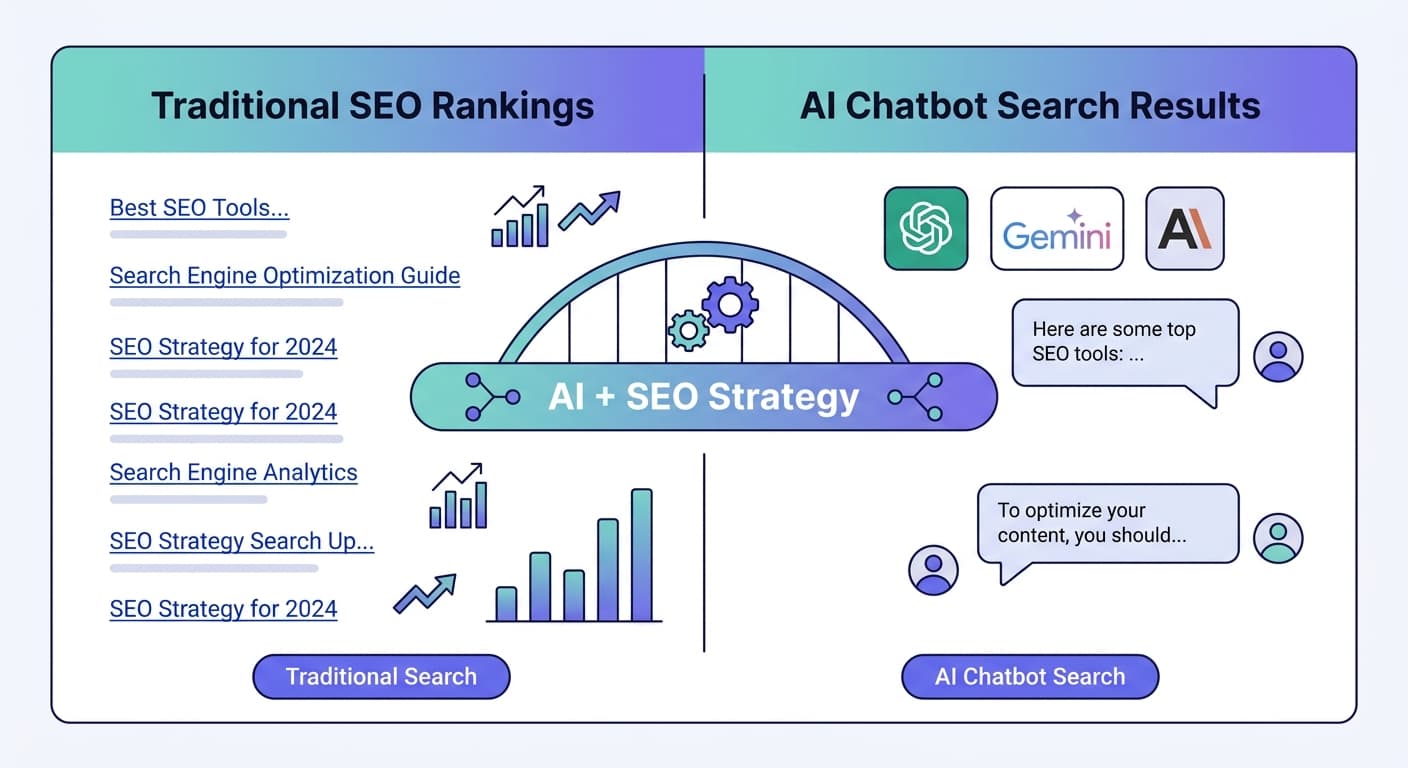
Effective SEO trend monitoring today means tracking signals across two distinct but deeply interconnected worlds: traditional Google search and AI-generated responses from platforms like ChatGPT, Claude, Gemini, and Perplexity. Brands that understand this dual reality are pulling ahead. Those that don't are watching their visibility erode without knowing why.
This guide gives you the complete, data-backed playbook for monitoring SEO trends in 2026 — what to watch, how to measure it, and what actions to take when things shift.
Why SEO Trend Monitoring Has Fundamentally Changed
As zero-click searches continue to rise and AI-generated answers occupy more SERP real estate, traditional traffic metrics no longer tell the full story of SEO performance. In many cases, users are discovering brands, consuming information, and forming purchasing decisions without ever clicking through to a website.
This isn't just about losing clicks. SEO is no longer purely a traffic acquisition channel — it is a visibility and authority channel that influences decisions earlier in the customer journey.
The numbers confirm the scale of the shift:
Google's AI Overview now reaches over 2 billion monthly users, with informational searches triggering AI Overviews at rates as high as 80–88% depending on the industry.
AI assistants like ChatGPT are transforming how people search, with AI expected to handle 25% of global queries by 2026.
Brands are 6.5x more likely to be cited through third-party sources than their own domains.
AI-referral visitors are more engaged than standard visitors: they view nearly twice as many pages and spend twice as long on site.
The implication is clear: the brands that win in 2026 won't just rank — they'll be the ones that are recognized, referenced, and recommended.
The Two Pillars of Modern SEO Trend Monitoring
Modern SEO trend monitoring sits on two pillars that must work in parallel. Miss either one, and you're leaving critical intelligence on the table.
Pillar 1: Traditional Search Trend Monitoring
Traditional monitoring — tracking keyword rankings, search volume, SERP features, and organic traffic — remains foundational. Organic search traffic is down slightly by 2.5% between February 2024 and November 2025, not 25% or 50% as some predicted. Traditional SEO is not dead; it has simply evolved.
Key signals to monitor on the traditional side:
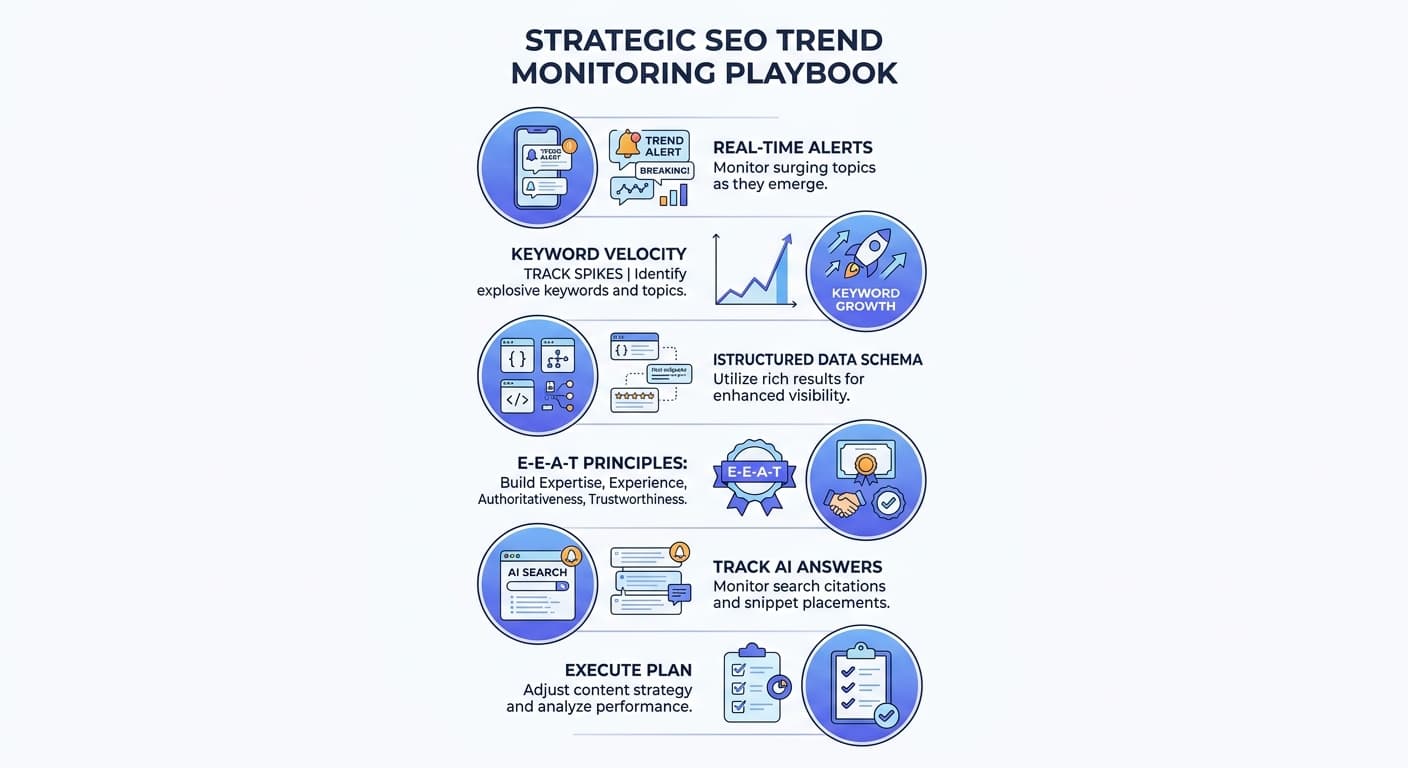
Keyword velocity — not just volume, but rate of growth
SERP feature changes — featured snippets, People Also Ask, Shopping carousels
Competitor ranking shifts — who's gaining or losing ground on your core terms
Click-through rate trends — impressions vs. clicks across your keyword clusters
Algorithm update impact — correlating ranking drops or gains with known Google updates
In 2026, the most effective teams are balancing long-term view with "velocity" — the ability to identify and capture demand while it is still spiking. Google Trends' "Trending Now" forecasting engine now updates every 10 minutes, giving marketers a near-real-time signal of emerging demand.
These breakout topics represent high-intent demand with often lower competition than established keywords. Traditional tools often aggregate clickstream data over 30 to 90 days — by the time a breakout term appears in those databases, the trend curve may have already flattened. The 2026 strategy involves identifying these terms during their growth phase.
Pillar 2: AI Visibility Trend Monitoring
This is the new frontier — and where most brands are still woefully underprepared.
An AI search monitoring platform is a tool that tracks how your brand, your content, and your competitors appear inside AI-generated responses across search engines and large language model tools. Think of it as a listening layer sitting on top of traditional rank tracking.
AI SEO tracking accuracy varies widely depending on the platform and methodology used. Key factors include prompt coverage, response capture frequency, and how well a tool detects citations or brand mentions inside AI answers. Because AI responses can change across prompts and sessions, most experts recommend analyzing visibility trends over time rather than relying on single snapshots.
What to monitor on the AI visibility side:
Brand citation frequency — how often ChatGPT, Claude, Gemini, and Perplexity mention your brand
Prompt-level tracking — which specific queries trigger citations of your content
Competitor share of voice — who is being cited instead of you
Sentiment in AI responses — are AI answers presenting your brand positively?
Cited pages — which URLs are being pulled into AI-generated answers
How to Set Up a Complete SEO Trend Monitoring System
Step 1: Define Your Tracking Universe
Before you can monitor trends, you need to define what you're monitoring:
Core keyword clusters — the topics central to your business, grouped by intent (informational, commercial, transactional)
Brand queries — your brand name and key product/service terms
Competitor terms — keywords and prompts where you want visibility against rivals
Industry trend terms — emerging topics in your niche, monitored for velocity
Use tools like our keyword gap analyzer and keyword grouping tool to build a structured tracking universe that covers all the right angles.
Step 2: Layer Your Data Sources
No single tool tells the whole story. No single tool covers all SEO disciplines well. Effective stacks combine a rank tracker, a keyword/competitive intelligence tool, Google Search Console for first-party data, and Google Analytics 4 for traffic analysis.
Your monitoring stack in 2026 should include:
Data Layer | What to Use | What It Tells You |
|---|---|---|
Traditional rankings | Rank tracker + GSC | Keyword position trends |
Organic traffic | GA4 + GSC | CTR, impressions, sessions |
AI chatbot citations | AI visibility platform | Brand mentions in LLMs |
Content performance | Content analytics | What's being cited and why |
Competitor tracking | Competitive intel tools | Share of voice vs. rivals |
Step 3: Monitor AI Prompts Systematically
One of the most direct benefits of AI search monitoring is knowing when and how your brand appears in AI-generated responses. If a prospect asks ChatGPT to recommend the best enterprise SEO agency, your monitoring platform tells you whether your brand is named, what context surrounds it, and how often it surfaces across different types of queries. This data shapes your content strategy in a concrete way.
Build a library of tracked prompts that reflect how your target audience searches in AI tools. These typically fall into three categories:
Navigational prompts ("What is [Brand Name]?")
Comparison prompts ("Best [product category] tools")
Problem-solution prompts ("How do I [task your product solves]?")
Step 4: Act on Trend Signals Quickly
The biggest SEO blind spot today is not your keyword rankings, but whether AI tools are answering buyer questions using your content or a competitor's. Content gaps identified through AI monitoring can be acted on weeks earlier than those found through traditional keyword volume trends.
When your monitoring surfaces a spike or a gap, here's the rapid-response framework:
Validate the trend — confirm it across multiple data sources before creating content
Assess the AI void — check whether current AI responses adequately cover the topic
Publish authoritative content — fill the gap with depth, data, and original insight
Reinforce with structured data — use schema markup to make content easily parseable by AI systems
Track the impact — monitor whether your new content earns citations in AI responses
Key SEO Trends to Monitor in 2026
1. AI Overview Trigger Rate by Query Type
As of 2026, the AI Overview reaches over 2 billion monthly users, with informational searches triggering AI Overviews at rates as high as 80–88%. In contrast, commercial queries account for an 8.69% trigger rate while transactional queries account for 1.76% and navigational queries 1.43%.
What to do: Prioritize monitoring your informational content for AI Overview inclusion. These are the queries where visibility has shifted most dramatically away from traditional organic clicks.
2. Keyword Velocity vs. Volume
Breakout trends (5,000%+ growth) offer a strategic complement to high-volume historical keywords, helping brands appear in AI-first search results that prioritize real-time relevance.
Monitor both. High-volume terms build your foundation; breakout velocity terms catch emerging demand before your competitors do.
3. Conversational Query Evolution
User behavior has evolved from keyword-heavy searches (e.g., "running shoes cheap") to natural language prompts (e.g., "tell me about the best running shoes for marathon training"). This shift means content structure should adapt.
Track how the phrasing of queries in your niche is evolving. Use your prompt tracking data to identify when new conversational patterns emerge.
4. E-E-A-T Signal Strength
The importance of Experience, Expertise, Authoritativeness, and Trustworthiness (E-E-A-T) is expected to increase in 2026, putting a stronger emphasis on showcasing first-hand knowledge in website content. These are signals search engines use to evaluate the quality and trustworthiness of content.
Use the E-E-A-T checker to audit how well your pages signal expertise and authority — both for Google and for AI systems deciding which sources to cite.
5. Zero-Click Behavior by Category
Not all query types are affected equally by zero-click behavior. The 60% zero-click rate means more users get answers without clicking any result. If your content is the source being cited in an AI Overview, you still get brand visibility and authority — even without the click.
Monitor your branded search volume alongside AI citation rates. Growing brand awareness may not show up in organic sessions, but it will show up in branded queries and direct traffic.
The Content Strategy That Wins in Both Worlds
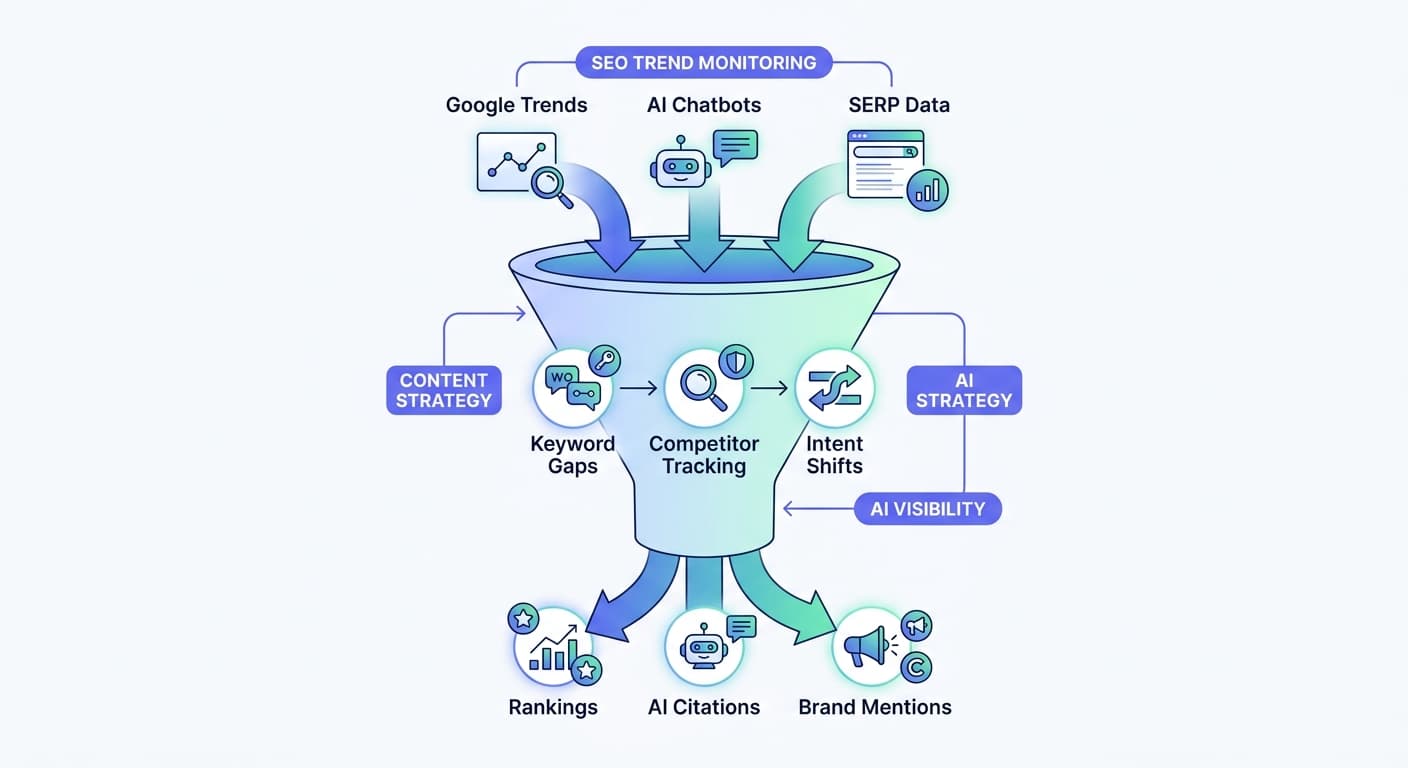
Monitoring trends is only valuable if it drives better content decisions. Here's what the data says about what actually earns visibility in both Google and AI search:
Depth Beats Breadth
When it comes to securing AI mentions and citations, content depth (sentence and word counts) and readability matter most, while traditional SEO metrics like traffic and backlinks have little impact. Comprehensive, well-structured content that genuinely answers a question is the single most reliable path to AI citations.
Build Topical Clusters, Not Isolated Pages
In practice, this looks like building content clusters that map to a full line of inquiry, not just a single search. Think about all the follow-up questions a reader might have after consuming a top-level piece, and make sure those are answered somewhere in your content ecosystem — ideally linked together in a way that keeps the user moving through their research with you.
Use the topical map generator to systematically plan content clusters that cover topics exhaustively enough to become a go-to citation source for AI systems.
Structured Data Is Non-Negotiable
Structured data has been around for a long time, but in 2026, it's a focal point. AI systems use structured signals to extract and verify facts from web pages. Structured data, named entities, and citation-ready content are the tactics that drive AI citations.
Freshness Matters More Than Ever
Generative AI engines no longer just match exact keywords — they interpret intent and context. These systems look for comprehensive, semantically rich answers that align with what the user is really asking. Some models also demonstrate a clear preference for fresh content, making regular updates to existing pages a core part of your trend monitoring response strategy.
Monitor Competitor Citations — and Close the Gap
Identify the specific claims and data points that earn citations. Spot the competitor content being cited so you can produce a stronger, more authoritative version.
This is where monitoring transforms into strategy. Every competitor citation you identify is an actionable brief for content that can displace them.
Common SEO Trend Monitoring Mistakes to Avoid
Even well-resourced teams get this wrong. Here are the pitfalls to sidestep:
Monitoring rankings without monitoring AI visibility — half the picture leads to flawed conclusions
Reacting to single data points — most experts recommend analyzing visibility trends over time rather than relying on single snapshots
Ignoring sentiment — whether AI systems present your brand positively or negatively is as important as whether they mention you at all
Only monitoring branded prompts — unbranded category-level prompts often drive the highest-value AI citations
Treating monitoring as a reporting exercise — turning monitoring insights into action requires a clear sprint trigger system, not just a dashboard
Neglecting technical foundations — AI crawlers need clean, accessible pages to cite your content; run regular technical SEO audits to ensure nothing is blocking your content from being indexed and understood
Measuring the ROI of SEO Trend Monitoring
The case for investing in robust trend monitoring has never been stronger. In 2026, AI-driven analytics platforms play an increasingly important role. These tools offer predictive insights, performance forecasting, and trend detection that help businesses adapt quickly to algorithm changes and shifting user behavior.
Metrics to track when evaluating the ROI of your monitoring efforts:
AI citation rate — percentage of tracked prompts where your brand is cited
Share of voice in AI responses — your citations vs. competitors across key topic areas
Branded search growth — a downstream signal of AI-driven brand awareness
Organic impressions — rising impressions with declining CTR often signals AI Overview presence
Content efficiency — which monitored trends led to new content that earned citations fastest
SEO experts save an average of 12.5 hours per week through AI support — time that can be reinvested in the strategic interpretation of trend data and faster content execution.
QuickSEO is a free Google Search Console dashboard for all your websites. Connect Search Console, pick the properties you want, and see clicks, impressions, CTR and average position for every site on one screen, each compared with the previous period, with the keywords and pages behind the numbers. Connect Search Console for free →
Conclusion
SEO trend monitoring in 2026 is no longer a single-channel exercise. The latest trends show that SEO is no longer just about rankings and clicks — it's about visibility across search engines, AI tools, and discovery platforms.
The brands winning in this environment share a common approach: they watch both traditional search signals and AI citation patterns simultaneously, they act on emerging trends faster than their competitors, and they build content designed to earn trust from both Google's algorithms and the large language models that power AI search.
Your monitoring system is your early warning system, your competitive intelligence engine, and your content strategy compass — all at once. Build it right, and you'll know about the next big shift before your competitors even realize it's happening.
Start with your keyword clusters. Layer in AI prompt tracking. Build content that earns citations. And measure the compound effect over time. That's the SEO trend monitoring playbook for 2026 — and the brands running it are already pulling ahead.
QuickSEO shows clicks, impressions, keywords and pages for every website you manage, compared with the period before.
- Unlimited websites on the free plan
- No credit card needed
Keep reading
Related posts
More articles on the same topics, prioritized by shared tags and keyword overlap.