
 Summarize in ChatGPT
If your SEO strategy is still built entirely around chasing a "#1 ranking," you're playing a game that's already changed — dramatically. As of 2026, Google displays 37 distinct SERP features in the US, including AI Overviews, AI Mode, People Also Ask, Featured Snippets, Things to Know, Shopping carousels, Local Pack, Video carousels, Top Stories, and Merchant Listings. Together, these elements have fundamentally reshaped what "visibility" means in search.
According to Semrush Sensor data from March 2026, only 1.16% of Google's first page results are without SERP features of any kind. That means for virtually every keyword you care about, SERP features are part of the competitive landscape — and tracking them is now non-negotiable for any serious SEO program.
This guide breaks down everything you need to know about SERP feature tracking in 2026: what features matter most, how to monitor them, how to win them, and how to extend your tracking into the AI search era.
What Are SERP Features (And Why They Matter More Than Ever)?
SERP features are unique elements that appear on Google's search engine results page that go beyond the traditional "10 blue links." Common examples include AI Overviews, Knowledge Panels, video carousels, and image packs. These search features answer questions directly, showcase rich visuals, and offer quick access to specific information.
Google's 37 distinct SERP features occupy 60–80% of above-the-fold real estate on most commercial queries. In other words, the space traditionally owned by organic blue links has been radically compressed.
A third-place ranking can still perform well on a clean results page — but that same ranking can become close to irrelevant if the query triggers a snippet, a PAA block, a video carousel, and an AI Overview above it.
The CTR impact is severe. Ahrefs' December 2025 analysis of 300,000 keywords found that the presence of an AI Overview alone cuts the top-ranking page's click-through rate by 58%.
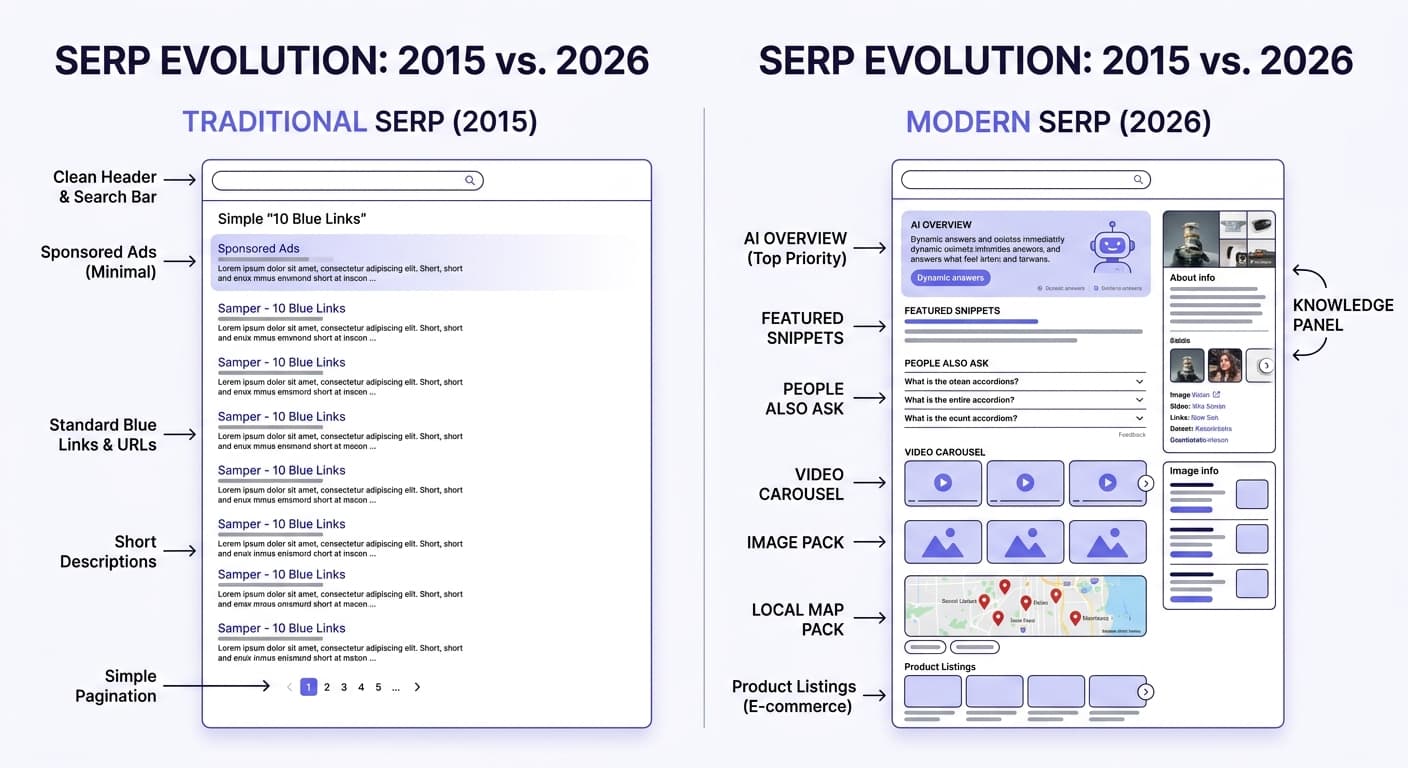
In 2026 and beyond, search visibility is defined not by where you rank but by where and how your brand appears across the entire SERP. That shift demands a fundamentally different approach to tracking.
The 7 Most Important SERP Features to Track
1. AI Overviews
AI Overviews may have had a bumpy start in early 2024, but today they're a common element in search results. Semrush Sensor data from March 2026 shows that AI Overviews appear in more than 30% of searches.
This is now the most high-stakes SERP feature to monitor. Being cited inside an AI Overview — or being displaced by one — can make or break your organic performance on an entire keyword cluster.
2. Featured Snippets
Featured snippets remain one of the most valuable search features for driving organic traffic. These "position zero" results appear above traditional organic listings and can significantly increase click-through rates. In 2026, featured snippets appear for approximately 12–15% of queries.
Featured snippets appear in four main formats. Paragraph snippets answer who, what, why, and how questions. List snippets present step-by-step processes or ranked items in ordered or unordered list format. Winning a snippet means understanding which format Google prefers for a given query — and structuring your content to match it.
3. People Also Ask (PAA)
PAA boxes expand the SERP real estate for topics your content addresses. Each PAA question is an opportunity to rank in an additional visible position. A single search query might trigger a featured snippet, followed by video results, a People Also Ask box, and organic shopping listings. Tracking which PAA questions appear for your target keywords — and who currently answers them — is essential for a complete picture of SERP ownership.
4. Knowledge Panels
Knowledge panels provide authoritative information about entities, brands, and topics directly in the search results. These features are particularly important for businesses, public figures, and well-known organizations. For branded queries especially, your Knowledge Panel presence shapes first impressions.
5. Local Pack
For businesses with geographic intent, the Local Pack is often the most valuable real estate on the page. Segment local intent keywords away from national informational terms — local pack visibility and featured snippet visibility behave differently, so they shouldn't live in the same undifferentiated report.
6. Video Carousels & Image Packs
Visual SERP features are growing in prevalence and can dramatically increase traffic from multimedia content. Tracking whether video or image features appear for your target queries — and whether your content is eligible — is a key part of a modern SERP audit.
7. People Also Search For (PASF)
PASF is the easiest SERP feature to confuse with PAA and the easiest to underestimate. It appears after a user clicks an organic result and returns to the SERP. Google injects a "People also search for" block beneath the clicked result. Where PAA reveals intent broadening, PASF reveals intent refinement — "what did the previous click fail to answer?"
Why Traditional Rank Tracking Falls Short
The old SEO reporting model breaks down. Rank tracking tells you where a page sits. It doesn't tell you whether your brand appears in the snippet, whether an AI Overview cites you, whether a competitor replaced your mention, or whether your visibility moved above or below the fold.
Traditional rank trackers show position. They often fail to show who owns the visible answer, who appears across multiple features, and which sources are cited inside AI-generated responses. Search results now behave more like a layered visibility system than a ranked list.
The implication? If you only track rank position, you're optimizing for a page that doesn't exist anymore.
Winning SERP features is increasingly inseparable from AI search optimization, as many SERP features — especially AI Overviews — operate on the same content quality signals that determine AI citation rates. If you're optimizing exclusively for traditional keyword rankings, you're competing for one lane on a ten-lane highway.
How to Build a SERP Feature Tracking Workflow
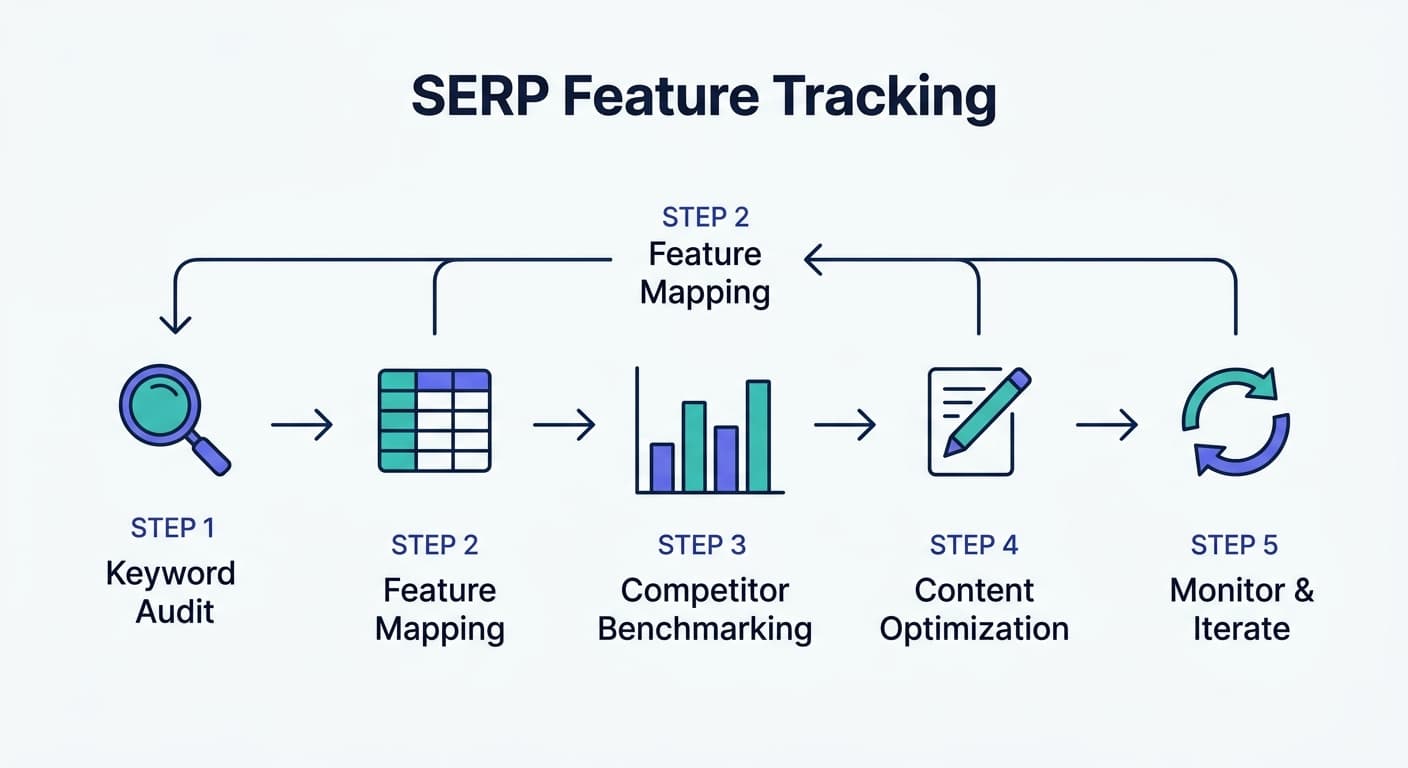
Building an effective SERP feature tracking system requires structure. Here's the workflow we recommend:
Step 1: Keyword Audit & Feature Mapping
Start by cataloguing which SERP features appear for each of your target keywords. SERP data refers to all the information displayed on a Search Engine Results Page when you type in a query. When you recognize what formats dominate the SERP, you can tailor your strategy to match what's working.
Use our free Keyword Density Checker and Keyword Gap Analyzer to identify which of your keywords are dominated by specific feature types — and where gaps exist that your content could fill.
Step 2: Competitor Feature Benchmarking
SERP data shows who's ranking, who's rising, and who's slipping. You can keep tabs on competitors' titles, meta descriptions, featured content, and which SERP features they occupy. This visibility helps you identify opportunities to stand out by targeting a different SERP feature or updating your content to reclaim lost ground.
Regularly benchmark your SERP feature performance against competitors. Track your share of features in your industry and identify areas where competitors are gaining ground.
Step 3: Content Optimization for Target Features
Building effective SERP feature optimization in 2026 requires integrating technical implementation, content formatting, and strategic targeting alongside keyword research, competitive analysis, and ongoing monitoring. Success demands understanding how each feature type drives visibility — from schema markup for rich result eligibility to featured snippet formatting for position zero capture.
Key formatting principles:
Structure content with clear H2/H3 headers to make it easy for Google to extract answers
Answer questions directly in the first 40–60 words beneath a header
Use structured lists and tables where appropriate for snippet-friendly formatting
Implement schema markup to qualify for rich results — use our free Structured Data Validator to check your pages
Optimize for E-E-A-T signals to build the topical authority that underpins feature eligibility
Step 4: Set Up Monitoring & Alerts
Use volatility as your guide. High-competition keywords and premium features need tighter monitoring because ownership can shift quickly. Stable long-tail groups can usually be reviewed less often.
Set up rank tracking for your full keyword portfolio using tools like Semrush, Ahrefs, or SE Ranking to give you the broad view and daily position data for reporting. Layer on visual SERP monitoring for your top priority pages.
Step 5: Extend Tracking Into AI Search
Position alone is not enough. You need to know whether an AI result appeared, which domains it cited, whether your brand was mentioned, and which competitors keep showing up as the machine's preferred sources.
No single tool covers everything. The strongest reporting setup combines a traditional SERP tracker for Google visibility with an AI search layer for the channels that traditional tools cannot reach. That combination gives you the full picture of where your brand shows up in search in 2026 — and where it does not.
Choosing the Right SERP Feature Tracking Tools
Semrush's Position Tracking tool tracks keyword rankings and SERP features across locations, devices, and search engines. You can monitor daily ranking changes, compare visibility with competitors, and group keywords with tags. It also shows which SERP features your site appears in, such as featured snippets, AI Overviews, and local packs.
For enterprises managing large keyword sets, STAT Search Analytics is the preferred choice for large-scale SERP feature tracking.
When evaluating any SERP tracking tool, look for these key capabilities:
Feature-level reporting — not just rank position, but which features you own vs. your competitors
AI Overview tracking — whether the tool surfaces AI citations and which domains are included
Location-specific data — essential for local SEO and multi-market brands
Competitor benchmarking — side-by-side feature ownership across your competitive set
Alerting — proactive notifications when you gain or lose a feature
Use the SERP Preview tool at QuickSEO to quickly visualize how your pages appear in search results before and after optimization.
SERP Features + AI Search: The New Visibility Frontier
The bigger issue in 2026 is that even feature-level tracking can miss the answer layer if it stops at classic Google modules and ignores AI outputs. For this reason, treat feature tracking as visibility analysis, not just rank monitoring.
SERP features will expand, AI-driven experiences will mature, and traditional rankings will represent only one dimension of visibility. The brands that win search in 2026 and beyond will be those who track and optimize across the entire search experience — from blue links to AI answers.
The connection between SERP feature ownership and AI citation rates is becoming impossible to ignore. A practical reporting setup should combine classic and modern signals: track whether the page gained the target feature, track whether Google is showing a different result format than before, and track whether AI-generated answers cite your domain or your competitors for the same topic.
For a deeper dive into how AI search engines decide what to cite and surface, check out our guide on AI citation sources: how ChatGPT, Claude, Gemini choose what to cite.
Common SERP Feature Tracking Mistakes to Avoid
1. Treating ranking position as the only success metric A page at position #3 below an AI Overview, a featured snippet, and a PAA block is effectively invisible. Always pair position data with feature-level context.
2. Not segmenting by intent Not all keywords are created equal. Some trigger a clean set of organic results, while others are flooded with ads, maps, videos, and snippets, leaving less real estate for traditional SEO. SERP data helps you decide which keywords are worth your time and which might be too competitive or dominated by paid placements.
3. Ignoring competitor feature ownership Your opportunity isn't always "rank higher." Sometimes it's "win the feature combination that keeps the page visible." A zero-click environment doesn't make SEO useless — it makes feature ownership, citations, and brand recall more important than many teams are measuring.
4. Unstructured content Common SERP feature weaknesses include unstructured content that fails to format answers clearly for snippet extraction or organize information in list and table formats Google prefers.
5. Static reporting cycles on volatile keywords If a keyword influences pipeline, local discovery, or branded trust, don't rely on a relaxed reporting cycle. High-value features can change hands overnight.
The Strategic Takeaway
Understanding SERP features in 2026 is no longer about basic keyword rankings — it's about dominating the search results page with rich snippets, knowledge panels, and featured positions that drive visibility and clicks.
Modern SEO success means building a layered tracking system that covers:
Which SERP features your keywords trigger
Who currently owns each feature
How your content needs to change to compete for each placement
How AI Overviews and chatbot answers are citing (or ignoring) your domain
The brands that invest in this level of visibility intelligence will outperform those still chasing position numbers on a simpler scoreboard.
Ready to stop guessing and start winning? QuickSEO automatically finds where you're invisible in Google and AI chatbots, writes on-brand articles built to rank and get cited, and publishes them to your site — every day. No copy-paste, no manual work. Just real organic growth on autopilot. 👉 Start growing your traffic at quickseo.ai** — no payment required.**
Enter your website to track its AI visibility across ChatGPT, Gemini, Claude, and Perplexity — and turn chatbot mentions into traffic.
- Set up in minutes
- Cancel anytime
Keep reading
Related posts
More articles on the same topics, prioritized by shared tags and keyword overlap.


