Summarize in ChatGPT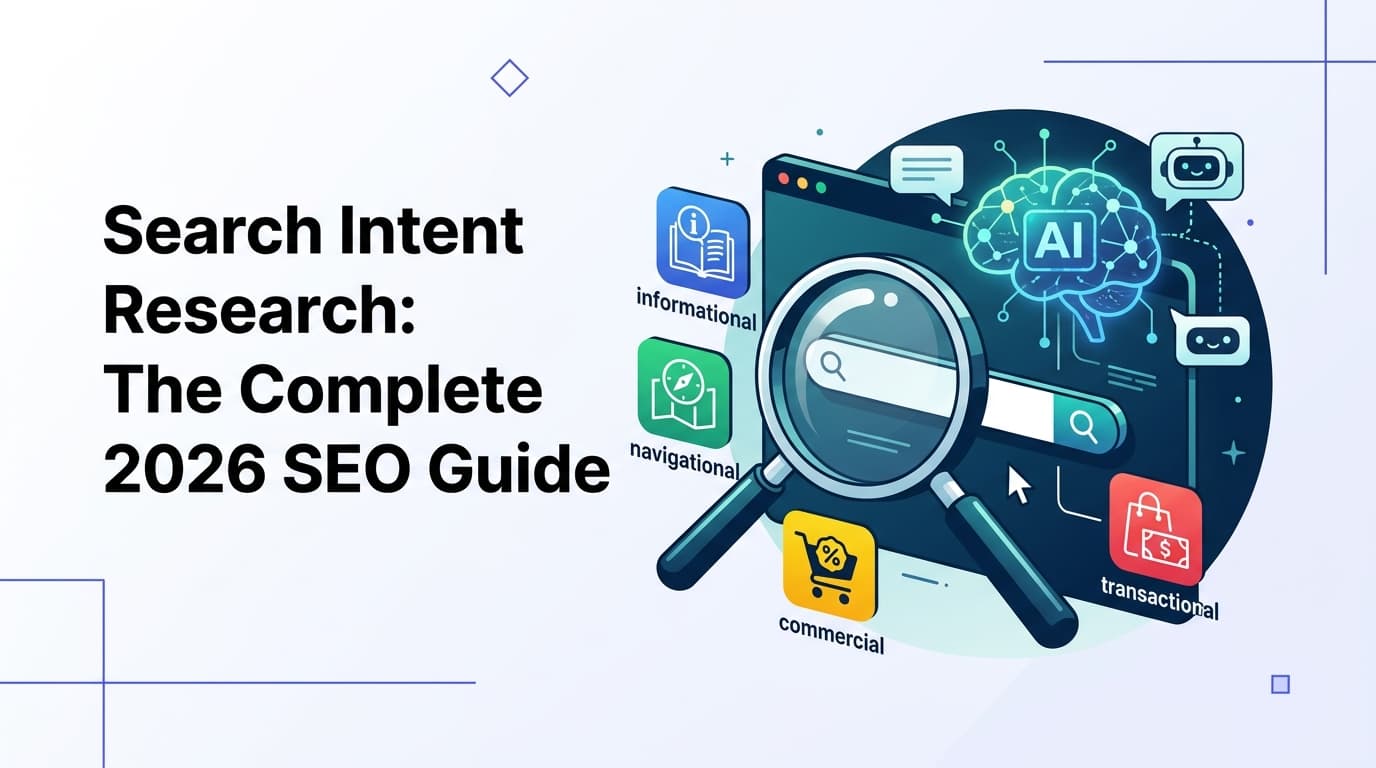
If you've been chasing keyword rankings but still aren't getting the traffic or conversions you expect, the problem almost certainly isn't your backlinks or your page speed. It's your understanding of search intent.
Search intent optimization is the practice of matching a page's content, format, and depth to what searchers actually want when they type a query — not to the keyword itself. It is the single most common reason technically sound pages fail to rank, and the fastest ranking fix available in 2026.
In 2026, this has become even more pressing. SEO success depends less on keyword placement and more on aligning with user intent. Search engines are no longer fooled by keyword stuffing or thin content — instead, they prioritize websites that demonstrate a deep understanding of what people truly want when they search.
This guide walks you through everything you need to know about search intent research: what it is, the different types, how to conduct it effectively, and how the rise of AI search has expanded the rules entirely.
What Is Search Intent (and Why Does It Matter More Than Ever)?
Search intent is the "why" behind an Internet search. Every time someone types or speaks a query into a search engine, they have a purpose — maybe they want to learn something, visit a specific site, or buy a product or service.
The distinction between keywords and intent is critical. Keywords are words or phrases that a user types into a search engine. Search intent, on the other hand, is the meaning behind those words. Although two users may use similar keywords, the results can differ based on their intentions — which is why intent plays a bigger role in SEO than matching keywords alone.
Here's a real-world example: "Roof repair" and "emergency roof repair cost in Austin" are the same topic. But one is a person browsing, and the other is someone ready to call right now. Same keyword category. Completely different intent.
Why Google Now Treats Intent as a Threshold
What's changed in 2026 is how accurately Google identifies intent. Algorithms now use NLP, entity recognition, and behavioral data — dwell time, bounce rates, return searches — to understand what a user actually wants.
Google's ranking systems now treat intent match as a threshold you either clear or you don't. You can have the strongest backlink profile in your niche, flawless technical SEO, and a page that loads instantly — and still lose to a thinner competitor whose page simply matches intent better.
Machine learning models analyze billions of interactions daily. Click patterns, dwell time, scroll behavior, and pogo sticking all feed ranking systems. If a page ranks but fails to satisfy intent, it does not stay visible for long — which is why search intent directly affects ranking stability.
The 6 Types of Search Intent in 2026
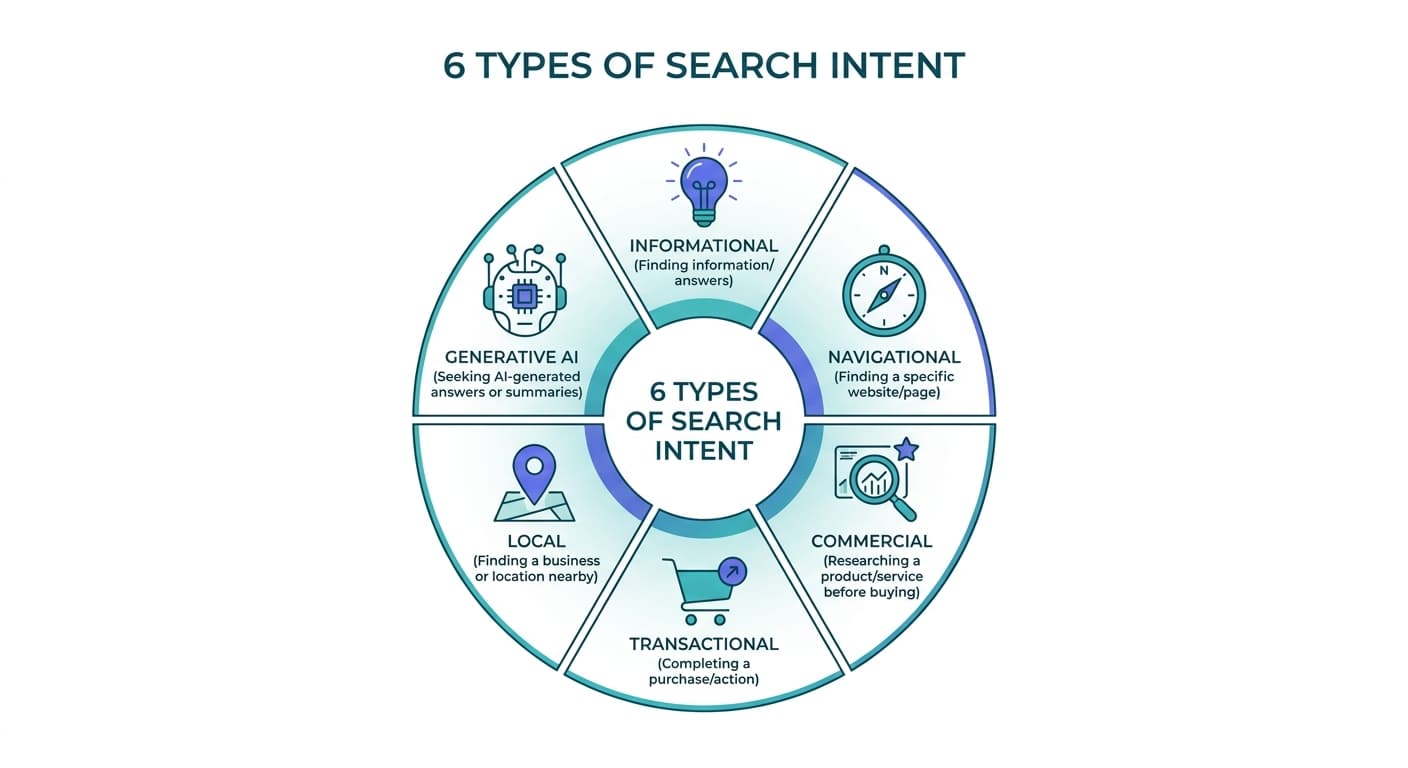
The classic SEO framework recognized four intent types. In 2026, search intent is commonly categorized into four main types: informational, commercial, transactional, and navigational — but we also now add local and generative intent types. Most real queries have multiple intents.
1. Informational Intent
Informational queries represent the largest category of search behavior, where users seek knowledge, answers, or educational content. These searches typically begin with question words like "what," "how," "why," or "when." In 2026, informational intent has evolved to include complex, multi-part questions that require comprehensive responses.
Examples: "What is keyword cannibalization?", "How does AI search work?", "Why is my bounce rate high?"
Best content format: Long-form guides, how-to articles, explainer posts, FAQs
Pro tip: Use our AI FAQ Generator to quickly build out the Q&A content that dominates informational SERPs.
2. Navigational Intent
Navigational queries occur when users search for specific websites, brands, or online destinations. These searches demonstrate clear intent to reach a particular digital location, often using brand names or specific product identifiers.
Examples: "QuickSEO login", "Ahrefs pricing page", "Google Search Console"
Best content format: Ensure your branded pages, login portals, and official links are easily discoverable for your brand name.
3. Commercial Intent
Commercial search intent reflects a user's intention to research products or services before making a purchase decision, often involving comparisons between options. Commercial keywords include "best," "top," "review," "comparison," "vs," "alternatives," "pricing," and "features." These commercial queries are mid-funnel because the user is problem-aware and solution-aware, but not yet vendor-decided.
Examples: "Best AI visibility tracking tools 2026", "QuickSEO vs Otterly", "Semrush alternatives"
Best content format: Comparison pages, review posts, "best of" listicles, product breakdowns
4. Transactional Intent
Transactional queries indicate immediate purchase intent or desire to complete a specific action. These searches represent the highest commercial value and typically include action words like "buy," "purchase," "download," or "subscribe." In 2026, transactional intent has become more sophisticated, with users employing longer, more specific queries that include desired features, price ranges, or delivery preferences.
Examples: "Sign up for AI rank tracker", "Buy Ahrefs plan", "Download SEO audit template"
Best content format: Landing pages, product pages, clear CTAs, strong trust signals
5. Local Intent
Local search is almost entirely intent-driven. Every "near me" query, every "[service] in [city]" search — these users are ready to act, not browse. In 2026, Google's AI Overviews will pull local business recommendations above the map pack for many queries.
Examples: "SEO agency near me", "digital marketing consultant Chicago", "web design services London"
Best content format: Location-specific service pages, Google Business Profile optimization, review-rich content
6. Generative AI Intent (The New Frontier)
The rise of AI tools like ChatGPT has introduced a new type of search intent known as generative search intent, where users expect AI to perform specific tasks or generate outputs rather than just providing links to information. SEO will evolve from a "ranking game" into Generative Engine Optimization (GEO), focusing on making content machine-readable, citable, and trusted by AI agents. The primary goal is to get cited within AI-generated responses.
Research shows that generative search intent is the top AI search intent in ChatGPT, accounting for 37.5% of queries — meaning users ask directly for a concrete output, such as "create X," "draft Y," or "do Z."
Examples: "Write a blog post about X", "Create a comparison table of top CRM tools", "Draft a cold email for SaaS leads"
How to Research Search Intent: A Step-by-Step Framework
Step 1: Analyze the SERP (The Most Reliable Signal)
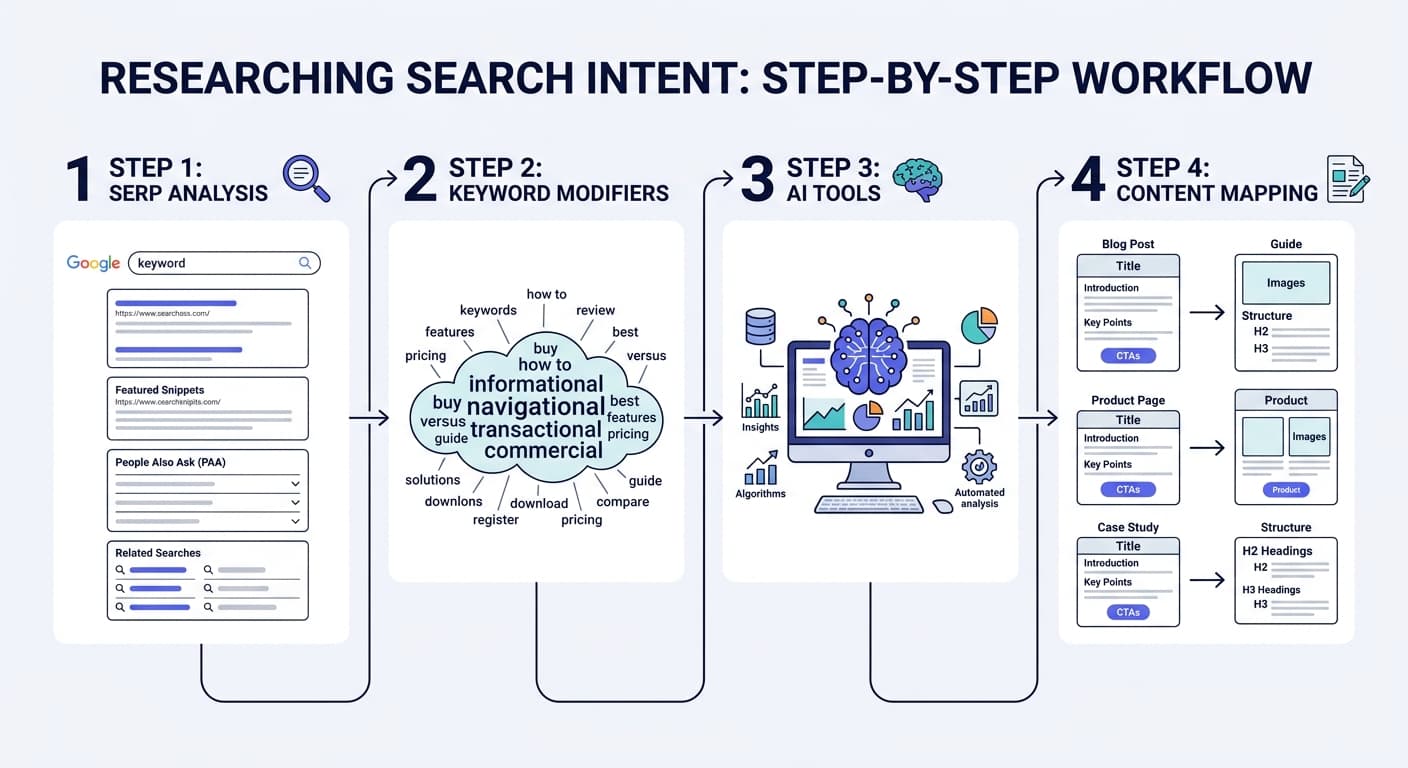
The easiest and most accurate way to understand intent is to look at what's already ranking on Google. Start by typing your keyword into Google and carefully examining the top 10 results. Ask yourself: What type of content shows up — is it a blog post, product page, video, or guide? What format is it in — listicle, comparison, how-to tutorial, or landing page? What's the angle — beginner-friendly, in-depth, or focused on products?
Pay close attention to:
Featured snippets — typically signal informational intent (Google is giving a direct answer)
People Also Ask (PAA) — reveals related questions that show what visitors really want to learn
Shopping results — a clear transactional signal
Local map packs — strong local intent indicator
Step 2: Decode Keyword Modifiers
The words users add to their core keywords reveal significant information about their intent. Create lists of common modifiers for each intent type:
Informational modifiers: how, what, why, guide, tutorial, tips
Commercial modifiers: best, top, review, comparison, vs
Transactional modifiers: buy, price, cost, discount, deal
Navigational modifiers: brand names, login, official, website
Long-tail keywords — those longer, more specific phrases — often give away intent more clearly. For instance: "cheap hotels in Goa with sea view" signals transactional intent (the user wants to book), while "how to choose the right running shoes" signals informational intent (the user wants guidance). By paying attention to these words, you can immediately understand what your visitors are hoping to find.
Step 3: Use Keyword Research Tools with Intent Classification
Google Keyword Planner now includes intent classification features, while tools like Semrush and Ahrefs provide intent analysis capabilities. These tools give you a head start, but always validate with manual SERP analysis.
Use our Keyword Density Checker and Keyword Gap Analyzer to uncover which intent signals your content is already covering — and where you have gaps versus competitors.
Step 4: Check Behavioral Signals in Your Analytics
Use Google Analytics and Search Console to segment performance by intent types. Watch organic CTR, time on page, scroll depth, bounce rate, return visits, lead quality, and conversion events.
Pages with high bounce rates and low time-on-page are often suffering from intent mismatch — they're attracting the right keyword traffic but delivering the wrong content type.
Step 5: Test Intent in AI Chatbots
If you want to rank in traditional Google results, you still need to optimize for informational, navigational, commercial, and transactional intent. But if you want visibility in ChatGPT, Perplexity, or Claude, you need to optimize for exploratory, comparative research, and synthesis intent. The smartest strategy is to optimize for both — create content that serves traditional intent (for Google) AND new intent types (for AI search). It's not an either/or choice.
Common Search Intent Mistakes (and How to Fix Them)
Even experienced SEOs fall into these traps. Here's what to watch out for:
❌ Targeting High Volume Over Intent Value
A high-volume informational keyword that AI Overviews have hollowed out is worth less than a lower-volume commercial keyword that still converts. Prioritize keywords where a click still has genuine business value.
❌ Serving the Wrong Page Type
A common issue is serving the wrong kind of page for the query. For example, a business might try to rank a hard-selling service page for a search that clearly has informational intent. Instead of helping, this confuses users and increases bounce rates. The better approach is to provide an educational blog post or guide when people are still in the research stage, and save the sales pitch for transactional searches.
❌ Writing Long "Because Long Ranks"
Writing long because "long ranks" is a mistake. Length is a symptom of thorough intent matching, not a cause of ranking. A concise page beats a padded one when the intent is a quick answer.
❌ Never Re-Checking Intent
Never re-checking intent is a common failure. Intent drifts — a query that was informational in 2024 can become commercial as a market matures. Re-read the SERP during every content review. A monthly check on strategic queries and a quarterly cluster review helps you avoid producing content for an outdated intent.
❌ Ignoring Mixed-Intent SERPs
Many keywords have mixed intent, meaning users might have different goals when searching for the same term. For example, "iPhone 15" could be informational (specs and features) or transactional (purchase). When results are split between formats, build separate pages rather than a compromise that serves no one.
Search Intent in the Age of AI Search
One of the most significant developments in 2026 is that search intent now has to be optimized for two very different surfaces — traditional Google and AI chatbots like ChatGPT, Claude, Gemini, and Perplexity.
Google's AI Overviews now appear for nearly half of all search queries. For informational intent, an AI-generated answer sits above everything on the page — before organic results, before ads. Click-through rates on broad informational keywords have dropped sharply. A page ranking third in 2024 can rank third today and receive a fraction of the previous traffic. The position didn't move. The behavior of the results page did.
This creates a critical strategic shift. The pages that still earn clicks are those matching commercial and transactional intent, where users want to compare and buy rather than read a summary. In 2026, intent optimization increasingly means prioritizing queries where a click still has value and structuring content so AI engines cite you.
How to Optimize Content for AI Citation
To maximize your chances of being cited in AI-generated responses, follow these principles:
Answer the question clearly in the first sentence — no preamble. Use structured headings that mirror how people phrase their queries.
Simply creating content is not enough; the 2026 SEO expert must ensure content is structured to be easily cited and actively used in AI conversations.
Use structured data such as FAQ, HowTo, Product, Organization, and LocalBusiness schema to help search engines and AI systems interpret meaning.
Include original data, statistics, and first-hand experience that AI models want to reference.
Our E-E-A-T Checker helps you audit whether your content demonstrates the experience, expertise, authoritativeness, and trustworthiness signals that both Google and AI chatbots prioritize when selecting sources to cite.
For a deeper dive into how AI systems choose what to surface, check out our guide on how ChatGPT, Claude, and Gemini choose what to cite.
Matching Content Format to Intent Type
Once you've identified the dominant intent behind a keyword, your content format must match it precisely. Here's a quick reference:
Intent Type | Best Content Formats |
|---|---|
Informational | How-to guides, explainers, blog posts, FAQs, videos |
Commercial | Comparison articles, review posts, "best of" lists, vs. pages |
Transactional | Product pages, landing pages, pricing pages, sign-up flows |
Navigational | Brand pages, login pages, official product documentation |
Local | Location-specific service pages, Google Business Profiles |
Generative AI | Structured, citable content with clear data and direct answers |
Aligning content with a keyword's search intent not only enhances user engagement but also leads to better conversion rates, as users are more likely to find what they need and take action.
Building a Search Intent Research Workflow
Here's how to build a repeatable, scalable search intent research process for your team:
Build your keyword list — Start with your target topics and pull keyword variations using SEO tools
Classify intent — Use keyword modifiers and SERP analysis to assign each keyword a primary intent type
Audit existing pages — Use our Internal Linking Audit to see whether your current pages are aligned with the intent signals Google is rewarding
Map intent to content — Assign the right page format to each intent type
Create or update content — Build pages that match format, angle, and depth to the dominant intent
Monitor performance — Track CTR, bounce rate, conversions, and AI citation rates
Revisit quarterly — Intent shifts as markets evolve; regular SERP re-analysis keeps your strategy current
This makes search intent optimization not just a content strategy, but a visibility strategy. Algorithms change, but human needs don't. Content written to genuinely help remains useful even as ranking systems evolve — which is why intent-focused pages tend to survive updates that wipe out keyword-heavy competitors.
QuickSEO is a free Google Search Console dashboard for all your websites. Connect Search Console, pick the properties you want, and see clicks, impressions, CTR and average position for every site on one screen, each compared with the previous period, with the keywords and pages behind the numbers. Connect Search Console for free →
Conclusion
Search intent research has always been the foundation of effective SEO — but in 2026, it's the entire game. SEO is no longer a contest of who repeats a target keyword the most. The winning brands are the ones that understand user search intent, answer the real question behind the query, and make content useful enough for both humans and AI systems.
From the classic four-category model to the new generative AI intent type, understanding the "why" behind a search query lets you build content that ranks, converts, and gets cited across every search surface — traditional and AI-powered alike.
The process isn't complicated, but it does require consistency: analyze the SERP, decode the modifiers, map the right content format, and revisit regularly as intent evolves. Do that, and your content will do what it was always supposed to do — genuinely help the people searching for it.
QuickSEO shows clicks, impressions, keywords and pages for every website you manage, compared with the period before.
- Unlimited websites on the free plan
- No credit card needed
Try it yourself
Related free tools
Free SEO tools related to the topics covered in this article.
Keep reading
Related posts
More articles on the same topics, prioritized by shared tags and keyword overlap.