SEO Metrics Basics: The Complete Beginner's Guide for 2026

 Summarize in ChatGPT
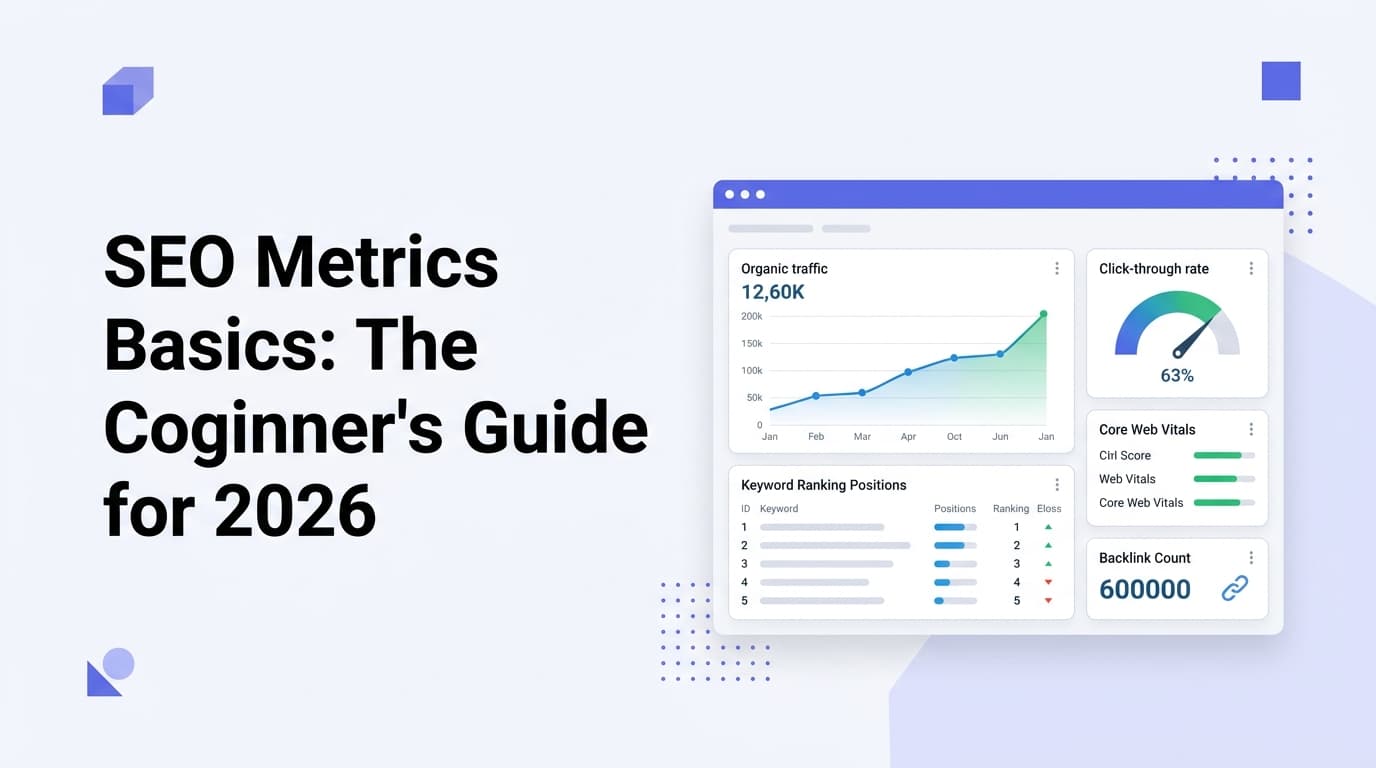
If you've ever stared at a sea of numbers in Google Search Console or Google Analytics and wondered what actually matters — you're not alone. SEO produces a lot of data. But only a handful of those numbers will tell you whether your strategy is working, what to fix, and where your next big win is hiding.
This guide cuts through the noise. We'll walk through every essential SEO metric a beginner needs to understand in 2026 — what each one means, why it matters, how to find it, and what a healthy benchmark looks like.
What Are SEO Metrics (and Why Do They Matter)?
SEO metrics are measurable values that show how a website is performing in organic search. They range from high-level traffic numbers down to granular technical signals like crawl errors and page load speed.
Here's the important distinction beginners often miss: SEO KPIs measure success against goals, while SEO metrics simply measure activity or performance data. Not every metric should be treated as a KPI. SEO metrics include impressions, clicks, sessions, and backlinks — these numbers describe what is happening. SEO KPIs, however, evaluate whether those numbers support business objectives.
In other words, tracking 50 metrics is less useful than deeply understanding 8–10 that are tied to your actual goals. Most SEO teams are better served by tracking 5–8 core KPIs with discipline than by monitoring 20 loosely defined metrics. A good starting set: Organic Traffic Volume, Organic Conversions, Search Visibility, SEO ROI, and Technical Crawl Efficiency.
Let's break each category down.
The Four Categories of SEO Metrics
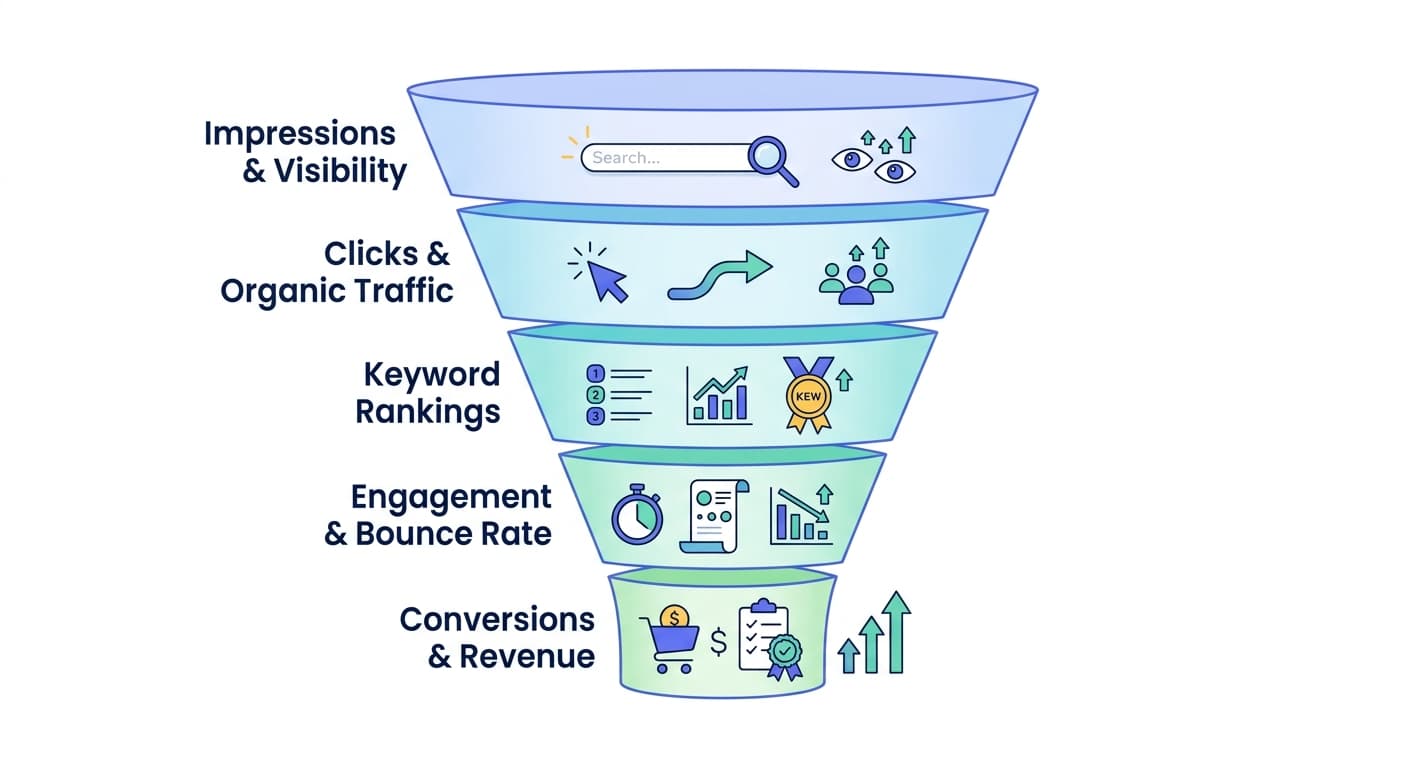
Before diving into individual metrics, it helps to know how they're grouped. They fall into four categories: Visibility metrics show how often a site appears in search results (impressions, rankings, SERP features). Traffic metrics show how many people actually click through (organic sessions, CTR, organic users). The other two categories are engagement metrics (what people do once they land on your site) and authority & technical metrics (the health signals that determine whether Google can crawl and trust your site).
Category 1: Visibility Metrics
Impressions
Search impressions measure how many times your website appears in search results, regardless of whether users click on your listing. For B2B SaaS companies, impressions are the earliest signal that content is gaining traction in the SERP.
Impressions are found in Google Search Console under the Performance tab. They tell you whether Google is showing your pages at all — but they don't tell you whether people are clicking. A page with thousands of impressions and almost no clicks is a strong signal that your title tag or meta description needs work.
Keyword Rankings
Keywords still matter in 2026. Even though Google has become far smarter in understanding user intent, it still considers keywords to evaluate content relevance and quality.
Keywords are classified by search intent (informational, navigational, commercial). As a marketer, you should keep a close eye on the ranking of keywords, because a single drop or increase in the ranking can significantly impact the overall performance.
What position should you aim for? Aim to reach the first page (positions 1–10) for your target keywords, as rankings beyond page one receive minimal traffic. For competitive terms, even moving from position 5 to position 3 can double your click volume because of CTR's exponential decay curve.
Click-Through Rate (CTR)
CTR, which stands for click-through rate, is defined as the number of people who view and click on your site among all those that find it on a search engine. A high CTR assures you that your titles and descriptions are effective enough to click.
The formula is simple: CTR = (Clicks ÷ Impressions) × 100%
If organic traffic is increasing but the conversion rate is flat, that points to intent mismatch or content quality issues. If impressions are rising but click-through rate is dropping, that signals SERP feature competition, weak titles, or brand visibility problems.
Use QuickSEO's free SERP Preview Tool to see exactly how your title tag and meta description appear in Google before publishing — so you can optimize for clicks from day one.
Category 2: Traffic Metrics
Organic Traffic
Organic traffic measures all non-paid visits to your website from search engines. It represents the total audience you're reaching through SEO efforts, and for most companies, it's the top of the content-driven pipeline. Organic traffic creates a sustainable audience without ongoing ad spend. Each visitor represents potential for conversion, and growth in this metric indicates your overall SEO strategy is working.
Where to find it: Google Analytics 4 (GA4) under Acquisition → Traffic Acquisition → filter by "Organic Search." Also available in Google Search Console under Performance → Total Clicks.
Benchmark: A healthy site in a stable industry grows organic traffic 10 to 25 percent year over year. New sites can grow faster (50 to 200 percent) once they pass the initial sandbox period of three to six months.
Branded vs. Non-Branded Traffic
For brand growth, non-branded traffic is one of the most telling metrics. Non-branded organic traffic tells you whether new audiences who don't yet know your name are discovering you through searches for the problems you solve — which is the true measure of SEO reach.
Category 3: Engagement & Conversion Metrics
Organic Conversion Rate
Organic conversion rate is calculated by dividing the number of conversions from organic search by the total organic visitors, then multiplying by 100. This shows the percentage of users who complete a desired action. For example, if 1,000 organic users visit your site and 50 complete a purchase or form submission, your organic conversion rate is 5%. This is one of the most important SEO performance metrics because it measures quality, not just volume.
Businesses that monitor conversion-focused SEO metrics move beyond visibility and focus on measurable growth, making SEO a revenue-driving channel instead of just a traffic source.
Engagement Rate & Session Duration
In Google Analytics 4, the old "bounce rate" has been replaced by engagement rate — the share of sessions that last 10+ seconds, trigger a conversion event, or include 2+ pageviews. In GA4, bounce rate is basically the inverse of engagement rate. That makes bounce rate easy to misread. A "high bounce" blog post might be doing its job if users get the answer, scroll, and leave.
Use engagement metrics as diagnostic signals, not standalone proof that SEO is working or failing.
Category 4: Authority & Technical Metrics
Referring Domains
A referring domain is a unique website that links to a target site. Referring domains are a stronger authority signal than raw backlink counts because 100 links from one site count less than 10 links from 10 sites.
Focus on the growth trend in referring domains rather than the absolute count. Steady growth in referring domains is a healthy benchmark. Lost links should be investigated, since broken backlinks are often easy to reclaim. You can audit your backlink profile using our free Broken Link Checker to spot and recover lost link equity.
In 2026, link quality matters more than quantity. Backlinks are assessed primarily through context, source authority, and editorial intent. Links embedded naturally within relevant content carry more weight than those placed in footers, directories, or templated sections.
Indexed Pages
Indexed pages are the URLs Google has added to its index and can show in search results. When indexed pages drop suddenly, something is blocking crawl: a noindex tag, a robots.txt error, or a canonical issue.
A sudden drop in indexed pages is a red flag that needs immediate investigation. Check Google Search Console → Indexing → Pages for a breakdown of why pages may be excluded.
Core Web Vitals
Core Web Vitals are Google's set of performance metrics that measure real-world user experience: Largest Contentful Paint (LCP), Interaction to Next Paint (INP), and Cumulative Layout Shift (CLS).
When Google evaluates your website's performance, it doesn't just look at content quality or backlinks. The search engine now considers how real users experience your site through these specific measurable metrics. They quantify loading speed, interactivity, and visual stability — three fundamental aspects that determine whether visitors stay on your page or click away.
How much do they affect rankings? Core Web Vitals function as one ranking factor amongst hundreds in Google's algorithm, not a magic switch that determines positions. They work alongside content quality, relevance, authority, and other signals. Think of them as a tiebreaker that becomes increasingly important as other factors become equal. When your content matches search intent and your site has reasonable authority, Core Web Vitals can make the difference between position three and position eight.
Benchmark: All three metrics should be in the "Good" range on at least 75 percent of pageviews.
Crawl Errors
Crawl errors occur when search engine bots cannot access or index certain pages. Common examples include broken links, server errors, and blocked resources. If important pages cannot be crawled, they cannot rank.
Monitor these in Google Search Console regularly, and use a tool like the Robots.txt Validator to ensure you're not accidentally blocking your most important pages.
The New Frontier: AI Visibility Metrics
Here's what most beginner SEO guides still aren't covering: your visibility in AI search results.
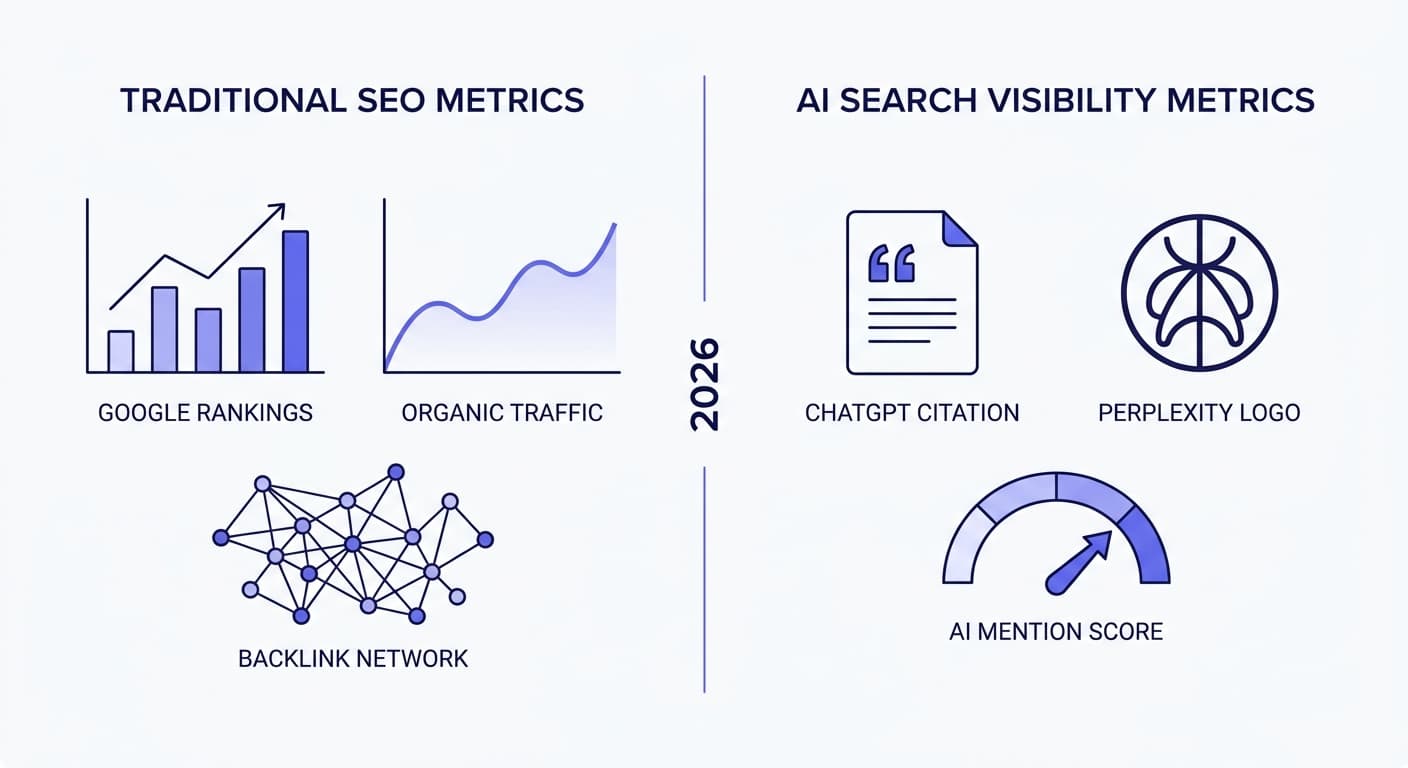
Traditional SEO metrics still drive most search traffic in 2026, but AI search visibility now sits alongside them. Brands that ignore AI citation tracking will lose visibility in a growing share of search journeys.
AI & LLM traffic stands out as an SEO KPI in 2026 because it measures early discovery and brand influence, not just visits. When looked at alongside organic traffic, rankings, and conversions, it helps explain how SEO performance is changing.
AI visibility metrics track how often and how prominently your brand is cited when ChatGPT, Claude, Gemini, and Perplexity answer questions related to your industry. This is a fundamentally different kind of measurement from traditional rankings — but it's becoming just as strategically important.
To dive deeper into how AI platforms decide which sources to cite, check out our guide on LLM citation sources.
How to Read Your Metrics Together
Google's own guidance makes one principle clear: Search Console shows what happens before users land on your website, while GA4 shows what users do after they arrive. Used together, they give a more complete SEO performance picture.
Here's a simple framework for interpreting your metrics:
Signal | What It Means | Action |
|---|---|---|
High impressions, low CTR | Pages are showing but titles aren't compelling | Rewrite title tags and meta descriptions |
High traffic, low conversions | Wrong audience or intent mismatch | Reassess keyword targeting |
Rankings improving, revenue flat | Winning low-intent searches | Focus on commercial keywords |
Traffic growing, engagement low | Content isn't delivering on its promise | Improve content depth and relevance |
Indexed pages dropping | Crawl or indexation issue | Check robots.txt, canonical tags, noindex |
The key discipline is to review KPIs on a regular schedule, document what changed, and connect each change to specific SEO actions — otherwise you are observing data without learning from it.
How Often Should You Check Each Metric?
Most SEO metrics should be reviewed monthly, with rankings and Core Web Vitals checked weekly. Daily tracking is rarely useful because organic data fluctuates with search demand, and trend lines are clearer over 30-day windows.
Here's a practical cadence:
Weekly: Keyword rankings, traffic trends
Monthly: Organic traffic, conversions, backlink profile, technical health, Core Web Vitals
Quarterly: Full SEO ROI review, strategy reassessment
Avoiding the "Vanity Metrics" Trap
We are in 2026, where marketers are surrounded by more analytical tools and performance metrics than ever before. However, the challenge is that not every metric actually tells you whether the SEO strategy is working. Many marketers focus on surface-level numbers that look impressive but offer little real insight. Meanwhile, the metrics that truly reflect rankings, user engagement, and credibility often get overlooked.
The solution: always connect your metrics to a business goal. There is no single most important SEO metric. The most important metric depends on the business goal. For lead generation, organic conversions matter most. For ecommerce, revenue from organic. For brand growth, non-branded traffic.
Tools to Track Your SEO Metrics
You don't need to spend a fortune to get started. Here are the essentials:
Google Search Console — impressions, clicks, CTR, keyword positions, index coverage, Core Web Vitals
Google Analytics 4 — organic sessions, engagement rate, conversion rate, user behavior
Ahrefs / Semrush — keyword rankings at scale, referring domains, competitor analysis (industry-standard paid tools starting from around $120 per month)
QuickSEO's free tools — for quick audits, including our Meta Tag Analyzer, Internal Linking Audit, and E-E-A-T Checker
For AI visibility, platforms like QuickSEO automatically track how your brand appears across ChatGPT, Claude, Gemini, and Perplexity — and surfaces the gaps where you're invisible but competitors are getting cited.
Summary: Your SEO Metrics Quick-Reference
Here are the core metrics every beginner should be tracking from day one:
Organic Traffic — total non-paid visitors from search
Keyword Rankings — position for your target keywords
Impressions — how often you appear in search results
Click-Through Rate (CTR) — percentage of searchers who click your listing
Organic Conversion Rate — percentage of organic visitors who complete a goal
Referring Domains — number of unique sites linking to you
Core Web Vitals — LCP, INP, CLS scores for user experience
Indexed Pages — how many of your pages Google has indexed
Crawl Errors — broken or blocked pages preventing indexation
AI Search Visibility — how often your brand is cited in AI chatbot answers
SEO success is no longer measured by rankings alone. In 2026, a strong SEO measurement system tracks visibility, traffic quality, user engagement, technical performance, conversions, revenue, and AI search visibility.
🚀 Stop Guessing. Start Growing — with QuickSEO
QuickSEO finds where you're invisible in Google and AI chatbots, writes on-brand articles built to rank and get cited, then publishes them to your site — every day, on autopilot. No more manually tracking every metric across six different tools. QuickSEO surfaces your ranking gaps, generates 1,800-word research-backed articles, and monitors your AI visibility across ChatGPT, Claude, Gemini, and Perplexity — all in one place. Start growing your organic traffic today → (No payment required)
Enter your website to track its AI visibility across ChatGPT, Gemini, Claude, and Perplexity — and turn chatbot mentions into traffic.
- Set up in minutes
- Cancel anytime
Keep reading
Related posts
More articles on the same topics, prioritized by shared tags and keyword overlap.